
What if the hardest part of surviving a home renovation isn’t choosing finishes, but figuring out how your household will function while work is underway? A kitchen remodel can leave you wondering where dinner will come from. A bathroom project can make a familiar morning routine feel complicated. Dust, noise, changing access to rooms, and decisions along the way are all worth planning for.
A practical plan can make daily life more manageable and help you set clear expectations. This guide covers how to decide whether to stay home, protect essential routines, and prepare for changes in room access and work conditions.
Clear communication and organized project coordination can also make decisions easier to handle. For homeowners planning a renovation in Greater Boston, understanding the process before construction begins can reduce uncertainty. River City Construction Inc manages residential remodeling projects, including kitchen and bathroom work, with project management and subcontractor coordination. Preparation won’t remove every disruption, but it can help you feel ready for what comes next.
Key Takeaways
- Start with an honest picture of your household’s needs to define what a manageable renovation looks like.
- Prepare by clearing work areas and choosing where displaced belongings will go.
- Compare staying home, relocating temporarily, or adjusting routines. Consider how the work sequence may affect room access.
- Keep questions, decisions, and household needs organized so you can raise concerns early during construction.
- For surviving a home renovation in the Boston area, clarify your priorities and constraints, then discuss how project management and subcontractor coordination support the work.
Surviving a Home Renovation Starts with an Honest Plan for Daily Life
Imagine getting ready for work while your kitchen is being remodeled. The coffee maker is boxed up, the usual route through the house is blocked, and everyone needs to know where breakfast will happen. Renovation can interrupt familiar routines, even when the finished space is something your household has wanted for years. Surviving a home renovation starts with planning for these everyday changes, not just choosing what the new room will look like.
Success doesn’t mean construction happens without inconvenience. It means expectations are manageable, decisions are clear, and your household has workable ways to eat, rest, work, and get ready. Renovation can involve many kinds of home improvements, as the broad overview of Home improvement illustrates. The practical question is how the specific work will affect your home. If you’re considering Boston kitchen remodeling, start by thinking about how the project may affect cooking, food storage, and access to other rooms.
Can you stay in your home during a renovation?
It depends on which rooms are affected and whether the work limits access to everyday essentials. A project focused on one room may leave other parts of the home usable. Work in a kitchen or bathroom can make daily routines harder to maintain. Consider who lives in the home, including children or older adults, whether pets need a quieter or more predictable space, and whether anyone needs a place to work from home.
Staying may make sense if your household can use the remaining spaces comfortably. Temporary relocation may be worth considering if essential rooms will be unavailable or daily life would become unworkable. Neither choice suits every household. Think through where you’ll prepare meals, sleep, use the bathroom, and keep needed belongings, then compare those needs with the project’s scope and sequence.
Set household expectations before work begins
Talk through likely routine changes together before construction starts. Decide on practical alternatives, such as where meals will happen or where someone can take a work call. Make a short list of questions about room access, affected areas, and how updates or new decisions will be communicated. Clear answers help household members know what to expect instead of being surprised in the middle of a busy day.
The best plan depends on the work areas, access to essentials, household needs, and how much disruption your family can reasonably manage. Let the project scope and your household’s circumstances guide the decision. A realistic plan won’t prevent every change, but it gives everyone a shared starting point.
Prepare Your Home and Household Before Renovation Work Begins
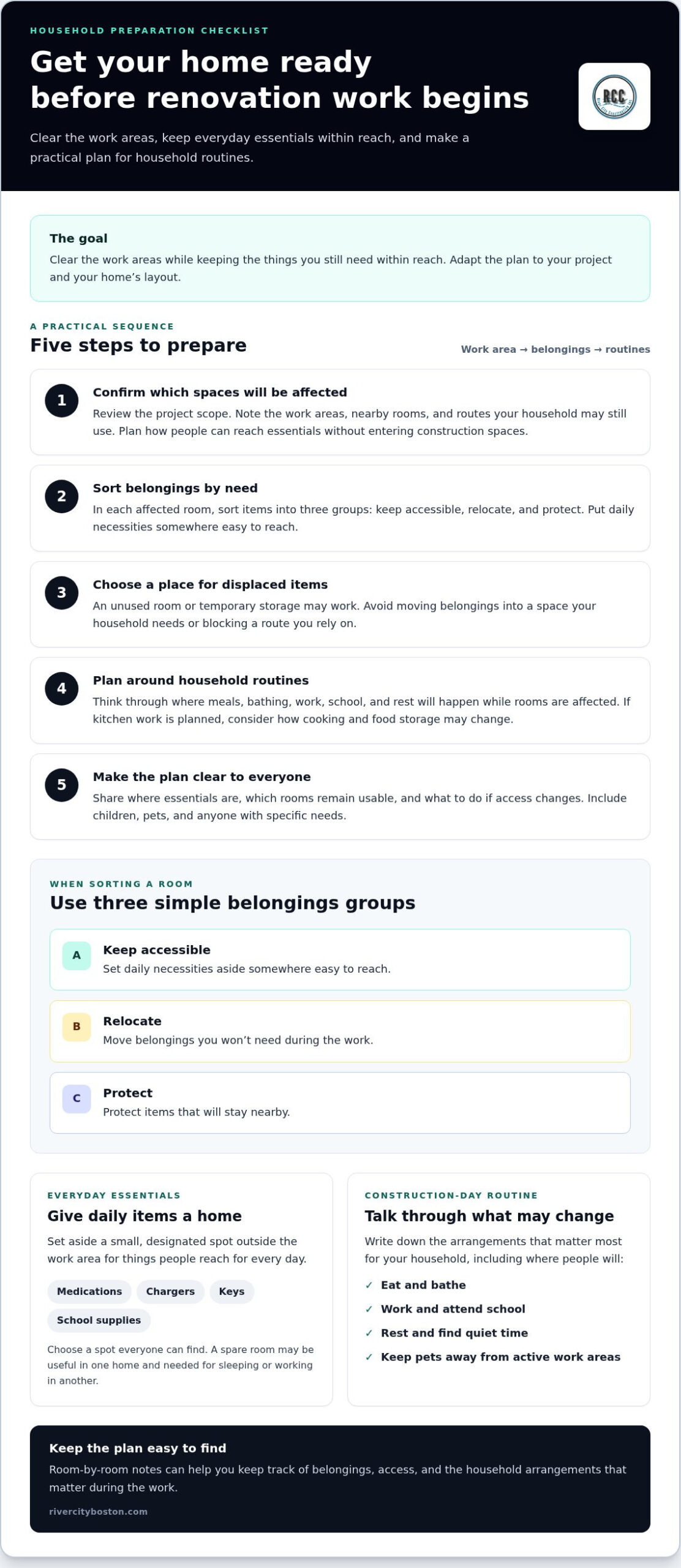
A little preparation can spare you the daily hunt for a phone charger, school bag, or the pan you use every morning. Start with the rooms affected by the work, then adapt this sequence to your project and home layout. The goal isn’t to pack away everything. It’s to clear work areas while keeping the things you still need within reach.
- 1. Confirm which spaces will be affected. Review the project scope to identify work areas, nearby rooms, and routes your household may still use. Plan how people will reach everyday essentials without entering spaces set aside for construction.
- 2. Sort belongings by need. In each affected room, group items into three categories: keep accessible, relocate, and protect. Put daily necessities somewhere easy to reach, move belongings you won’t need, and protect items that are staying nearby.
- 3. Choose a place for displaced items. An unused room or temporary storage may work, depending on your home and project. Keep the arrangement practical: don’t move belongings into a space your household needs or block a route you rely on.
- 4. Plan around household routines. Consider meals, bathing, work, school, and rest. If kitchen work is part of the project, review Boston kitchen remodeling services as you think through how cooking and food storage may change.
- 5. Make the plan clear to everyone. Share where essentials are, which rooms remain usable, and what to do if access changes. Include children, pets, and anyone with specific needs in the plan.
Organize belongings and preserve access to essentials
Set aside a small, designated spot for items people reach for every day, such as medications, chargers, keys, or school supplies. Choose a location outside the work area that everyone can find. Your home’s layout matters: a spare room may be useful in one house but needed for sleeping or working in another. Keeping your own organized room-by-room notes alongside your project plans will help you stay on track.
Create a realistic household routine for construction days
Think through where meals, bathing, work, school, and rest will happen while rooms are affected. A family with children may need a predictable place for backpacks and quiet time. Pet owners may want to plan how to keep animals away from active work areas. Write down the arrangements that matter most, then discuss your project needs with River City Construction Inc so household routines can be part of the planning conversation. The right preparation depends on the scope of the work and the layout of your home.
Compare Renovation Choices That Can Reduce Stress at Home
It’s easy to assume you can keep life running as usual while construction happens around you. But a room that’s temporarily unavailable can change where you cook, work, or unwind. Access may also change as the work progresses. Surviving a home renovation often means choosing a household arrangement that fits the project instead of expecting every routine to stay untouched.
Staying home versus arranging a temporary place
Staying home keeps familiar surroundings and everyday belongings close, but may mean adjusting to limited access around active work areas. Staying somewhere else can create more separation from the disruption, though it also changes daily routines. Consider the project scope, your household’s schedules, and which rooms will remain usable. No single choice fits every home or remodeling project.
| Option | What it may make easier | What to consider |
|---|---|---|
| Stay at home | Keeping familiar surroundings and everyday belongings close. | Whether essential rooms and usable routes remain accessible during the work. |
| Arrange a temporary place | Creating distance from disruption in the home. | How the change affects household schedules, responsibilities, and daily needs. |
| Adjust routines at home | Maintaining access to the home while changing how certain tasks happen. | Whether there’s a workable alternative for meals, bathing, work, or rest. |
Use the comparison as a starting point, then weigh each option against the rooms affected and the people who rely on them. A household with usable space away from the work area may have different choices from one where an essential room is involved.
One project phase at a time or overlapping work?
The order of the work can change which rooms are available at different points. If work moves from one area to another, household access may shift as the project progresses. If tasks in different areas overlap, several routines could be affected at once. Neither approach automatically removes disruption; each creates different practical considerations.
Ask the project team to explain the anticipated sequence, which spaces may be affected at each stage, and how changes will be communicated. Project management and subcontractor coordination help organize work across the people involved. Clear updates help your household respond as conditions change. Discussing the sequence early gives you a better basis for arranging meals, work, and other routines without assuming the home will function exactly as it does now.
Manage Disruption, Questions, and Changing Decisions During Construction
A renovation day can bring a small surprise: a room is harder to reach than expected, a new question comes up, or the household needs to adjust its plans. Keep one running note on your phone or in a notebook to stay oriented. Add questions, decisions, and household needs as they arise rather than relying on memory at the end of a busy day.
Keep communication and decisions organized
Use a short check-in to review what’s still open and what needs follow-up. Note a question about room access, record a decision you’ve made, and flag anything that affects your household’s routine. Keep project-related decisions together so details are easier to find later.
Before work is underway, agree with the project team on who handles updates and how questions or changes will be discussed. If something is unclear, raise it early and explain what you need to know. For example, if a change could affect where your family works or rests, say so while there’s time to talk through the impact on your household. Clear, timely questions can reduce confusion, even though they can’t prevent every change.
Make room for dust, noise, and routine changes
Think about how dust and noise may affect the spaces you use, and plan where you can work, rest, or spend time away from the affected area. A quiet room may help with a work call or a child’s homework. Another part of the home may work better for downtime. The right arrangement depends on your home and the work being done.
Discuss practical boundaries around active work areas with the project team. Clarify which spaces are being worked in and how your household should handle access as the work progresses. If bathroom access is a concern, reviewing bathroom remodeling services can help you frame the conversation around how the room may affect everyday routines.
Keep the plan flexible. A note that says “use the back room for calls” may work one day and need adjusting the next. Update your household list as questions are answered so everyone stays informed without trying to remember every conversation. That small habit can make surviving a home renovation feel more manageable as decisions and daily needs change.
Make Your Boston-Area Renovation Easier with a Clear Next-Step Plan
Once you’ve considered how construction may affect your household, turn those concerns into a practical project conversation. Write down what matters most, which rooms are involved, and what your family needs to keep doing during the work. This gives you a clear starting point to discuss project scope, how the work may be sequenced, and how updates and decisions will be handled.
Turn your concerns into a useful project conversation
Put your goals in priority order. For a kitchen remodel, that might mean improving storage while explaining how losing access to the room could affect meals. For a bathroom project, note who relies on that space and what you want to understand about access as work progresses. The Boston kitchen remodeling page offers a place to explore that room-specific project context.
Bring questions about what the work includes, which areas may be affected, and how the sequence will be explained. Share household constraints, such as work-from-home needs or routines that depend on a particular room. The more clearly you describe what your household needs to understand, the more useful the planning conversation can be.
Plan a renovation with a local remodeling team
In Boston-area homes, project planning needs to account for the rooms and routines involved, not just the finished design. River City Construction Inc works on residential remodeling in Greater Boston, including kitchens, bathrooms, and basements. Project management helps organize the work, while subcontractor coordination brings the different people involved into the project plan. These responsibilities help homeowners understand how the work fits together and where questions belong.
For surviving a home renovation with greater confidence, start with your priorities, household constraints, and open questions. Then discuss how they relate to the project scope and expected sequence. Clear planning can’t remove every disruption, but it gives your household and the project team a stronger basis for decisions as the work moves forward.
Move Forward with a Plan That Fits Your Household
Surviving a home renovation is easier when your plan accounts for the people who live in the home, not just the rooms being updated. Decide which routines need alternatives, prepare spaces and belongings for the work, and keep questions and decisions organized as the project moves forward.
Bring your priorities and household constraints into a conversation about the project’s scope, sequence, and communication. River City Construction Inc works on Greater Boston residential remodeling projects, including kitchens, bathrooms, basements, and other home renovations. Project management and subcontractor coordination help organize the work and keep the process clear for homeowners.
With thoughtful preparation and a clear plan, you can meet the changes ahead with greater confidence and look forward to a home shaped around your needs.
Frequently Asked Questions
Is it possible to stay in your home during a renovation?
Yes, it may be possible to stay home, depending on the rooms affected and how the work is arranged. Consider whether you’ll have access to essential spaces, where household members can work or rest, and how children or pets will manage around active work areas. If the project affects several important rooms, staying elsewhere may be more practical. The best choice depends on your project scope, home layout, and household needs.
What should I do first when preparing for a home renovation?
Start by identifying which rooms will be affected and what your household needs to keep close at hand. Sort belongings into items to keep accessible, relocate, or protect, then choose a practical place for displaced items. Think through meals, bathing, work, school, and rest. A short list of questions about room access, project sequence, and updates gives you a useful starting point for planning and discussion.
How can I reduce dust and disruption during a renovation?
Plan how your household will use spaces away from the active work area, and discuss practical boundaries with the project team. Keep everyday essentials in an easy-to-reach spot outside affected rooms, and consider where people can work, rest, or spend time if noise interrupts their usual routine. Dust and disruption can vary with the work and home layout, so discuss what to expect rather than assuming every space will remain unaffected.
Should I move out during a home renovation?
Moving out can make sense if the project limits access to essential rooms or makes daily routines difficult to maintain. Staying may work if usable spaces remain and your household can adapt. Compare the project scope with your schedules, household needs, and available rooms before deciding. Neither option eliminates every inconvenience, and there isn’t one answer for every home. Make a plan that feels workable for the people living there.
How do you manage meals during a kitchen renovation?
Plan meals around the cooking and food-storage options your household will have during the work. Before the kitchen becomes difficult to use, set aside items you’ll need and choose simple alternatives that fit your routine. Think about where you’ll eat and how household members’ schedules affect meal planning. Discuss which parts of the kitchen may be affected and how the project sequence may change access, so you can adjust the plan as needed.
How should I handle renovation delays or changing plans?
Keep questions, decisions, and follow-up items together in one running list. If a change affects room access or your household routine, raise the concern promptly and ask how it relates to the project scope and sequence. Agree with the project team on who provides updates and how decisions will be discussed. Clear communication can help everyone understand changing conditions, though it can’t guarantee a particular schedule or prevent every adjustment.
How do I make living through a bathroom remodel easier?
First, plan how household members will manage bathing and getting ready if the bathroom is affected. Consider daily schedules, available alternatives, and who needs access at particular times. Keep toiletries and other necessities together where they’re easy to find, and discuss room access and expected work sequence with the project team. River City Construction Inc serves Greater Boston communities, including Boston, Winchester, Medford, Somerville, Cambridge, Belmont, Lexington, Concord, Wellesley, Newton, Wayland, and Natick.
