What if the right ADU builder is not the one who sketches a design fastest, but the one who first asks what your property and town will allow? If you’re comparing ADU builders Massachusetts has to offer, an early feasibility discussion can help set realistic expectations before plans take shape.
It’s natural to focus on the layout, how much space you need, and who will use it. But property conditions, local review requirements, and project scope can all affect the path from idea to construction. Raise those questions early to make proposals easier to compare and reduce surprises as the project develops.
This guide covers the first feasibility questions, why approval steps depend on your municipality, and how to compare design-build partners using the same project-specific criteria. You’ll also learn what to gather before requesting a consultation or quote. For Greater Boston homeowners, River City Construction Inc offers ADU design-build support, bringing design and construction into one project discussion.
Key Takeaways
- An ADU is a separate living space on the same property as a primary home, not simply an expanded room or general home addition.
- Start by defining household needs and checking what may be allowed at the specific address before planning construction.
- Compare ADU builders Massachusetts homeowners are considering using the same project assumptions, including experience, scope, design coordination, and communication.
- Bring your property address, goals, preferred layout, and any available plans or site details to make builder conversations more useful.
- A coordinated design-build discussion can connect your design goals with construction planning as you consider the next step.
What Should Massachusetts Homeowners Know Before Hiring an ADU Builder?
Imagine your parent needs a little more support, or an adult child is ready to move back home. You want to make room for family while staying in the home and neighborhood you know. An accessory dwelling unit may be one option to explore. Before choosing among ADU builders Massachusetts homeowners should understand what an ADU is and what needs to be checked at their property.
What counts as an accessory dwelling unit?
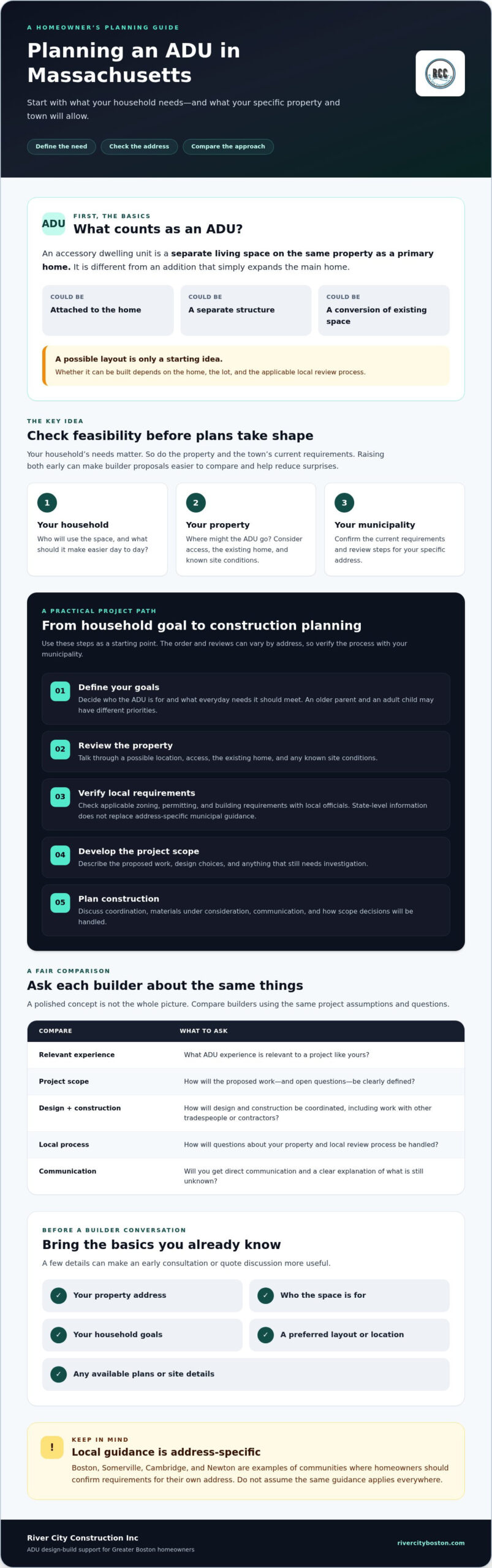
An ADU is a separate living space connected to or located on the same property as a primary home. It differs from a general addition, which usually expands the main home rather than creating a distinct place to live. For a neutral overview of common terms and forms, see Accessory Dwelling Unit (ADU).
A practical definition: An ADU is a separate living space associated with a primary home. Whether a particular design can be built depends on property-specific review and current local requirements.
An ADU might be attached to the house, built separately, or created by converting existing space. These are starting concepts, not proof that a particular project is eligible. This guide focuses on planning and selecting a builder, not guaranteeing approval. Each option needs to be considered in light of the home, the lot, and the applicable review process.
Why does Massachusetts ADU feasibility depend on the town?
Homeowners need to check current statewide requirements as well as the process used by the municipality where the property is located. Local review and site details can affect which questions need answers. Boston, Somerville, Cambridge, and Newton are examples of communities where homeowners should confirm requirements for their specific address. Do not assume the same guidance applies everywhere.
Before relying on general information or a builder’s early impression, contact the relevant municipality to confirm current requirements and review steps. Ask how the property’s location and proposed ADU type affect the process. Getting clarity early helps keep design discussions grounded in what still needs verification.
When assessing prospective builders, look beyond a polished concept. Ask about relevant ADU experience, how they’ll define the project scope, and how they coordinate design and construction, including work involving other tradespeople or contractors. Look for direct communication and a clear explanation of how open questions about the property and local process will be handled. These details give you a stronger basis for comparing proposals.
How Does an ADU Design-Build Project Move from Feasibility to Construction?
A well-managed ADU project moves from household goals to a property-specific plan, then into construction planning. The steps below are a useful starting point, but the order and required reviews can vary by address. Confirm the current process for your municipality before relying on a general outline.
- Define your goals. Decide who the ADU is for and what day-to-day needs it should meet. A space for an older parent may call for different priorities than one for an adult child.
- Review the property. Discuss the possible location, access, the existing home, and any known site conditions. These details can help determine which concepts are practical to explore.
- Verify local requirements. Check applicable zoning, permitting, and building requirements with local officials. The Massachusetts ADU Regulations page is a useful starting point for state-level information, but it does not replace address-specific municipal guidance.
- Develop the project scope. Describe the proposed work more clearly, including design choices and items that still need investigation.
- Plan construction. Discuss how the work will be coordinated, what materials are being considered, how communication will happen, and how decisions about the scope will be handled.
Review the property before developing a detailed design, because the site and local requirements can affect which ideas are practical to pursue.
What should happen during an initial property review?
Come prepared to explain the intended use, household needs, and where you imagine the ADU might go. A side yard, existing garage, or space within the home may suggest different starting points, but none should be treated as suitable without review. Access, existing home conditions, and other site details can influence the concept and the work it may involve. Confirm applicable requirements with municipal officials as the idea develops.
What should homeowners expect during design and construction planning?
With a design-build approach, design ideas and construction planning are discussed in a coordinated way. This can connect the desired layout with questions about the work, materials, and project scope. It does not mean approvals are automatic or that every site question will be resolved at the first meeting. Plans may need to change as the property and required reviews become clearer.
Ask how the builder will communicate updates, coordinate design and construction discussions, and bring scope decisions to your attention. If you’re ready to talk through your property and goals, you can discuss an ADU project with River City. A focused conversation can help identify what to verify and what information to gather next.
How Can You Compare ADU Builders in Massachusetts Fairly?
Comparing ADU builders Massachusetts homeowners are considering is easier when you look beyond the first figure on a proposal. Builders may describe different work, make different assumptions, or assign coordination responsibilities differently. Share the same project information with each builder, then compare the details of each proposal.
| What to compare | Questions to ask |
|---|---|
| Relevant ADU experience | Can the builder share examples of similar ADU projects and references you can contact? |
| Scope clarity | What work is included, excluded, assumed, or still subject to review? |
| Design coordination | How are design choices connected to construction planning? |
| Communication | Who gives updates, and how are questions and decisions handled? |
| Local process familiarity | How does the builder approach checking requirements for your municipality and property? |
Ask for relevant project examples and references, then verify the details directly. A reference can help you understand how communication and coordination felt from a homeowner’s perspective, but it does not replace a clear written proposal for your project.
What questions should you ask an ADU contractor?
Ask how the builder evaluates property feasibility before developing detailed design ideas. Find out who coordinates design decisions, construction planning, subcontractors, and homeowner updates. Ask what the proposed scope includes and excludes, what assumptions it relies on, and which items need further review. These questions can show whether the proposal reflects your goals or only a broad initial concept.
How do you compare design-build proposals without missing important details?
Design-build brings design and construction planning into a coordinated process. The Design-Build Institute of America offers an overview of the design-build process, but each proposal still needs close review. Compare written deliverables, responsibilities, items reserved for later choices or cost decisions, and decision points, not just headline totals. The lowest initial figure may reflect a narrower scope or different assumptions rather than a like-for-like offer.
Where possible, give each builder the same project assumptions and ask for the proposed scope in writing. Check how changes or unknown conditions in the existing home would be discussed and documented before work moves forward. If an item is unclear, ask for clarification instead of comparing unlike proposals. Homeowners looking for another local perspective can also explore an ADU builders in Newton, MA buying guide as they refine their questions.
What Should You Prepare Before Meeting ADU Builders Near Boston?
A little preparation can make an initial conversation more useful, even if you do not have plans or a finished design. Bring what you know about the property and what you hope the ADU will do for your household. A builder can help identify questions to investigate, but an early discussion cannot replace formal review by the municipality responsible for the property.
What information helps a builder understand your ADU goals?
Start with how the space might be used. Will a parent, adult child, or another household member live there? What should it support in everyday life? For example, a family planning a space for a parent might prioritize privacy and easy access while also wanting a convenient connection to the main home. Sorting out those needs before discussing floor plans helps the builder understand what matters most.
- Property address: Identify the municipality responsible for the home.
- Household needs: Note who may use the space and which activities it should support.
- Preferred layout or location: Describe early ideas, such as an attached, detached, or converted-space concept, without assuming it is feasible.
- Priorities: Write down preferences for privacy, access, storage, or connection to the main home.
- Known site information: Share what you know about the property and existing home.
- Available records: Gather plans, photographs, or information about past renovations if you have them. These may help, but do not assume they are required for an initial conversation.
Which local questions should you verify before settling on a plan?
Write down questions about current ADU requirements and local review steps before committing to a particular design. A Boston-area project may involve different municipal processes depending on the address. For example, homeowners in Boston, Medford, or Belmont should confirm requirements with the municipality responsible for their property rather than assuming one town’s guidance applies elsewhere.
Ask a builder how they approach property questions, define the proposed scope, communicate updates, and coordinate design with construction planning. Keep a list of anything that remains uncertain. An initial discussion may help identify what needs checking, but do not treat it as confirmation of eligibility, approval, a construction timeline, or a specific design.
With these details in hand, conversations with ADU builders Massachusetts homeowners are considering can be more focused. You’ll be better prepared to explain your goals, ask practical questions, and understand what needs verification before plans advance.
How Can a Local ADU Design-Build Contractor Help You Take the Next Step?
Once you’ve gathered property information and clarified your household’s needs, connect those details before moving forward. Verify local feasibility, describe your goals, compare written scopes, and discuss the project with a builder. This keeps the conversation focused on what is known, what still needs checking, and which decisions may come next.
River City Construction Inc is a Greater Boston residential contractor offering ADU design-build solutions. Its service area includes Boston, Winchester, Medford, Somerville, Cambridge, and Newton, along with other nearby Massachusetts communities. In a coordinated design-build conversation, homeowners can discuss design ideas and construction planning together. That is a way to explore the project, not a substitute for municipal review or confirmation of the scope.
What should a first conversation with a local ADU builder clarify?
Explain the property, who may use the ADU, and what you hope the space will make possible. Share any early layout or location ideas, then flag questions you have not verified, such as local review steps or site conditions. Ask how design discussions connect with construction planning, who will communicate about decisions, and what a useful next discussion would cover.
Keep the discussion exploratory until you’ve confirmed the applicable local requirements and project scope. A builder conversation can help organize questions, but it should not be treated as proof that a particular plan will be approved or can be built as imagined.
When are you ready to request a quote?
You do not need finished plans to start talking. A quote discussion is more useful when you can describe your goals, share what you know about the property, and explain the work you want considered. If important details are unknown, identify them so they can be distinguished from confirmed project assumptions.
River City offers free quotes. Contact the company to discuss whether its ADU design-build service fits your plans and what information would help frame the conversation. For homeowners comparing ADU builders Massachusetts, a clear discussion of goals, property details, and scope is a practical next step toward an informed decision.
Take the Next Step Toward a Well-Planned ADU
A strong ADU project starts with clear goals, a realistic understanding of the property, and a builder who can discuss design and construction planning together. As you compare ADU builders Massachusetts homeowners can consider, focus on transparent scope and thoughtful communication, not just the first proposal figure.
River City Construction Inc offers ADU design-build solutions for Greater Boston homeowners, including those in Boston, Winchester, Medford, Somerville, Cambridge, Belmont, Lexington, Concord, Wellesley, Newton, Wayland, and Natick. Homeowners can request a free quote and discuss their property and project goals with the team.
Frequently Asked Questions
What does an ADU builder do?
An ADU builder helps homeowners explore and plan construction of a separate living space connected to or on the same property as a primary home. With a design-build approach, design ideas and construction planning can be discussed together. The conversation may cover the property, intended use, possible scope, and questions that need review. River City Construction Inc offers ADU design-build solutions in the Greater Boston area.
Do I need to check local rules before hiring an ADU builder in Massachusetts?
Yes. Check current requirements for the property’s municipality before relying on a general description or committing to a design. State-level guidance and local review steps may both matter, and the applicable process can depend on the specific address and proposal. A builder can help identify questions to raise, but an initial conversation is not formal approval. Confirm current zoning, permitting, and building-review information with the relevant municipality.
Can every Massachusetts home have an ADU?
No. Do not assume every property can accommodate the ADU you have in mind. The home, lot, proposed location, existing conditions, and requirements for the address can all affect feasibility. An attached, detached, or converted-space idea needs property-specific review. Before investing in detailed plans, confirm current requirements with the municipality and discuss site questions with a builder. A preliminary discussion can identify unknowns, not guarantee eligibility.
How do I choose an ADU builder near Boston?
Compare relevant ADU experience, written scope, design coordination, communication, and familiarity with checking local processes. Ask for comparable project examples and references, then verify details directly. River City Construction Inc serves Greater Boston and nearby communities, including Boston, Winchester, Medford, Somerville, Cambridge, Belmont, Lexington, Concord, Wellesley, Newton, Wayland, and Natick. Compare proposals using the same project assumptions to see where scope or responsibilities differ.
What should I bring to an ADU builder consultation?
Bring the property address, a description of your goals and household needs, and any early thoughts about layout or location. Note known site details and prepare questions about scope, communication, coordination, and local review. Available plans, photographs, and information about past renovations may help explain the property, but you do not need to assume they are required to start a conversation. Be ready to distinguish what you know from what still needs verification.
Does an ADU builder handle permits in Massachusetts?
Permit responsibilities can vary, so do not assume the builder will handle every application or approval. Ask directly what support is included, who prepares or submits materials, and which tasks remain yours. Confirm the required process with the municipality responsible for the property. ADU builders Massachusetts homeowners consider should explain how they approach local requirements and make clear which responsibilities are part of the proposed scope.
When should I contact an ADU builder?
Contact a builder once you have an initial idea, even if you have not chosen a layout or gathered every document. An early conversation can help organize your goals and identify property or local-process questions to verify before detailed planning. River City Construction Inc offers free quotes for homeowners discussing an ADU project. Share what you know about the address and intended use, and clarify what remains uncertain as you explore next steps.
Ready to discuss your property and ADU goals? Contact River City Construction Inc to request a free quote.