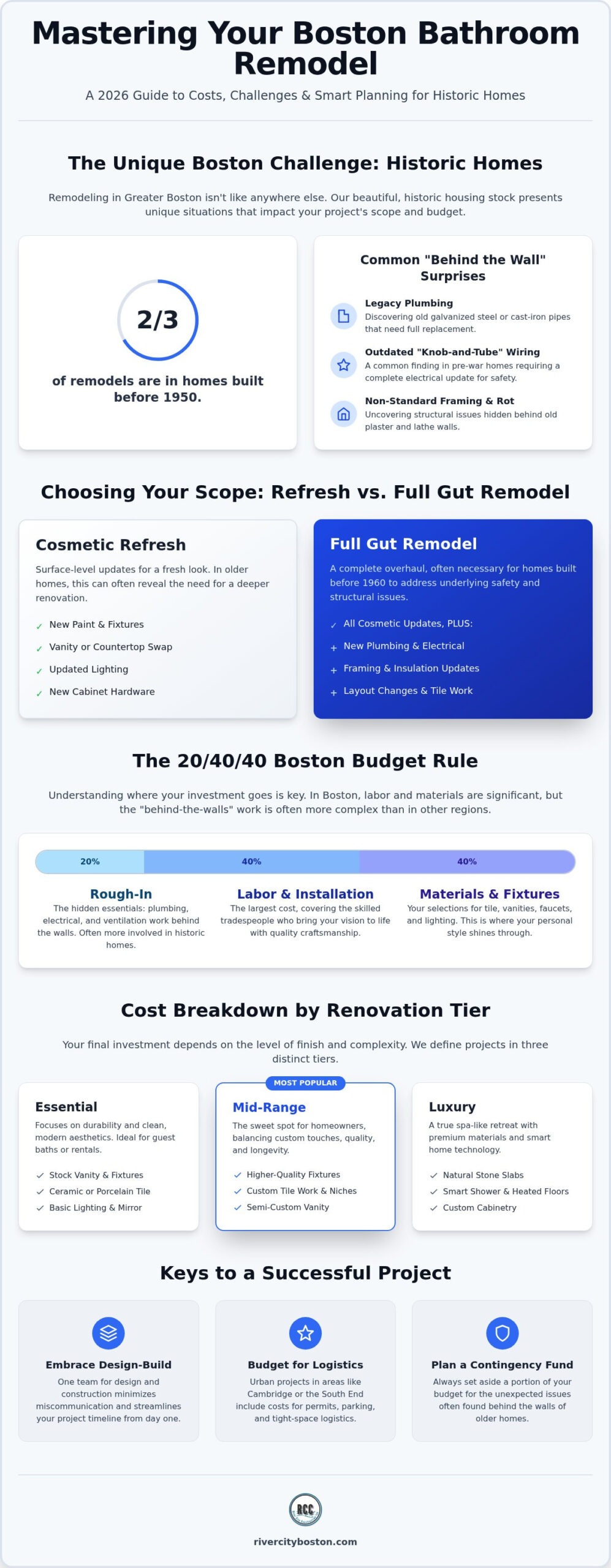
Imagine pulling back the dated subway tile in your South End brownstone only to find “knob-and-tube” wiring staring back at you from 1920. It’s a common story for local homeowners, as roughly two-thirds of the houses we remodel in the Greater Boston area were built before 1950. You’re likely feeling a mix of excitement for a beautiful new space and a healthy dose of anxiety about the final bill. It’s normal to worry about hidden structural rot or how long the permit office in Cambridge or Somerville will take to sign off on your plans.
This guide will help you master your bathroom remodel cost boston by breaking down the local factors that actually drive your budget. You’ll gain a clear understanding of where your investment goes, whether you’re planning a simple cosmetic refresh or a complex gut renovation. We’ll explore the specific challenges of our historic New England architecture and set realistic expectations for your 2026 project timeline. By the end, you’ll have the confidence to choose the right level of renovation for your home’s value and your family’s needs. We’re here to ensure your project starts with a solid plan and ends with the quality craftsmanship your home deserves.
Key Takeaways
- Identify the crucial differences between a cosmetic refresh and a full gut remodel to determine the right scope for your home’s value.
- Prepare for the unique structural challenges found in historic Boston homes, including legacy plumbing and non-standard framing surprises.
- Learn how labor, permitting, and urban logistics influence your bathroom remodel cost boston more than material choices alone.
- Discover how a design-build approach minimizes “change order” fatigue by integrating technical planning with aesthetic design from day one.
- Understand the importance of setting a realistic contingency budget to account for the hidden issues often found behind older plaster walls.
Understanding the 2026 Boston Bathroom Remodel Market
The home improvement industry has always been shaped by local conditions, and Boston is a particularly demanding environment. Tight streets, dense neighborhoods, and a housing stock that skews heavily toward pre-war construction create a remodeling landscape unlike anywhere else in New England. Before you can accurately plan your bathroom remodel cost boston, you need to understand what’s actually driving prices in 2026 and why national cost guides often miss the mark for our market.
Two forces are putting consistent upward pressure on project budgets this year. First, skilled tradespeople in the Greater Boston area remain in high demand, with licensed plumbers and tile setters often booked weeks out before a project even breaks ground. Second, material lead times and pricing have stabilized compared to the disruptions of a few years ago, but they haven’t returned to pre-pandemic norms. Planning ahead and locking in materials early is no longer optional; it’s simply smart project management.
Cosmetic Refresh vs. Full Gut Remodel
A cosmetic refresh typically covers surface-level updates: a fresh coat of paint, new cabinet hardware, a vanity swap, or a modern light fixture. These changes can genuinely transform how a bathroom feels without touching a single pipe. But here’s the honest reality for most Greater Boston homeowners: if your home was built before 1960, a cosmetic update often reveals why a deeper renovation is necessary. Galvanized steel pipes, outdated venting, and original cast-iron drain lines don’t become safer because you’ve put new tile over them. The age of your home is often the deciding factor in your minimum required scope, not your personal preference.
The Local Labor Landscape
Hiring in Massachusetts means working within a framework of licensing requirements that exist to protect you. A licensed, insured contractor isn’t just a legal checkbox; it’s your primary protection if something goes wrong behind the walls. Your choice of project structure matters just as much as who you hire. Working with a design-build firm means one team handles both the design and the construction under a single contract, which reduces miscommunication and keeps your project moving. The alternative, hiring a separate architect and then bidding out construction, can work well but often extends your timeline considerably in a market where contractor availability is already tight.
Your neighborhood adds another layer of complexity. A bathroom remodel cost boston project in Cambridge or the South End carries logistical costs, such as paid parking permits for contractor vehicles and stricter noise ordinances, that a similar project in Natick or Winchester simply doesn’t face. These aren’t deal-breakers, but they belong in your budget from day one.
Cost Breakdown by Renovation Tier: From Functional to Luxury
Your investment in a new bathroom is rarely just about square footage. In a city like Boston, the final tally depends heavily on the level of finish you select and the complexity of the installation. When we evaluate a bathroom remodel cost boston, we look at three distinct tiers: Essential, Mid-Range, and Luxury.
The Essential Tier focuses on durability and clean, modern aesthetics. It’s an excellent choice for a guest bath or a rental property where you want a fresh look that stands up to daily wear. The Mid-Range Tier is where most local homeowners land. This level allows for custom tile work, recessed shower niches, and higher-quality fixtures that offer more personality and longevity. For those seeking a true spa-like retreat, the Luxury Tier introduces premium elements like natural stone slabs, smart showers with digital temperature controls, and heated flooring for those cold New England mornings.
Allocating Your Budget: The 20/40/40 Rule
Understanding where the money goes helps take the mystery out of the renovation process. We often suggest the 20/40/40 rule as a helpful guideline for Boston projects. Roughly 20% of your budget covers “rough-in” costs. This includes the plumbing and electrical work hidden behind your walls, which is often more involved in our local historic homes. Labor and installation typically represent the largest chunk, around 40%, because skilled craftsmanship in Massachusetts requires a significant investment in expertise. The remaining 40% goes toward your materials and fixtures. This is the area where your choices, like selecting a custom-built vanity over a stock model, can most easily shift the total project scope.
Choosing Your Tier Based on ROI
In neighborhoods like Somerville or Cambridge, adding a second bathroom to a traditional triple-decker can drastically increase resale value. It’s often better to choose a mid-range finish for a second bath than to go luxury on a single one. Take the example of a client we worked with in Newton. They wanted to update their primary suite for maximum impact but were mindful of their total investment. By choosing high-quality porcelain tile that mimicked the look of expensive marble and pairing it with a professional-grade double vanity, they achieved a high-end feel without the luxury price tag. This strategic approach ensured their home was competitive for a future sale while providing the daily comfort they desired. If you’re ready to see how these tiers apply to your own space, feel free to reach out to our team for a conversation about your specific goals.
The “Historic Home” Factor: Why Boston Remodels Are Unique
In a city where many floor plans predate the automobile, a standard square-footage estimate rarely tells the full story of your bathroom remodel cost boston. Unlike newer construction in other parts of the country, Boston’s historic brownstones and triple-deckers often hide decades of legacy infrastructure. When you open up the walls in a home built in the early 1900s, you aren’t just looking at a renovation; you’re looking at a modernization project. Legacy plumbing, such as lead or galvanized steel pipes, must be replaced to meet current safety standards and ensure the longevity of your new fixtures.
Electrical requirements have also evolved significantly. A modern bathroom with high-efficiency lighting, heated floors, and smart mirrors often draws more power than an entire floor did in 1940. It’s common for a bathroom renovation to trigger a necessary electrical panel upgrade to handle these new loads safely. Additionally, if you live in a designated historic district like Concord or Lexington, you’ll need to navigate specific local guidelines that can influence everything from window replacements to exterior venting. These factors make the pre-construction phase the most critical part of your project.
Behind the Walls: What We Often Find
We often refer to the demolition phase as the “can of worms” moment for older homes. We recently managed a project in Winchester where the goal was a straightforward tile update. Once the original plaster was removed, we discovered significant structural rot in the floor joists caused by a slow, century-old leak. Because this is a common reality in our region, we recommend setting aside a contingency fund of 10% to 20% specifically for structural or mechanical surprises. Working with experienced bathroom designers in Boston is essential for these old layouts, as they can help reconfigure the space to work with non-standard framing and existing stack locations.
Navigating Local Building Codes
Massachusetts building codes, specifically the 9th Edition of 780 CMR, have strict requirements that older homes rarely meet in their original state. Common violations we fix include improper venting for drain lines and inadequate bathroom exhaust systems. Modern codes also mandate specific window and ventilation standards to prevent moisture buildup and mold. In 2026, “Green” building standards are playing a larger role in local renovations, requiring more efficient water usage and better insulation. These updates might seem like extra steps, but they provide the peace of mind that your home is safe, efficient, and fully compliant with current laws.
Strategic Budgeting: Maximizing Your ROI and Avoiding Overages
A successful renovation starts long before the first tile is removed. When planning your bathroom remodel cost boston, the goal is to create a space that feels personal while protecting your home’s equity. Many homeowners fall into the trap of change order fatigue, where small adjustments during construction lead to significant budget creep. This usually happens when decisions about fixtures or layouts are made on the fly. By finalizing every detail during the design-build phase, you lock in your vision and your budget before the hammers start swinging.
It’s tempting to buy your own vanity or faucets to save money, but this often backfires. If a homeowner-supplied part arrives damaged or with missing pieces, the project stalls. You end up paying for the contractor’s downtime while waiting for a replacement. Professional teams prefer to source materials because they can guarantee the quality and manage the logistics. This approach actually saves you money in the long run by keeping the schedule on track and ensuring all components are compatible with your plumbing.
In New England, timing matters. Interior work can happen year-round, but many families prefer to start projects in the spring or fall. Winter remodels sometimes offer more flexibility in a contractor’s schedule, provided the logistics of snow removal and site access are managed properly by a team that understands local winter conditions.
Smart Material Choices for 2026
Durability is the key to a strong return on investment. Quartz and large-format porcelain are top choices for 2026 because they offer the look of natural stone without the high maintenance. We also emphasize the longevity of quality kitchen and bath cabinetry. In the Boston real estate market, timeless designs, such as neutral palettes and high-quality finishes, consistently outlast trendy styles during a home sale. You want a design that looks as good in ten years as it does on the day it’s finished.
The Hidden Costs of DIY and Handyman Fixes
Cutting corners with unpermitted work or “under-the-table” fixes creates long-term financial risks. We once met a homeowner in Medford who had to redo a one-year-old bathroom because the previous cheap fix didn’t include proper waterproofing. This led to significant mold in the subfloor. Beyond the physical damage, unpermitted work can stall a home sale or lead to insurance claims being denied. Investing in licensed professionals ensures your home is protected by warranties and meets all Massachusetts safety standards.
Planning Your Project with River City Construction
Choosing a partner for your home shouldn’t feel like a transaction. It’s a significant emotional and financial commitment. At River City Construction, we’ve built our reputation on being a “Master Craftsman and Trusted Neighbor” for homeowners across Greater Boston. Our design-build model is specifically designed to manage the bathroom remodel cost boston by providing a single point of contact from your first sketch to the final walkthrough. This approach is particularly effective in 2026, as it allows us to streamline communication and lock in material orders early, protecting you from the inefficiencies that often drive up costs in traditional construction.
Whether you’re updating a historic brownstone in Somerville or a sprawling estate in Newton, our team understands the local nuances that make New England projects unique. We handle the heavy lifting of coordinating specialized subcontractors and navigating the complex permitting processes in cities like Cambridge and Winchester. You don’t have to worry about the specific building codes or the logistics of dumpster placement on a narrow street. We manage those details so you can focus on the transformation of your space. During our first consultation, we’ll discuss your goals, evaluate your existing layout, and begin the process of turning your vision into a structured, actionable plan.
A Transparent, Structured Process
We believe that a methodical approach is the best way to reduce homeowner anxiety. Our process is grounded in integrity and transparency, ensuring you’re never left wondering about the status of your project. We treat every home with the same high standards we’d apply to a neighbor’s house, focusing on durability and professional excellence. By identifying potential structural surprises early and maintaining a disciplined schedule, we provide the peace of mind that comes from working with a seasoned expert who values your time and investment as much as you do.
Next Steps for Your Boston Remodel
Ready to move from the planning phase to reality? The best way to start is by gathering your ideas and preparing for a detailed site visit. We recommend reviewing our portfolio of luxury bathroom remodels in Boston to see how we’ve blended modern functionality with local architectural charm. When you’re prepared to discuss your project, contact River City for a free evaluation. We’ll walk through your space together, listen to your needs, and provide the professional insight you need to begin your renovation with confidence.
Start Your Boston Bathroom Transformation Today
Planning for a bathroom remodel cost boston doesn’t have to be a source of stress. By choosing a design-build approach, you ensure that every detail, from historic plumbing upgrades to modern tile finishes, is managed by a single team. We’ve seen how proper pre-construction planning saves homeowners from the common pitfalls of renovations in our local neighborhoods. Whether you’re in a Cambridge brownstone or a Newton estate, your project deserves the precision and care of a seasoned specialist.
Our team at River City Construction brings localized expertise and a commitment to transparency to every project. We handle the permitting, the subcontractor coordination, and the technical surprises so you can focus on the excitement of your new space. You can trust that we’ll treat your home with the same high standards we’d apply to our own neighbors’ properties. We’re ready to help you navigate the complexities of 2026 budgeting and design with confidence.
We look forward to helping you build a space that adds lasting value and comfort to your home for years to come.
Frequently Asked Questions
Is a bathroom remodel worth it in the Boston area in 2026?
Yes, investing in a bathroom renovation remains a smart financial move in the Greater Boston market. According to regional data, mid-range projects in New England typically recoup between 60% and 68% of their cost at resale. Beyond the financial return, updating a bathroom in an older home in towns like Belmont or Wayland significantly improves daily comfort and energy efficiency. It also ensures your property remains competitive in a market that values modernized historic homes.
How long does a typical bathroom renovation take in a historic home?
A standard full bathroom renovation usually takes three to five weeks, while a primary suite can extend to six or ten weeks. In historic homes found in Winchester or Lexington, the timeline often depends on what we find behind the plaster. Surprises like rotted subfloors or outdated knob-and-tube wiring can add time to the schedule. We prioritize a methodical pace to ensure all structural repairs meet the current Massachusetts building codes.
Do I need a permit for a small bathroom renovation in Somerville or Cambridge?
You generally need building, plumbing, and electrical permits for any project that involves moving or replacing internal components. In Somerville and Cambridge, these permits must be pulled by licensed professionals to ensure the work complies with the 9th Edition of the Massachusetts Building Code. Skipping this step can lead to significant issues when you eventually try to sell your home, as unpermitted work often requires costly corrections during the inspection process.
What is the most expensive part of a bathroom remodel?
Labor is the largest expense, typically accounting for 40% to 60% of your total bathroom remodel cost boston. This is because high-quality tile installation, licensed plumbing, and expert electrical work require specialized skills that are in high demand across Massachusetts. Beyond labor, the “rough-in” phase, which involves updating old pipes and wiring behind the walls, often costs more than the visible finishes like vanities or faucets in our region’s older housing stock.
How can I save money on my Boston bathroom renovation without sacrificing quality?
The most effective way to save is by keeping your existing plumbing layout. Moving a toilet or shower can add thousands to your budget in labor and materials. You can also choose high-quality porcelain tile that mimics the look of natural stone for a fraction of the price. We suggest focusing your spending on high-use items like faucets and vanities while using more budget-friendly options for wall tile or lighting to balance the overall investment.
Should I expand my bathroom footprint or keep the existing layout?
Keeping your existing layout is the most cost-effective choice, as moving plumbing lines can add between $3,000 and $8,000 to a project. However, in dense neighborhoods like Somerville or Cambridge, expanding a cramped bathroom can significantly increase your home’s marketability. If your current space feels claustrophobic, a modest expansion into an adjacent closet might offer a better long-term return on investment than a simple surface-level update of a poorly functioning room.
What are the current trends for master bathrooms in Massachusetts?
Many homeowners in towns like Wellesley and Concord are opting for walk-in showers and full wet rooms to create a spa-like feel. Floating vanities are also popular because they make smaller bathrooms feel more spacious and are easier to clean. We are also seeing a growing demand for aging-in-place features, such as stylish grab bars and wider doorways, which ensure the bathroom remains functional and safe for residents as they grow older.
Can I stay in my home during a full bathroom gut remodel?
You can certainly stay in your home during construction, provided you have access to another functioning bathroom. We take great care to minimize disruption by using dust barriers and maintaining a clean work zone. While there will be noise during the demolition phase, our organized project management ensures the most intrusive work happens during standard business hours. Most families in Medford or Belmont find the temporary inconvenience well worth the final result.