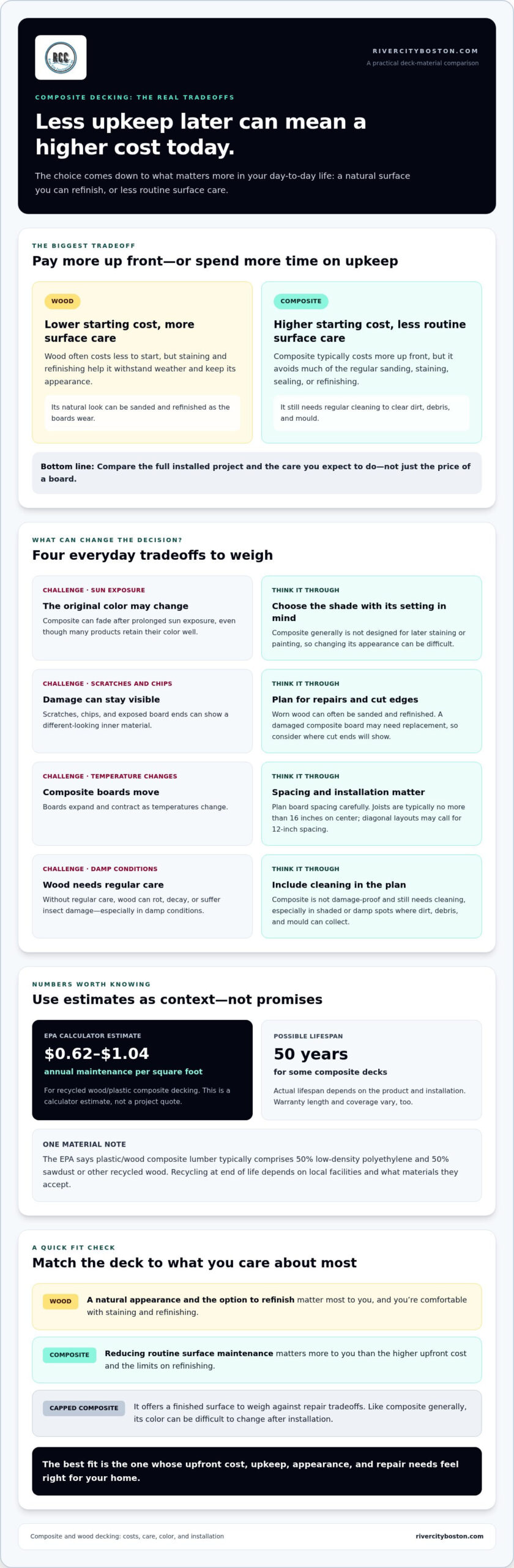
A deck that needs less upkeep after installation may cost more at the outset. The composite decking pros and cons come down to that tradeoff: composite typically costs more upfront than wood but needs less sanding, staining, sealing, or refinishing. It can retain its color well, though prolonged sun may cause fading, and the boards expand and contract as temperatures change.
It makes sense to consider more than the initial quote when choosing a deck. Wood offers a natural look and can be refinished, while composite can reduce routine upkeep. Neither material suits every homeowner.
This comparison explains how composite and wood differ in upfront cost, long-term value, board movement, and color retention. It also covers capped composite boards and the tradeoffs to weigh before choosing a material. Use these points to match your decking to your maintenance preferences, desired appearance, and the conditions the deck will face.
Key Takeaways
- Compare the higher upfront cost of composite with the time and maintenance it may save over the years.
- Account for temperature-related board movement when planning the deck, since careful spacing and installation matter.
- Choose color with the long term in mind: composite can fade in prolonged sunlight and is difficult to recolor after installation.
- Weigh capped boards’ potential benefits against the tradeoffs in appearance, repair, and comfort before choosing a surface.
Is composite decking worth it?
Composite may be worth the higher upfront cost if reduced upkeep matters more to you than a natural wood finish. Weigh fading, repair needs, and installation alongside the initial price.
Composite Decking and Wood Vulnerability
Without regular care, wood decking can rot, decay, or suffer insect damage, especially in damp conditions. Sun and weather can also fade wood, so staining and refinishing help maintain its appearance. Composite avoids much of this routine surface treatment, but it is not damage-proof: scratches, chips, and exposed board ends can remain visible and often cannot be sanded smooth like wood.
UV Exposure and Color Fading
Composite boards can fade after prolonged sun exposure as UV rays affect the material over time. Many products retain their color well, but “low maintenance” does not mean the original shade is guaranteed to remain unchanged. Choose a color with the deck’s sun exposure in mind. Unlike wood, composite generally is not designed for later staining or painting, so changing its appearance can be difficult.
Scratches, Chips, and Exposed Board Ends
A worn wood board can often be sanded and refinished; a damaged composite board may need to be replaced. Scratches or chips can expose inner material with a different appearance, especially at cut ends. During planning, consider where cut edges will be visible and how board ends will be finished. These details shape the finished look, even if the deck’s main surface remains in good condition.
Lifespan, Maintenance, and Installation
Some composite decks may last 50 years, but lifespan depends on the product and installation. Warranty length and coverage also vary by manufacturer and product. Plan regular cleaning to clear dirt, debris, and mould, especially in shaded or damp spots. For installation, joists are typically spaced no more than 16 inches on center; diagonal board layouts may call for 12-inch spacing.
Residential deck replacement requirements vary across U.S. jurisdictions. Whether a permit applies depends on local rules and the scope of the replacement. For environmental context, the U.S. Environmental Protection Agency says plastic/wood composite lumber typically comprises 50% low-density polyethylene and 50% sawdust or other recycled wood. Some brands use recycled materials, while end-of-life recycling depends on available local facilities and material acceptance.
For upkeep context, the U.S. Environmental Protection Agency calculator lists annual maintenance costs for recycled wood/plastic composite decking of $0.62 to $1.04 per square foot. This is a calculator estimate, not a project quote. A practical review of composite decking pros and cons should compare material, care, and appearance together.
| Option | Upkeep | Color and repair | Best fit |
|---|---|---|---|
| Wood decking | Staining and refinishing | Can be sanded; may fade | Natural appearance and refinishing |
| Composite decking | Regular cleaning | Can fade; damaged boards may need replacement | Less routine surface maintenance |
| Capped composite | Regular cleaning | Color is difficult to change after installation | Homeowners weighing a finished surface against repair tradeoffs |
Choose wood if you value refinishing and a natural surface most; choose composite if reducing routine upkeep matters more.
Upfront cost and return on investment
Composite decking often costs more upfront than traditional wood, including pressure-treated timber. Lower upkeep may offset some of that initial difference over time, but the value depends on the project and your priorities.
Composite Decking Upfront Cost
The initial cost of a composite deck reflects more than the boards. Compare the complete project scope: demolition, site preparation, framing, fasteners, and finishing all affect the total. Wood may cost less to start, while composite is an option for homeowners seeking less recurring surface care. Compare equivalent project scopes, not just the price of one board with another.
Pressure-treated wood is still wood, so it needs care to withstand weathering. Composite typically requires a larger initial investment, while lower routine maintenance can improve its long-term value. Polyvinyl chloride (PVC) decking is another option, but it is made from a different material. Assess each choice by its installed scope, expected upkeep, and finish rather than assuming its cost or value matches composite.
Regional costs and product availability vary with local supply, delivery distance, labor, and project conditions. For a useful comparison, use the same deck size, design, and removal or preparation needs for each material. Then compare the boards and accessories available for that project so the estimates reflect similar choices.
Upfront Cost and Resale Value
Resale value is not a straightforward refund of the original deck cost. A well-presented outdoor space may support a home’s overall appeal, but buyers can weigh appearance, condition, and upkeep differently. Composite may suit someone seeking less routine care; traditional wood may appeal to someone who prefers its natural look.
To assess value over time, list the initial project scope alongside future care tasks. Include staining and refinishing for wood, then compare them with the cleaning needs of composite. Consider how long you expect to use the deck and whether reduced upkeep matters more than a lower starting cost. This makes the decision personal and practical instead of relying on an assumed resale premium.
Compare pressure-treated wood, composite, and PVC by installed scope, appearance, and ongoing care. Composite often costs more initially than wood. PVC is a separate material choice, so compare its project details rather than treating it as identical to composite.
Project price depends on the case and is provided after a quote request; deck size, site preparation, framing, material selection, and finishing shape the scope. For a project-specific comparison, share your deck project details and priorities.
Before deciding, compare complete project scopes, note the care each material needs, and choose the option that fits both your budget and plans for the deck.
Board expansion and contraction
Composite boards move as temperatures change, so installation gaps are part of the design, not just a finishing detail. The boards’ plastic and wood-fiber components respond differently to heat, which can contribute to bending or warping in extremely hot weather.
Plan the layout before fastening the first board. Follow the manufacturer’s installation directions for the material, temperature, and deck design. Allow for movement at the board ends and sides. Tight spacing can leave too little room as boards expand; excessive gaps can make the finished surface look uneven. A durable deck starts with spacing suited to its specific boards.
Joist spacing matters, too. Joists are the supports beneath the deck boards. Composite decking guidance recommends spacing them no more than 16 inches on center, meaning from the center of one joist to the next. For diagonal installations, manufacturers advise a maximum spacing of 12 inches on center. The shorter support span helps boards remain supported across the layout.
- For a straight layout, set joists no more than 16 inches on center.
- For diagonal boards, use the advised 12-inch maximum spacing.
- Before cutting, map board ends and transitions to preserve consistent movement gaps.
Pay special attention to corners and picture-frame borders. A 45-degree miter joins two boards at an angled cut, often around a deck’s edge. That cut can make expansion gaps uneven at the board ends. Measure the openings at the joint and adjacent edges, then adjust the layout rather than forcing boards tightly together. A small planning change can prevent one corner from looking crowded as temperatures shift.
Heat deserves attention on a sunny deck. Composite boards can warp or bend in extremely hot weather because the plastic and wood fibers expand at different rates. Do not treat composite like solid wood or assume that installation practices for treated lumber apply unchanged. Follow the chosen product’s spacing and fastening directions, especially where boards meet steps, posts, or a fixed edge.
On an existing deck, inspect the joints in warm and cool weather. Look for uneven gaps, raised ends, or boards pressing against a fixed structure. These signs may indicate movement but do not prove a single cause; assess the support spacing and board layout together. If replacing only part of the deck, match the new board’s installation details to the existing framing rather than relying on appearance alone.
Good planning balances three things: temperature-related movement, consistent gaps, and support beneath each board. Apply the 16-inch spacing guidance to straight runs and the 12-inch maximum to diagonal layouts, then use the manufacturer’s directions for the selected material.
Composite decking color retention
Composite decking can retain its color and appearance for years, with minimal fading from ultraviolet exposure, often called UV rays. That does not mean the material stays unchanged in every setting. Prolonged sunlight can fade boards over time, while shaded sections may look different from sunlit ones. Plan for the exposure your deck will receive.
Before choosing a color, compare available shades with your home’s exterior and the deck’s surroundings. For example, a dark board beside pale siding creates stronger contrast than a light, neutral shade. Composite comes in a range of colors and textures, but its color and finish are set during manufacturing. Choose carefully: painting or staining usually is not suitable, and changing the color later can be difficult.
Sunlight is only part of the picture. Weather can affect the appearance of any outdoor surface, and wood decking can fade with sun and exposure. Wood often needs ongoing staining or refinishing to maintain its appearance. Composite may suit homeowners who want to avoid that recurring color treatment, but prolonged direct sun can still cause fading.
Use these practical steps to assess a color before installation:
- Compare color options beside your siding, trim, and outdoor furniture.
- Look at the deck’s sunny and shaded areas, since their exposure differs.
- Consider how a board’s color will look alongside nearby landscaping and hard surfaces.
These comparisons can prevent a common mismatch: choosing a board based only on a small display or indoor image. A shade that looks warm indoors may appear more pronounced in direct sunlight. Assess the color in the context of your home and consider how much sun reaches the deck during the day. The aim is a finish that suits the setting as natural light changes.
Color retention also matters for repairs. Composite boards generally cannot be sanded, stained, or painted to blend with older boards. If damage requires replacing a whole board, the replacement may look different if the original surface has faded. Keep this in mind when weighing composite’s low-maintenance appeal against wood’s ability to be refinished. The right choice depends on whether consistent color with less routine treatment matters more than the flexibility to refresh a wood surface.
Treat the initial color choice as a lasting design decision, not a detail to revisit after installation. Composite decking color can be difficult to change once the boards are in place. Before settling on a shade, consider how it fits your home and outdoor setting. A choice made in context is more likely to remain satisfying than one based on a quick glance at a sample.
Consider the look you want across the deck, including how the color relates to nearby surfaces and areas with different levels of sunlight. If comparing options, view them in the same setting rather than relying on isolated impressions. This keeps the decision focused on the finished space and the limited flexibility for changes later. Careful consideration before installation helps you choose a composite color that suits the deck over time.
Capped composite decking pros and cons
A capped board has an outer layer over its composite core. This construction can provide a finished, consistent appearance, but the cap does not remove every tradeoff of composite decking. Assess the surface for appearance, comfort, repair needs, and suitability for your outdoor space.
The word “capped” alone does not establish how a board will perform. Composite decking resists rot, insects, and moisture, but still needs cleaning. Dirt and mould can build up in damp or shaded areas. Compare the specific board’s care directions and surface appearance rather than assuming a cap means no upkeep.
Color is another lasting decision. Composite colors and finishes are set during manufacturing, so a capped board generally cannot be repainted or stained if your preferences change. Prolonged sun can also fade composite over time. Compare colors with your siding and outdoor furniture, and consider how direct sunlight reaches the deck before choosing.
There are practical considerations after installation, too. Composite can become hot underfoot in prolonged sunlight, and a light color can help reduce heat absorption. It can also become slippery when wet, so consider areas near water. A capped finish does not remove these comfort and safety considerations.
- Consider a light shade if prolonged sun and surface heat are concerns.
- Think about wet conditions around steps or areas exposed to water.
- Choose a color you’re comfortable keeping, since later changes are difficult.
Repair needs also matter. A damaged composite board often needs to be replaced as a whole because it cannot be sanded or refinished like real wood. A replacement may stand out if surrounding boards have faded. Plan the layout with exposed edges in mind and consider how board ends will look in open areas.
Some composite decks may last 50 years, but that potential doesn’t remove the need for sound installation and routine care. Capped composite may suit a homeowner who values a consistent manufactured finish and less surface refinishing. Real wood may be a better match for someone who wants a natural look and the option to sand or refresh worn boards. The right decision comes down to which tradeoffs matter most: appearance, upkeep, comfort, and repair.
Before choosing, compare sample colors in the deck’s actual light, note where wet surfaces are likely, and decide how you would handle a damaged board. These practical checks help determine whether capped composite fits your priorities.
River City Construction: Kitchen Remodeling
River City Construction Inc offers Kitchen Remodeling for homeowners planning a more functional, updated kitchen. If your deck decision is part of a wider home improvement plan, consider how the project fits with the rooms and living spaces you want to improve.
River City Construction Inc also offers Bathroom Remodeling, Basement Remodeling, and Accessory Dwelling Unit (ADU) Services. These options may be relevant if you are weighing several home projects and deciding which changes best suit your household. Each project begins with your goals for the space and the improvements you have in mind.
To discuss a remodeling project, contact River City Construction Inc or visit rivercityboston.com.
Choose the deck that fits how you live
Before choosing a material, picture an ordinary week on your future deck. Consider how you will use the space, the look you want beside your home, and how much ongoing care feels manageable. The composite decking pros and cons are easier to weigh when your priorities are clear. Start with the qualities you value most, then compare the options against them.
If the deck is part of a larger home update, River City Construction Inc also offers Kitchen Remodeling, Bathroom Remodeling, and Basement Remodeling. Considering those plans together can help you see how the outdoor space relates to the rooms you are improving. Describe your goals to start shaping the project around your home.
With your priorities in view, you can move forward thoughtfully and choose a space that feels right for your home.
Frequently Asked Questions
What are the main pros and cons of composite decking?
Composite decking needs less routine surface care than wood but usually costs more upfront. It resists rot, insects, and moisture, yet boards can still fade, scratch, or need full replacement if damaged. Consider how you will use the deck: a household seeking to avoid recurring staining may prefer composite, while someone who values refinishing a natural wood surface may prefer wood.
How much does composite decking cost per square foot installed in the U.S.?
Installed costs vary by project, so a per-square-foot figure alone may not reflect the full scope. Board type, deck size, framing, site preparation, removal of an existing deck, stairs, and railings all affect the total. Compare estimates that cover the same work and materials. The project price depends on the scope and is provided after a quote request.
Does composite decking get hot, fade, stain, scratch, or become slippery?
Yes. Composite decking can get hot in prolonged sunlight, fade over time, scratch or chip, and become slippery when wet. Lighter colors can help reduce heat absorption, and regular cleaning helps prevent dirt, debris, and mould buildup. Consider where people may walk barefoot and where water collects. Follow the board’s care directions to choose a suitable cleaning routine.