You walk through a newly finished room and spot uneven trim, a fixture that doesn’t sit right, or work that looks different from what you agreed on. Before deciding what to do when a contractor does bad work, pause and compare the result with your contract, plans, and written messages. A concern may be real, but a clear picture of what was promised and what was completed can help you raise it calmly.
It’s understandable to worry that speaking up could make communication harder, or that fixing the problem will mean paying twice. You don’t have to jump straight to an accusation or a costly dispute. A measured first step is often to record what you’ve noticed and give the contractor a specific chance to respond.
This guide explains how to assess the workmanship against the agreed scope, gather useful records, and request a practical resolution in writing. You’ll also learn when it may make sense to seek qualified local or legal guidance. The aim is to move from uncertainty to an informed next step, one stage at a time.
Key Takeaways
- Learn how to tell whether a concern points to a mismatch between the finished work and the agreed scope.
- Use a simple sequence to organize your agreement, dated photos or video, and notes about each issue.
- When deciding what to do when a contractor does bad work, start with a calm written message that asks for a clear response and plan.
- Compare continued discussion, an independent assessment, and formal advice based on what each option can help you understand.
- Keep any future remodeling plans separate from the current dispute, and look for clear scope, realistic planning, transparent pricing, and consistent communication.
How to Tell Whether a Contractor’s Work Is Actually Poor Workmanship
Spotting a problem during a renovation can feel unsettling. Maybe the cabinets are installed, but a promised shelf is missing. Or the work is complete, yet the finish looks different from what you pictured. Before assuming the contractor has done poor work, compare what you can observe with what you agreed to in the contract, approved plans, and written change orders.
A concern is strongest when you can point to a specific difference between the completed work and the documented scope. That doesn’t mean your concern should be dismissed if the agreement is unclear. It means the project records and circumstances are useful starting points for understanding what happened.
Poor workmanship, unfinished work, or a change in expectations?
Think of the difference between a missed agreed item and a finish choice you simply don’t like. If the written scope includes a built-in shelf and it isn’t there, that’s a concrete omission to discuss. If the shelf is present but its appearance isn’t your preference, the issue may involve expectations or a design change instead. The signed scope and approved changes help clarify which applies.
Plans can change during a project. A written change order, meaning a record of an agreed adjustment, may explain why the finished result differs from the original plan. Review those records before deciding who is responsible. No single photo or sentence can establish fault without the project context.
Which concerns deserve prompt attention?
Start with what you can see and describe. “The tile is bad” is difficult to assess; “the tile pattern differs from the approved plan beside the vanity” gives the concern a clear location and reference point. A cosmetic preference may call for a conversation, while a visibly unfinished item or a result that appears inconsistent with the agreement needs careful review against the project documents.
A workmanship concern is a specific, observable difference between completed work and the agreed scope, supported by project records where possible.
Some issues concern appearance; others involve whether a component seems to perform the function described in the plans. For broader context on how structures are designed to carry loads and how failures are studied, see Structural integrity and failure. That reference is general background, not a verdict on your project. If you’re unsure what to do when a contractor does bad work, first make a clear comparison between what was promised and what’s there.
- Observable detail: Note the exact location and what appears incomplete, damaged, or different.
- Scope reference: Identify the matching contract item, plan detail, or approved change.
- Expectation check: Separate a documented requirement from a preference that wasn’t recorded.
This comparison helps you raise a focused concern rather than beginning with a broad accusation. If the agreement and finished work don’t clearly line up, record what remains uncertain. You can then discuss the facts and seek clarification before choosing your next step.
First Steps: Review the Agreement and Document the Work
Once you’ve identified a specific concern, take a breath before sending a message or arranging further work. A clear record can help you explain what you noticed and give the contractor a fair chance to understand it. It won’t decide who is legally responsible, but it can make the next conversation more focused.
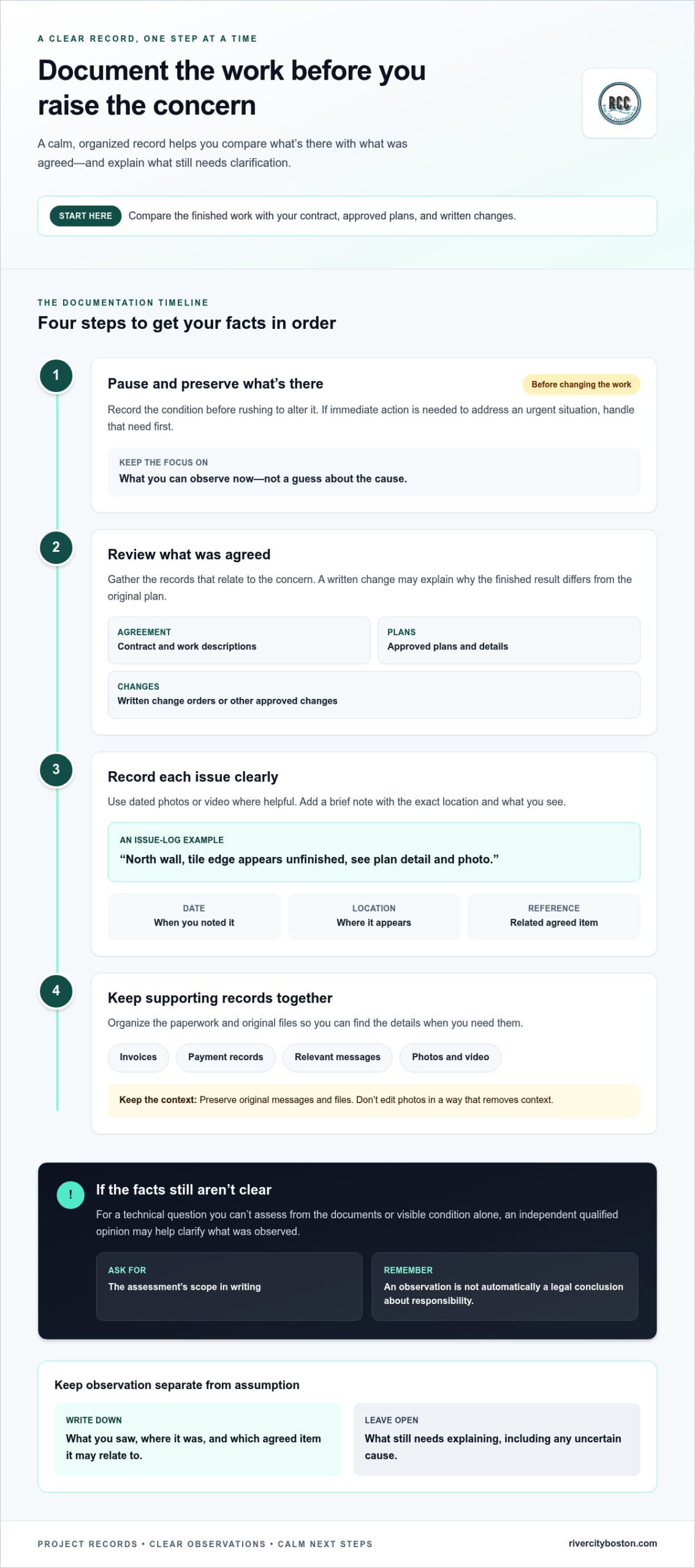
Use this sequence to get organized:
- Pause and preserve what’s there. Avoid rushing to alter the work before you’ve recorded the condition, unless immediate action is needed to address an urgent situation.
- Review the agreement. Gather the contract, approved plans, written changes, and any descriptions of the work that relate to the concern.
- Record each issue. Take dated photos or video where they help show the condition. Add a brief note describing what you see and where.
- Organize supporting records. Keep invoices, payment records, and relevant messages together with the project documents.
Build a clear record of the work and the concern
Give each concern its own entry in a simple issue log. Note the date, location, visible condition, and the agreed item it may relate to. For example, write “north wall, tile edge appears unfinished, see plan detail and photo” rather than “poor tile work.” Keep original messages and files, and don’t edit photos in a way that removes context. Link each entry to its supporting records so you can find them easily.
A tidy file is useful whether you’re clarifying a misunderstanding or discussing an unresolved problem. Keep facts separate from assumptions: record what you observed, then note what you still need explained. That makes it easier to describe the issue without presenting a guess as a proven cause.
When an independent assessment may help
If the disagreement involves a technical question that you can’t assess from the documents or visible condition alone, an independent qualified opinion may help clarify what was observed. Ask for the assessment’s scope in writing, and keep its findings with your records. An expert’s observation can inform your understanding, but it isn’t automatically a legal conclusion about responsibility.
Be precise when referring to an assessment. If it says a condition may have a particular cause, preserve that uncertainty rather than describing the cause as established. For general background on options related to construction disputes, the American Arbitration Association’s construction dispute resolution resources may help you understand the subject; they don’t determine the facts of your project.
Good records support a practical conversation, but they can’t guarantee a particular outcome. If you’re planning a separate remodeling project for the future, clear documentation and communication are valuable habits there, too. You can discuss a future remodeling project without treating that conversation as a way to resolve your current concern.
How to Raise Poor Work With the Contractor and Seek a Resolution
Once you’ve reviewed the agreement and identified the concerns, put your request in writing. A calm, specific message gives the contractor something clear to respond to and helps keep the conversation focused on the work, not assumptions about intent. If you’re deciding what to do when a contractor does bad work, aim first for a practical exchange that can clarify the issue and possible next steps.
What to include in a written request
Identify the project and describe each concern by location. Refer to the contract, plan, or approved change that appears relevant, and attach only the dated images or records that help explain the point. Ask for a written response and, if seeing the condition together could help, suggest a time to walk through it on site.
For example, instead of writing, “The bathroom work is unacceptable,” you might say: “The finish beside the shower appears different from the approved plan. I’ve attached a photo and the plan detail. Could you explain how this item was completed and propose a way to address it?” Adjust the wording to your own situation. The goal is a clear question, not a verdict.
Keep a copy of your message and any reply with your project records. Avoid threats or public accusations while the facts are still being discussed. If you’re unsure how to frame a concern or understand your options, the Construction Consumer Advocacy Institute is a separate resource related to consumer concerns in construction.
Compare proposed fixes without escalating prematurely
If the contractor suggests a correction, ask for a plain-language description of what will change and how the proposed work addresses the item in the agreed scope. A useful reply should make it easier to understand what is being offered, rather than leaving you to guess what “we’ll take care of it” means.
Before any revised work proceeds, keep changes to the scope, schedule, or cost in writing. A short written summary can confirm what both sides understood after a phone call or site conversation. If you disagree with the suggested approach, explain the specific point that remains unresolved and ask whether another practical option is available.
There’s no response deadline that fits every project. Refer to the terms in your agreement and seek appropriate advice if you’re unsure what timing applies. Keep follow-up messages measured and factual. If the conversation stalls, you can then compare the next steps that fit your situation rather than rushing into a formal dispute.
Resolving an existing concern is separate from planning a future remodel. For a separate project, you can discuss your remodeling plans with River City Construction.
If the Contractor Does Not Resolve the Problem: Compare Your Next Steps
If your written request doesn’t lead to a clear resolution, you still have choices. The right next step depends on what remains disputed, how much work is left, and what your agreement says. Before escalating, consider whether the issue is a technical question, a communication breakdown, or a concern about your rights under Massachusetts rules.
For homeowners weighing what to do when a contractor does bad work, it helps to compare options by purpose rather than treating every disagreement as a legal dispute.
- Continue written discussion if the contractor is responding and you’re still clarifying the concern. This keeps the focus on practical solutions, though it may not resolve a disagreement that depends on technical facts.
- Seek an independent assessment if the parties disagree about what the work shows or whether it matches the plans. It may add useful information, but it takes time and does not decide legal responsibility.
- Explore a neutral discussion or formal advice if direct communication has stalled or you need help understanding your options. These routes may clarify next steps, but their suitability depends on your circumstances.
When a neutral assessment or facilitated discussion may fit
An independent qualified opinion can be useful when the dispute turns on a technical detail that’s hard to assess from the agreement alone. A neutral discussion, such as mediation, may help both sides explore a resolution with someone impartial guiding the conversation. Neither option guarantees agreement. Weigh the time involved, the records you have, and how much work remains before choosing.
If you consider an assessment, be clear about what question you need answered and keep its scope and findings with your project records. Treat observations as observations, not as a final legal ruling. A facilitated discussion can also be more productive when each side can identify the specific points still in dispute.
When to seek Massachusetts-specific legal or consumer guidance
Contract terms, available remedies, and relevant deadlines can depend on the facts and current rules. For guidance about consumer options in Massachusetts, consult current information from the Massachusetts Attorney General’s Office or speak with a qualified attorney. Check any insurance question against the actual policy language and applicable terms. Coverage and responsibility depend on those terms and the facts, so don’t assume a policy will pay for a particular correction.
Verify Massachusetts rules and deadlines with an official source or qualified attorney before taking formal action.
Avoid withholding payment, cancelling an agreement, or filing a claim based only on general information. Those steps can have consequences that depend on your contract and circumstances. Get advice specific to your situation before deciding, and keep copies of relevant communications and records.
Any future remodeling plans are separate from resolving the current disagreement. For a future project, clear scope, careful planning, and transparent communication can help you make an informed decision.
Choosing a Remodeling Partner for the Work Ahead
Planning a future remodel is a separate decision from resolving a disagreement with a contractor. You don’t need to settle an existing dispute before thinking about what you’d like to change next. But after a difficult project, it’s natural to want a clearer picture of the process, scope, budget, and communication before making another commitment.
For any new project, look for a clearly defined scope, realistic planning, transparent pricing, and consistent communication. These details help you understand what the work is intended to include and make decisions with fewer surprises. If you’re weighing what to do when a contractor does bad work, keep that question separate from choosing a partner for a future kitchen, bathroom, or other remodeling project.
What a coordinated Design-Build process looks like
River City Construction Inc.’s Design-Build process brings design, planning, budgeting, and construction together under one roof. The project process includes a consultation, design and planning, permits, construction, and a final walkthrough. Clear plans and a dedicated point of contact can help keep decisions and communication organized as the project moves from early ideas to completed work.
For a distinct kitchen project, explore kitchen remodeling in Boston. You can discuss priorities such as layout, finishes, and how the space needs to function as part of planning that separate project.
Discuss a future Greater Boston remodeling project
River City Construction serves homeowners in Boston, Winchester, Medford, Somerville, Cambridge, Belmont, Lexington, Concord, Wellesley, Newton, Wayland, and Natick. If a bathroom is a future priority, bathroom remodeling services offer another way to explore a project distinct from your current contractor concern.
River City Construction Inc. brings 20+ years of experience to residential remodeling. The company is BBB Accredited, Licensed & Insured, and has 4.9 stars from 110 Google reviews. These details can help you assess a local remodeling option, while a clear conversation about your goals and project scope helps you decide whether the approach fits your plans.
For a future project, the company offers a free, no-obligation consultation. Eligible projects may also have exclusive project savings of up to $2,500. Discuss the work you’re considering, your priorities, and the planning needed to make an informed choice. This invitation is for a future remodeling project, not a service to resolve an existing contractor dispute.
Make Your Next Home Decision With Confidence
A difficult project can shake your confidence, but it doesn’t have to define every decision that follows. The question of what to do when a contractor does bad work is about the situation in front of you. Your hopes for a future renovation are a separate matter, and you can approach them with fresh expectations and a clear sense of what matters to your household.
Before planning your next project, take time to consider how you want the process to feel: clear decisions, a shared understanding of the work, and open communication as plans take shape. Those priorities can help you move forward thoughtfully, whether you’re considering a kitchen update, a more comfortable bathroom, or another improvement to your home.
When you’re ready to explore a future remodeling project, River City Construction can help you discuss the possibilities. A new plan can start with a conversation about what would make your home work better for you.
You can take the next step at your own pace. A clearer plan begins with a simple conversation.
Frequently Asked Questions
Can I withhold payment if a contractor does bad work?
Don’t withhold payment without first getting advice specific to your agreement and situation. Payment terms may depend on the contract, what work is complete, and the nature of the disagreement. Before making a decision, gather invoices, payment records, and any written description of the disputed work. If you’re unsure what to do when a contractor does bad work, a Massachusetts attorney can help you understand the possible consequences of withholding payment.
Does homeowners insurance cover poor contractor workmanship?
It depends on the policy language, the cause of the damage, and the facts. A policy may treat defective work differently from damage that results from it, so don’t assume either that the work is covered or that it’s excluded. Read the relevant policy sections and contact your insurer to ask how the specific situation is handled. Keep notes of the questions you asked and any response you receive.
Should I hire another contractor before the original contractor has a chance to respond?
Usually, give the original contractor a reasonable opportunity to respond before arranging replacement work, unless there’s a pressing reason to act sooner. A second contractor’s changes could make it harder to understand what was originally completed. If you need an independent opinion, clarify whether you’re seeking an assessment or asking someone to start repairs. Before authorizing work that changes the project, consider getting advice based on your agreement and circumstances.
What documents should I keep when a contractor’s work is unsatisfactory?
Keep the signed agreement and all later versions, along with permits or inspection records you received, invoices, receipts, proof of payments, and communications about decisions or delays. Save original digital files with their dates and retain any written estimate for proposed corrective work. If you speak by phone or in person, make a dated note of who was present and what was discussed, then keep it with the project file.
How long should I wait for a contractor to respond to a complaint?
There’s no single response period that fits every project. Check whether your agreement describes a process or timing for raising concerns, and make your request in writing so the date and details are clear. You can ask for a response by a reasonable date that suits the issue, but don’t treat that date as a legal deadline. If timing could affect your options in Massachusetts, seek current local guidance.
When should I speak with a lawyer about poor workmanship?
Consider speaking with a qualified attorney if the contractor won’t engage, the disagreement involves substantial unfinished or disputed work, or you’re considering withholding payment, ending the agreement, or making a formal claim. Legal options and deadlines can turn on details in your contract and current Massachusetts rules. Bring your agreement, payment records, relevant messages, and a short timeline of events so the lawyer can assess the situation more clearly.