The hourly rate is only one part of what a handyman visit in Boston may cost. The handyman hourly rate in Boston depends on the work, and minimum service, trip, or mileage fees can affect the total, even when a task takes little time.
It’s reasonable to want a clear idea of the cost before setting aside time for repairs. This guide explains how hourly pricing works and how preparation, cleanup, disposal, and other visit-related charges can affect the final bill. It also compares a short repair with a visit that covers several tasks, so you can focus on what drives the estimate rather than the hourly figure alone.
As you plan, consider which repairs could be handled during the same visit and whether the job is a small fix or part of a larger home project. The sections ahead explain typical pricing structures and the factors that shape the total estimate.
Key Takeaways
- Use Boston’s typical hourly rates as a starting point, then account for the job’s scope and the full visit cost.
- Minimum service and trip fees can affect the bill even when a repair takes little time; mileage may also factor into the total.
- Preparation, cleanup, and disposal are part of the job’s scope, so understanding how they’re handled helps you read an estimate more clearly.
- Materials purchased for handyman repairs are subject to 6.25% sales tax, according to the Massachusetts Department of Revenue.
- Bundling small repairs can help you plan a visit around the work that needs attention, rather than focusing on a single task.
How Much Does a Handyman Cost in Boston?
A Boston handyman bill depends on labor, visit terms, materials, and the work’s complexity. Look beyond the hourly charge to see what the estimate includes.
Boston Hourly Rate Range
The handyman hourly rate in Boston varies with the task, the worker’s experience, and the pricing method. Hourly pricing can suit repairs whose duration is uncertain before inspection. A fixed-price estimate may work for a clearly defined job, such as hanging shelves or adjusting a door. Before comparing labor charges, check what each estimate includes, such as preparation and cleanup.
Across the United States, self-employed handymen and franchise or corporate services may use different pricing structures. A smaller operator may base a rate on labor and travel, while a larger service may account for dispatch and business overhead. The word “contractor” alone does not explain the price. Check which labor, materials, and visit charges appear in the estimate.
A minimum call-out charge may apply even when a repair takes little time. Urgent or emergency work can have a different labor charge because timing, access, and the work required affect scheduling. The total may also change if the initial repair reveals another problem. Ask about the minimum, any trip charge, and what could change the quoted scope.
Flat rates are usually organized by task rather than time. Examples include faucet replacement, toilet replacement, ceiling-fan work, and garbage-disposal work. The specific installation, existing conditions, and materials determine what the flat rate covers. Read the task description carefully: a replacement price may cover a basic swap, while additional repairs or changes to existing connections may require separate labor.
Licensing requirements can depend on the type of work. Electrical, plumbing, and HVAC work requires licensed tradespeople, while complex jobs such as building entire structures should be performed by a licensed construction supervisor. Massachusetts sales tax is 6.25% on materials purchased for handyman repairs, according to Massachusetts Department of Revenue.
To assess insurance, review the handyman’s insurance documentation and confirm that the named business matches the estimate. When checking references, ask past customers about similar repairs, communication, and cleanup. Look for reviews that describe completed work rather than relying only on star ratings. These steps help you assess documented experience rather than broad claims.
Factors Affecting Labor Rates
Task complexity matters: replacing a faucet in an accessible sink differs from work involving damaged connections or restricted access. The time needed to prepare the area, protect nearby finishes, complete the repair, and clean up also shapes labor. Materials can affect the bill separately, including Massachusetts sales tax. For a broader renovation rather than isolated repairs, a Boston kitchen remodeling project has a different scope to plan.
Preparation, cleanup, and disposal costs
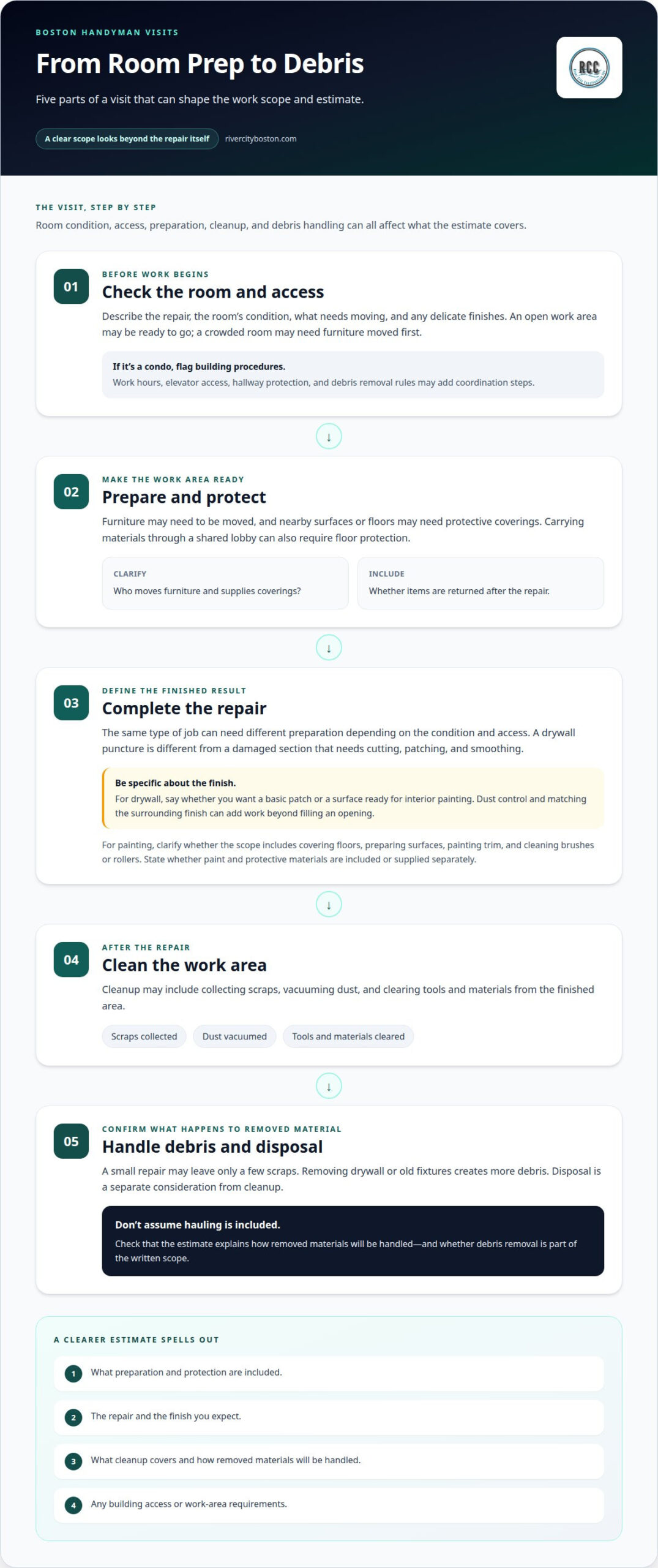
A handyman visit can involve more than the repair. In Boston, an estimate may account for preparing the work area, protecting nearby surfaces, cleaning up, and handling debris. Replacing a damaged section of drywall, for example, can involve moving furniture, covering floors, removing loose material, and clearing dust. Each step takes time and can affect the scope.
Preparation starts with access. Furniture may need to be moved from a crowded room, while an open area may be ready for work. When requesting an estimate, describe what needs moving and point out delicate finishes. The written scope should clarify whether the handyman moves furniture, supplies protective coverings, and returns items after the repair. These details distinguish repair labor from room preparation.
Cleanup may include collecting scraps, vacuuming dust, and clearing tools and materials from the finished area. Disposal is a separate consideration. A small repair may produce only a few scraps, while removing drywall or old fixtures creates more debris. The estimate should explain what cleanup includes and how removed materials will be handled. Don’t assume hauling is included unless the scope says so.
Condo association rules can add coordination steps, even when a repair is inside one unit. A building may have requirements for work hours, elevator access, hallway protection, or debris removal. Before scheduling, identify the applicable procedures and share them with the handyman. Carrying materials through a shared lobby, for example, may require additional floor protection. Building access and work-area restrictions can affect preparation time and the estimate.
Interior painting estimates depend on the room’s condition and the preparation required. A room with peeling paint or nail holes, or one where furniture needs moving, requires different preparation than a clear room with smooth walls. Clarify whether the scope includes covering floors, preparing surfaces, painting trim, and cleaning brushes or rollers. The estimate should also state whether paint and protective materials are included or supplied separately.
Drywall patching follows a similar sequence. A small puncture requires different preparation from a damaged section that needs cutting, patching, smoothing, and cleanup. Dust control and matching the surrounding finish can add work beyond filling the opening. Specify whether you want a basic patch or a surface ready for interior painting. That distinction helps keep estimates focused on the same finished result.
For a project estimate, describe the repair, room condition, access, and cleanup expectations in one request. The price depends on the project’s scope, preparation, materials, and disposal needs, and is provided after a quote request. Request a project quote with those details to help shape a clear estimate.
Minimum service, trip, and mileage fees
Even a short repair can involve a minimum charge or a separate travel fee. In Boston, the fee structure matters alongside the time spent on the work.
Visit Minimums and Trip Fees
These charges may cover dispatch, travel, and time reserved for the appointment, rather than repair labor alone. Review each estimate line by line. A trip fee and a minimum may both apply, or one may be included in the other.
Ask what each charge covers and whether it is credited toward completed work. For example, a service call may cover the visit, while installation labor is listed separately.
Minimum Handyman Charges
A minimum sets the lowest billable amount, even if a drywall patch or fixture adjustment takes little time. It is not necessarily an extra charge on top of hourly labor. The estimate should show whether the minimum replaces hourly billing or is added to travel charges.
Different definitions can explain the gap: one figure may describe a labor minimum, while another means a minimum charge for the full visit. Ask how the minimum applies to your repair. If several small tasks fit into one visit, have each included in the written scope before work begins.
Mileage charges may depend on travel distance and service area. There is no single Boston mileage amount that applies to every estimate. Check whether travel is charged as a flat trip fee, calculated by mileage, or included in the minimum. A longer drive to a home outside the central area may affect the total differently from a nearby appointment.
Electrical work, painting, fixture installation, and drywall patching can involve different preparation and labor. A small painting touch-up may fit within a visit minimum, while several rooms require a broader estimate. Massachusetts requires licensed tradespeople for electrical work. Describe the job clearly so the estimate distinguishes handyman tasks from work that requires a licensed trade.
To understand the final charge, compare the estimate’s labor, trip, mileage, and minimum terms. A brief fixture adjustment, for example, could still meet the visit minimum, while a longer installation may be billed by time. Grouping suitable repairs can make one appointment more useful, but the written scope should list each task and identify any separate travel charge.
Average handyman hourly rate in Boston
A Boston hourly average is a starting point, not a prediction of your final bill. The total depends on the repair, time required, visit terms, and whether the pricing is hourly or task-based. Adjusting a ceiling fixture and completing several repairs around a home can produce different estimates, even if both use an hourly labor rate. Compare the scopes, not just the headline rates.
Hourly pricing can be easier to interpret when a repair may involve additional steps. A handyman repairing a loose shelf, for example, might find that its anchors no longer hold. Replacing them adds work beyond tightening the original screws. Ask whether the estimate covers diagnosis, repair, and cleanup. A clear description shows what the hourly figure includes.
Flat pricing works differently. A task such as hanging shelves may have a set estimate based on the number of shelves, wall type, and installation needs. That estimate is not directly comparable to an hourly rate. One quote may include setup and cleanup, while another lists labor separately. Compare the scope before deciding which estimate offers better value.
Handyman tasks can also be grouped into one visit. A homeowner might have a sticking door, loose shelves, and a small drywall repair. Because these tasks may require different tools and amounts of time, the combined estimate should list each item. Grouping repairs helps define the visit, but it does not mean every task takes equal time or requires the same labor.
The average handyman hourly rate in Boston cannot tell you whether a particular estimate suits your repair. The condition of the work, access, materials, preparation, and cleanup all matter. A shelf in an open room is different from one above a stairwell. Ceiling work may also require extra setup to protect the room and position tools.
Use the same method to compare estimates. First, list each repair and the finished result you expect. Next, separate labor from materials, travel, and minimum charges. Then compare estimates describing the same tasks and conditions. Two faucet-repair quotes are not comparable if one includes replacement materials and the other covers labor only.
For Massachusetts homeowners, the pricing method should fit how predictable the job is. A well-defined repair may be easier to price as a task, while troubleshooting can take an uncertain amount of time. Ask how additional work will be handled if the first repair reveals another issue. This helps prevent a small repair from expanding into a broader scope without a clear explanation.
Use a local average to frame questions about an estimate, not as a promised price. The useful comparison is the complete scope: what work will be done, which materials are included, and how additional time is handled. This gives you a more practical basis for planning than the hourly figure alone.
What is the typical hourly rate range for handymen in Boston?
An hourly range is useful only when you know what the estimate covers. Adjusting a loose shelf may be straightforward, while a ceiling repair can require setup, surface protection, and cleanup. These tasks involve different amounts of labor, so comparing hourly quotes alone won’t show which estimate best fits the work.
Read the work description alongside the rate. Does it cover troubleshooting, installation, and finishing, or only the hands-on repair? A door that sticks because of a simple alignment issue is different from one with damaged hardware. The visible symptom may sound similar, but the repair steps and time required can change the estimate.
Pricing may be hourly or based on the task. Hourly billing tracks labor time and may suit repairs with uncertain conditions. A defined task may be estimated as a complete job. Compare estimates only after matching the scope, materials, and visit terms. Otherwise, a lower hourly figure may not represent the same finished work.
Consider a homeowner who needs shelves secured and a small wall repair. The estimate should describe each task, including preparation and cleanup. If the shelf needs new anchors, that work should be specified. If the wall needs additional finishing, state the expected result. Specific descriptions help explain why labor estimates differ.
Homes in Boston also vary in layout and access. Work in an open room may be easier to reach than a repair above a stairwell or inside a crowded closet. An estimate may reflect the setup required to reach the area and protect nearby surfaces. Share clear photos and describe access so the scope reflects the actual conditions.
Before choosing an estimate, compare these details:
- The repair tasks and expected finished result.
- Whether labor includes setup, protection, and cleanup.
- Whether materials and replacement parts are included.
- How additional work is described and approved.
- Whether travel or a visit minimum appears separately.
These details help you interpret an hourly range without treating it as a fixed total. Two estimates for ceiling work, for example, may differ because one includes surface protection and cleanup while the other covers labor only. The full scope, not the hourly figure by itself, shows what you are comparing.
If your repair list grows into a larger home project, separate routine fixes from renovation work. That helps keep the estimate focused on the right scope and outcome.
River City Construction: Handyman Service
River City Construction Inc offers Handyman Service to help homeowners address repairs around the home. If you have several smaller fixes in mind, describe each task and the result you want so the work can be clearly scoped.
For a larger update, Kitchen Remodeling, Bathroom Remodeling, or Basement Remodeling may be a better fit. A loose cabinet door is a handyman task; a full kitchen redesign calls for a broader remodeling scope. Choosing the right scale keeps the plan focused on what your home needs.
Describe the repairs or remodeling goals you have in mind, then contact River City Construction Inc to discuss the next step.
Plan your next home project with confidence
Use your repair list to decide what needs attention first and whether the work is a standalone fix or part of a broader update. The handyman hourly rate in Boston can help frame your planning, but first define the result you want. Note which room needs work, what is not functioning as it should, and what you would like the finished space to do better.
River City Construction Inc offers Handyman Service for home repairs, along with Kitchen Remodeling, Bathroom Remodeling, and Basement Remodeling. If several issues relate to one room’s layout or condition, a remodeling conversation may be more useful than treating each repair separately. If the work is limited to individual fixes, keep the task list focused and describe each item clearly.
Bring your priorities together before moving ahead. A clear description of the space and the changes you are considering gives the conversation a practical starting point. Whether you need a repair or are considering a room update, River City Construction Inc can help you discuss the right next step for your home.
Frequently Asked Questions
What affects how much you can charge as a handyman?
Your rate depends on the difficulty of the work, time involved, experience, and operating costs. Installing a straightforward shelf differs from troubleshooting a repair with hidden damage. Travel, tools, materials handling, and cleanup can also affect what you charge. Set the rate according to the actual scope, then explain whether it covers labor alone or includes other work. Clear terms help homeowners understand the bill.
Are materials included?
Materials may be included in a task estimate or listed separately, depending on how the work is priced. A faucet replacement, for example, could involve labor plus the faucet and any needed supplies. Check whether the estimate names the materials, who purchases them, and how returns or unused items are handled. Boston-area handymen may apply a 10% to 30% markup over retail prices for materials they source.
Is it worth it to hire a handyman?
Hiring a handyman can make sense when a repair requires tools, experience, or several coordinated steps you would rather not handle yourself. A homeowner with loose hardware, a damaged wall, and a sticking door may value having those tasks handled during one planned visit. For work that requires a licensed trade, use the appropriate licensed professional. Consider the scope, expected result, and time you would otherwise spend.
Want a real number for your list?
That figure describes an overall hiring cost, not an hourly rate or a promised bill for a specific repair. Keep it separate from task estimates when planning. A short repair, several combined tasks, and a larger home project can each have a different total based on scope and visit terms.
What is the average handyman hourly rate in Boston, MA in 2026?
Treat it as a point of comparison, then consider the specific task, pricing method, and included work. A complex repair and a simple adjustment may fall at different points within that range.
Do Boston handymen charge a minimum fee, trip charge, or service-call fee?
These charges may appear on separate estimate lines, or one charge may include the other. Check how they apply before comparing totals. A brief adjustment, for instance, could still meet a minimum even if the hands-on repair takes little time.
How much do Boston handymen charge for common small repairs and home projects?
Boston estimates vary by task and job conditions. Examples include hanging shelves, faucet replacement, drywall patching, ceiling-fan installation, TV mounting, and door repair. Compare the completed scope: a small patch may need finishing, while a fixture installation can involve existing conditions and setup. Check whether each estimate includes materials, preparation, and cleanup so you are comparing similar work.
What factors affect handyman hourly rates in Boston, such as job complexity and experience?
Rates depend on the repair’s complexity, the handyman’s experience, access to the work area, and the time required. Replacing an accessible fixture differs from diagnosing a problem behind a wall. A crowded room, difficult setup, or extra repair steps can also change the labor involved. Compare estimates that describe the same result, not just the hourly amount or the job’s short title.