
Picture a Boston kitchen renovation where new storage and better lighting make daily life easier, while the original trim and floors still feel at home. That balance is what many homeowners want, and it’s why choosing historic home renovation contractors Boston homeowners can communicate with matters. Older houses can hold surprises, and a plan that overlooks existing details may leave the finished space feeling out of place.
It’s reasonable to want modern comfort without losing the character that drew you to your home. Bring both goals into the renovation conversation from the start, alongside a clear scope and a plan for coordinating the work.
This guide explains how to plan a Boston historic home renovation, protect features worth keeping, and assess a contractor’s approach to your goals and the home’s existing details. It covers practical decisions for kitchens, bathrooms, and basements, plus ways to make the project scope easier to understand when questions about an older home arise. River City Construction Inc works on residential remodeling projects in Boston and nearby communities, including Winchester, Medford, Somerville, Cambridge, Belmont, Lexington, Concord, Wellesley, Newton, Wayland, and Natick.
Key Takeaways
- Decide which original features to retain, repair, adapt, or replace based on their condition and your renovation goals.
- Assess historic home renovation contractors Boston by how clearly they understand your priorities, define the project scope, and explain coordination.
- Look at relevant residential renovation examples to understand how a contractor approaches existing details, not just broad claims about experience.
- Plan in stages: document your goals, assess existing conditions, define the scope, verify applicable reviews, and prepare for the work.
- Connect modern updates, such as a brighter kitchen, to the home’s existing character through thoughtful planning and clear communication.
Why a Historic Home Renovation in Boston Needs a Different Plan
A homeowner may picture a brighter kitchen but worry that new cabinets or lighting will make the original trim feel like an afterthought. The goal isn’t to freeze the house in time. It’s to improve how the rooms work while understanding which existing features shape their character and how the home is put together.
A historic home renovation updates a house while taking its existing character and construction into account. The room’s layout, original details, materials, and household routines all affect what makes sense. A clear plan connects these considerations to design choices and project scope before construction begins, when a change can affect other parts of the work.
Historic renovation planning starts with the house itself; a standard room refresh can often start with the new look. For homeowners comparing historic home renovation contractors Boston, that distinction matters. A thoughtful plan connects desired improvements to the specific home rather than relying on a one-size-fits-all approach.
What makes Boston’s older homes distinct?
Back Bay, Beacon Hill, and the South End are familiar examples of Boston’s historic-home setting, but a neighborhood name doesn’t tell you exactly what’s inside an individual house. Details, layouts, finishes, and materials vary by property. One homeowner may want to retain original trim, while another may need to work around a room arrangement that affects storage or lighting.
Those details influence practical decisions. The location of existing walls and openings, for example, may affect how a kitchen connects to the rest of the home. A property’s designation and the proposed work can also affect which reviews may apply. The Boston Landmarks Commission page offers background on the city agency and its preservation role. Verify current requirements for the specific property and proposed work through the relevant official source.
Preserving character while improving everyday comfort
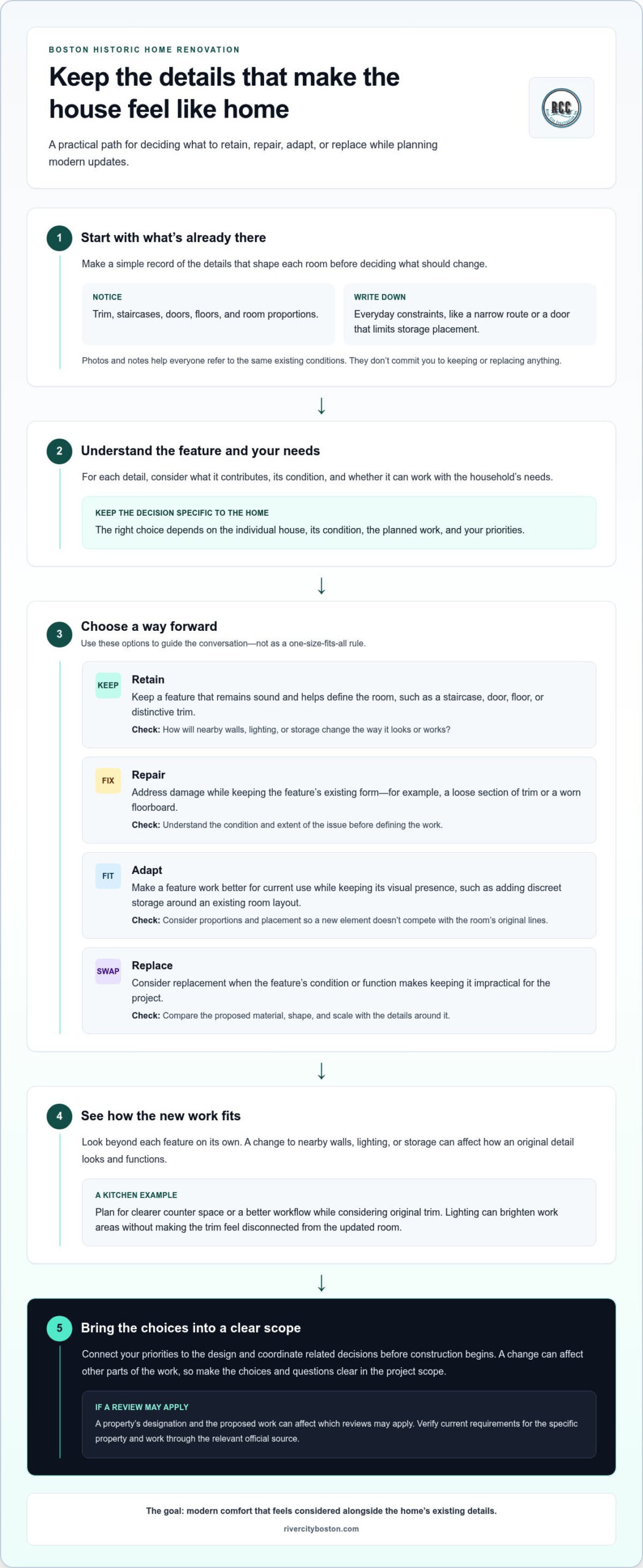
Preserving character doesn’t mean keeping every room exactly as it is. It means identifying which details help define the home, then considering how to improve comfort around them. A homeowner might want clearer counter space and a better kitchen workflow while retaining original trim. Lighting can be planned to brighten work areas without making the trim feel visually disconnected from the updated room.
Each choice should respond to the individual home and the people who live there. A solution that suits one kitchen may not suit another, even on the same street. A clearly defined scope helps connect the homeowner’s priorities to the design and coordinate related decisions. For a kitchen update, River City Construction’s Boston kitchen remodeling work can address practical goals such as improving how the space functions while considering the existing home.
How to Balance Original Details With Modern Home Needs
Preserving a home’s character doesn’t mean treating every old feature as untouchable. Consider what each detail contributes, what condition it’s in, and whether it can work with the household’s needs. The comparison below can help homeowners and their remodeling team discuss options before choices become part of the project scope.
| Approach | When it may fit | Project-specific caution |
|---|---|---|
| Retain | Keep a feature that remains sound and helps define the room, such as a staircase, door, floor, or distinctive trim. | Consider how new work will meet it. Changes to nearby walls, lighting, or storage can alter how the feature looks and functions. |
| Repair | Address damage while keeping the feature’s existing form, such as fixing a loose section of trim or a worn floorboard. | Understand the condition and extent of the issue before deciding what work belongs in the scope. |
| Adapt | Make a feature work better for current use while keeping its visual presence, such as adding discreet storage around an existing room layout. | Check proportions and placement. A new element can feel crowded if it competes with the room’s original lines. |
| Replace | Consider replacement when a feature’s condition or function makes retaining it impractical for the project. | Compare the proposed material, shape, and scale with the surrounding details before settling on a choice. |
This table is a discussion aid, not a universal rule for historic materials. A feature that seems easy to retain may need closer assessment, while another may be less defining than it first appears. The right decision depends on the home, its condition, the planned work, and the homeowner’s priorities.
Which original features shape the renovation plan?
Start by documenting visible details such as trim, staircases, doors, floors, and room proportions. Photos and notes help everyone refer to the same conditions during design and scope discussions. They also make everyday constraints easier to explain, such as a narrow route between the kitchen and dining area or a door that limits storage placement. Documentation doesn’t commit you to preserving or replacing everything. It gives the conversation a useful starting point.
Where can modern updates fit?
Modern comfort can come from practical changes: task lighting where meals are prepared, storage that keeps counters clear, a bathroom layout that better serves the household, or a smoother kitchen workflow. In a kitchen update, Boston kitchen remodeling decisions can be considered alongside the room’s proportions and surrounding finishes, so improved function feels connected to the home.
Material, scale, and placement all affect whether a new feature feels cohesive. A large storage unit may overwhelm a compact room; carefully placed lighting may improve visibility without drawing attention away from existing details. If you’re weighing these choices, a conversation about your renovation goals can help clarify priorities and the scope of a Boston-area remodeling project.
How to Evaluate Historic Home Renovation Contractors in Boston
A polished portfolio can catch your eye, but it doesn’t show how a contractor will approach your particular home. To assess fit, look at four things: understanding of your goals, clarity about the agreed work, project coordination, and communication as decisions come up. These criteria turn a broad impression into a practical conversation about your plans.
For historic home renovation contractors Boston homeowners are considering, relevant residential examples can be more useful than sweeping claims alone. A kitchen or bathroom project may not match your house exactly, but it can show how a team handles homeowner priorities, existing conditions, and connected decisions. Discuss how that experience relates to your plans without assuming every older home presents the same challenges.
A good project fit means your goals are understood, the agreed work is clear, the moving parts are coordinated, and communication stays straightforward.
Questions that reveal how a contractor approaches the home
Start with the house and the work you want done. If you’re updating a kitchen while keeping a doorway or trim detail, for example, the agreed work should account for both the functional improvement and the existing feature. Discuss what’s included, what decisions remain, and how those decisions affect the work. A written description of the agreed work can help align expectations, though its format can vary.
Ask about the sequence, too: which choices need to happen first, when your input will be needed, and how related tasks will be coordinated. These conversations show whether the project is being considered as a whole rather than as disconnected upgrades. River City Construction brings this homeowner-goal and planning focus to its Boston-area residential remodeling work.
Why project coordination matters in an older home
Design choices, material selections, skilled labor, and the schedules of other workers or trades all connect. A decision about a doorway, for instance, may affect nearby finishes or the order in which work can proceed. Coordination gives the team and homeowner a shared understanding of those connections. It can’t ensure every condition will be visible in advance or that plans will never need to change.
Keep a simple record of selections, approvals, and open questions. A note confirming the chosen finish or summarizing a planning discussion can prevent people from relying on different assumptions as work moves forward. Homeowners should understand what’s been decided, what remains open, and how a change may affect related work. That steady exchange supports a more organized renovation without promising a surprise-free process.
Planning a Historic Renovation in Boston: Scope, Reviews, and Next Steps
A little preparation can make early renovation conversations more useful. Before deciding what to change, gather your goals, learn what’s already in the home, and check whether the property’s location or official historic status affects the review process. Boston requirements can depend on the property and proposed work, so verify current details with the relevant official city or state source.
Use this sequence to organize your planning:
- Document your goals. Note which rooms are involved, what isn’t working for your household, and what you hope will improve. Include features you’d like to retain, such as a particular doorway or floor.
- Assess existing conditions. Take photographs and write down visible concerns or questions. A closer look at the specific home can help identify what needs further discussion before you decide which work to include.
- Define the project work. Describe what you want done, the results you’re hoping for, and decisions that are still open. A clear description connects your priorities to the work and how it will be coordinated.
- Verify reviews. Check whether the property’s location, official historic status, and proposed work bring an official review into consideration. Research the Boston Landmarks Commission or Massachusetts Historical Commission where relevant, and confirm current requirements through the appropriate official source.
- Plan the work. Once the project details and review considerations are clearer, discuss the order of tasks, material choices, and coordination so everyone understands what needs to happen and which decisions come first.
This order is a planning aid, not a guarantee that every condition will be visible at the outset. Older homes can raise questions as work is considered, so leave room in the conversation to address new information and how it may affect the planned work.
What to prepare before deciding which work to include
Make a simple list of household priorities, rooms affected, existing features you hope to retain, and improvements you want to make. Photos can show details that are hard to describe, while brief notes explain why they matter. For example, a picture of a tight passage beside a kitchen can help frame a discussion about storage and movement through the space.
A closer look at the specific home helps turn those observations into useful planning questions. It gives the homeowner and project team a clearer starting point for discussing the house, the proposed work, and what still needs to be understood.
How location-specific review can affect planning
Official historic status and review processes aren’t identical for every Boston property. Don’t assume a neighboring home follows the same process. Verify current requirements through the relevant official city or state source, including the Boston Landmarks Commission or Massachusetts Historical Commission when applicable.
Keep official review considerations distinct from the contractor’s plans for the work, scheduling, and construction coordination. Those planning conversations help organize the project, but they don’t replace checking the requirements that apply to the property. These questions can also help you assess historic home renovation contractors Boston homeowners are considering by how clearly they explain the planned work and next steps.
For a Boston-area renovation, including projects in Winchester, Medford, Somerville, Cambridge, Belmont, Lexington, Concord, Wellesley, Newton, Wayland, and Natick, start with the home’s specific needs and the work you want to accomplish.
Discuss Your Boston Home Renovation With River City Construction
After you’ve identified what matters in your home and started outlining the work, the next step is a clear conversation about what you want to accomplish. River City Construction Inc is a Greater Boston residential general contractor offering kitchen, bathroom, and basement remodeling. The company plans each project around its scope, coordination, and the homeowner’s goals rather than treating every house as if it needs the same updates.
That distinction matters in an older home. You may want a more functional kitchen while keeping a feature that gives the room its character, or a bathroom that better supports your household. A focused discussion can connect those priorities to practical remodeling work and clarify what needs consideration as the scope takes shape. If you’re comparing historic home renovation contractors Boston homeowners may work with, look for a conversation grounded in your actual home and requested improvements, not broad promises alone.
Connecting historic-home priorities with residential remodeling
A kitchen, bathroom, or basement project starts with how you want the space to work. You might need more usable storage and a smoother kitchen workflow while hoping to retain existing details. Those priorities can guide the remodeling discussion: what the work needs to accomplish, which parts of the home deserve careful consideration, and how related decisions will be coordinated. River City’s Boston kitchen remodeling work connects practical room updates with homeowner goals.
River City is a general contractor with residential remodeling experience. That helps keep the conversation focused on your home, the rooms involved, and the renovation work you’re considering, without assuming that every older house needs the same approach.
What to bring to an initial project conversation
You don’t need a finished plan to begin. A few useful details can make the discussion more concrete and help shape next steps around your home and priorities:
- The home’s location and the rooms you hope to update.
- Your main goals, such as improving storage, comfort, or how rooms function together.
- Features you hope to retain, with photographs that show their condition and surroundings.
- Questions about scope, the order of decisions, and how project coordination will work.
These details give the team a starting point, not a fixed design. As the home and requested work are discussed, project details can be shaped around what you want to achieve. Clear expectations about the scope and coordination help everyone stay focused on the same goals as planning moves forward.
Start With One Clear Renovation Priority
A renovation can feel easier to approach when you begin with one room and one practical goal. Before the first project conversation, write down what you want that space to do better, which details matter to you, and what questions are still open. That gives you a useful starting point without requiring every design decision to be settled in advance.
As you assess historic home renovation contractors Boston homeowners may consider, focus on whether the conversation helps turn those priorities into a clear, manageable scope. River City Construction works with homeowners on residential renovation projects and offers free quote requests. Requesting a quote can be a first step toward discussing the work you have in mind and how it aligns with your home and goals.
You don’t need a perfect plan to begin. A few notes, photographs, and an honest description of what isn’t working can help make the next discussion more productive.
With thoughtful planning and clear communication, you can move toward a home that feels more comfortable while still feeling like yours.
Frequently Asked Questions
Is renovating a historic home in Boston more complicated than renovating a newer home?
It can involve more questions, but the level of complexity depends on the home and the planned work. Existing materials, past alterations, and the condition of areas behind finished surfaces can all affect decisions. A property’s location or designation may also influence which reviews to research. For homeowners considering historic home renovation contractors Boston, a property-specific assessment is more useful than assuming every older house will present the same challenges.
Can I modernize a historic Boston home without losing its character?
Yes. Modern updates can support daily routines while keeping details that give the home its distinctive feel. For example, a household may want better task lighting for evening meal preparation without making a decorative ceiling feature the focus of the new design. Consider how new finishes, fixtures, and storage relate to the room’s scale and existing materials, then decide what best serves both the home and the people living in it.
Are all older homes in Boston considered historic properties?
No. A home’s age alone doesn’t establish that it has a formal historic designation. Properties can differ in whether they’re recognized individually or fall within a designated area, and relevant review considerations may differ too. If you’re unsure about a specific home, look up its status through the appropriate official Boston or Massachusetts source. That check can help you understand what questions to resolve before finalizing plans for exterior or interior work.
Does historic home renovation always mean replacing old windows and materials?
No. Replacement isn’t automatic. The right choice depends on a feature’s condition, how it functions, the renovation goals, and any relevant property-specific review. For windows, for instance, the discussion might begin with their current condition and what the homeowner wants to improve, rather than assuming replacement is the only path. Considering repair, adaptation, and replacement as separate possibilities helps keep decisions grounded in the individual project.
How can I plan for unexpected conditions in an older Boston home?
Leave room in your planning for questions that can’t be answered until the home is assessed more closely. Make a note of visible concerns, gather any useful records of past repairs, and discuss how new information could affect the scope and next decisions. Avoid treating an early estimate of the work as a promise that concealed conditions won’t arise. A clear process for recording changes and communicating their effects can help keep expectations aligned.
What should I share with a contractor before discussing a historic home renovation?
Share how you use the affected rooms and what you’d like to change in everyday terms. Mention household routines, features you’re concerned about, and any known past repairs that may help explain the home’s current condition. Photos can show details that are easy to miss in conversation. For a project in Boston, Winchester, Medford, Somerville, Cambridge, Belmont, Lexington, Concord, Wellesley, Newton, Wayland, or Natick, include the property’s location when discussing next steps.
