
The lowest bid on your spreadsheet might actually be the most expensive mistake you ever make. When you’re comparing general contractor quotes Boston homeowners often find themselves staring at three wildly different numbers for the exact same kitchen or bathroom project. It’s frustrating to feel like you’re trying to solve a puzzle where the pieces don’t fit. You want a fair price, but you also want the peace of mind that your home is in capable hands.
We understand that transparency is the foundation of any successful renovation. In this guide, we’ll show you how to decode complex construction jargon and identify the hidden costs that often lurk beneath a budget price tag. You’ll learn how to normalize different bid formats to ensure you’re comparing apples to apples. By the end, you’ll have the tools to choose a partner who values integrity as much as craftsmanship, keeping your Boston remodel on schedule and within your planned investment.
Key Takeaways
- Understand why a true “apples-to-apples” comparison requires looking beyond the bottom line to the specific scope of work and materials included.
- Master the process of comparing general contractor quotes Boston by identifying essential line items like “General Conditions” that separate professional builders from amateurs.
- Learn to spot red flags, such as bids significantly lower than the market average, which often signal hidden costs or incomplete project planning.
- Evaluate a contractor’s communication style and project roadmap as these are the most reliable predictors of your renovation’s success.
- Discover why a detailed, transparent quote is the first step in protecting your investment and ensuring high-quality results in competitive local markets.
Why Contractor Quotes in Boston are Rarely “Apples-to-Apples”
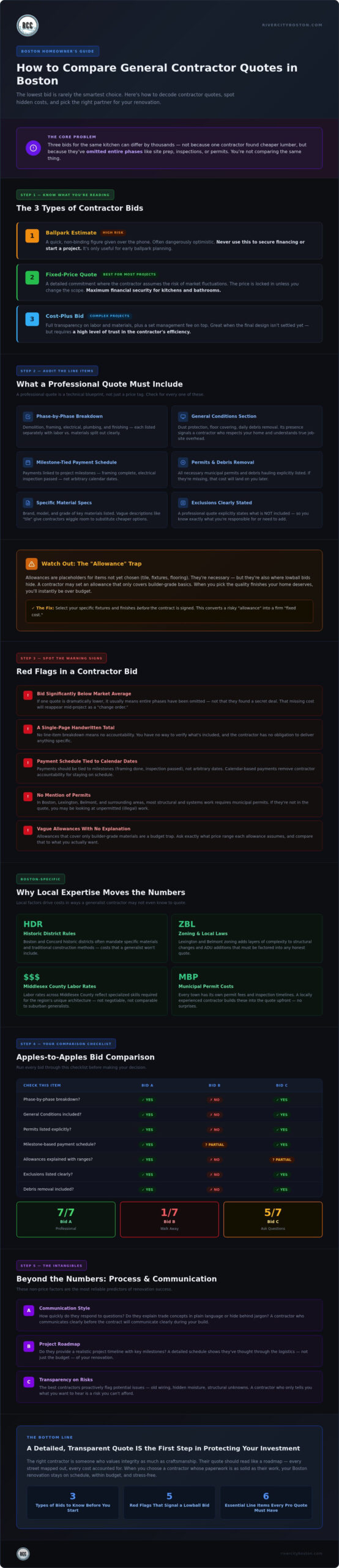
Receiving three different prices for the same kitchen remodel can feel like reading three different languages. One contractor might provide a single page with a handwritten total, while another presents a twenty-page binder detailing every screw and sealant. When you’re comparing general contractor quotes Boston homeowners must look past the final number to see what’s actually included. In residential construction, an “apples-to-apples” comparison means ensuring every bid covers the exact same scope of work, material quality, and administrative overhead. If one quote is significantly lower, it’s rarely because they found a cheaper source for lumber; it’s usually because they’ve omitted essential phases like site preparation or final inspections.
The lowest bid often creates a false sense of savings by pushing costs down the road. This lack of transparency leads to the “hidden costs” that cause so much anxiety during a build. A professional quote acts as a roadmap. If the roadmap is missing entire streets, you’ll inevitably get lost mid-project. Detailed bids reflect a contractor’s diligence and their respect for your financial boundaries.
The Three Main Types of Bids You Will See
The “Ballpark Estimate” is a quick, non-binding figure often given during an initial phone call. While it’s helpful for early planning, it’s often dangerously optimistic and should never be used to secure financing or start a project. A “Fixed-Price Quote” is a detailed commitment where the contractor assumes the risk of market fluctuations. This provides the most financial security for your bathroom renovation because the price is locked in unless you change the scope. Finally, the “Cost-Plus Bid” offers total transparency on labor and materials with a set management fee added on top. This model works well for complex projects where the final design isn’t fully settled, though it requires a high level of trust in the contractor’s efficiency.
Why Local Expertise Changes the Numbers
Local geography and history dictate more of your budget than you might expect. Historic district requirements in Boston or Concord often mandate specific materials or traditional construction methods that a generalist might overlook. Similarly, zoning laws and local regulations in Lexington or Belmont can add layers of complexity to structural changes or ADU additions. Labor rates across Middlesex County also vary, reflecting the specialized skills required for our region’s unique architecture. A comprehensive quote is one that explicitly includes the costs of debris removal and all necessary municipal permits.
Breaking Down the Line Items: What Should Be in a Professional Quote?
A professional quote is much more than a price tag; it’s a technical blueprint of your project’s financial health. When you’re comparing general contractor quotes Boston residents should look for a granular breakdown that separates labor from materials. A comprehensive document will typically organize costs into logical phases: demolition, framing, electrical, plumbing, and finishing. For instance, a kitchen remodeler Boston homeowners rely on will detail everything from cabinet installation to the specific plumbing rough-ins required for a new island sink.
Beyond the obvious construction phases, look for a section titled “General Conditions.” This includes critical site management tasks like dust protection, floor covering, and daily debris removal. While these might seem like small details, their presence in a quote indicates a contractor who respects your home and understands the true overhead of a clean, safe job site. Additionally, your quote should feature a payment schedule tied strictly to project milestones, such as the completion of framing or a passed electrical inspection, rather than arbitrary calendar dates.
The Truth About “Allowances”
Allowances are financial placeholders for items that haven’t been selected yet, such as tile, light fixtures, or hardwood flooring. They’re necessary in the early stages, but they can also be a hiding place for “lowball” bids. If a contractor provides an allowance that only covers the cost of basic, builder-grade materials, you’ll face an immediate budget deficit when you choose the high-quality finishes your home deserves. To protect your budget, try to select your specific fixtures and finishes before the final contract is signed. This turns an “allowance” into a “fixed cost,” removing the risk of mid-project price hikes.
Exclusions: What the Contractor ISN’T Doing
It might seem counterintuitive, but a clearly defined list of exclusions is a sign of a trustworthy partner. Common exclusions often include permit fees, final interior painting, or repairs for unforeseen structural rot found behind old walls. By listing these items, the contractor is being honest about where their responsibility ends and where potential extra costs might begin. Always ask for a written “Change Order” policy upfront. This ensures that if an exclusion becomes a necessary repair, the process for approving the new work and its cost is documented and transparent. If you’re ready to move from a rough estimate to a detailed roadmap, you can schedule a collaborative planning session with our team today.
Red Flags: How to Spot a “Lowball” Bid in the Boston Market
A bid that comes in 20% lower than the competition isn’t a bargain; it’s a warning. In the Boston market, labor and material costs remain relatively consistent for reputable firms. When comparing general contractor quotes Boston homeowners often find that a drastically lower price usually stems from a contractor who hasn’t fully grasped the project’s complexity or is planning to cut corners. Choosing the lowest number can jeopardize your long-term home value and remodeling ROI. It’s often better to pay for a realistic estimate upfront than to deal with expensive corrections later.
Consider a homeowner in Newton who recently accepted a basement finishing bid that was thousands below the average. The contractor initially seemed efficient but soon began requesting additional payments for items that should’ve been included. Eventually, the contractor stopped showing up, leaving the family with exposed wiring and an unfinished space. This scenario is common when a bid lacks the financial cushion necessary to handle the realities of Boston’s older housing stock. You should also verify that the contractor holds a valid Massachusetts Home Improvement Contractor (HIC) registration. This isn’t just a formality; it provides you with access to the Guaranty Fund if the project fails to meet legal standards.
Vague Descriptions and Missing Details
If a quote uses broad phrases like “Update Bathroom” instead of specific specifications like “Install Kohler K-706000 shower door,” you’re entering a dangerous zone. Vague language allows a contractor to swap high-quality materials for inferior alternatives later on. This lack of precision often leads to “he-said-she-said” arguments that stall progress and sour the partnership. A detailed quote is the best insurance against project delays and quality disputes.
Insurance and Licensing Shortcuts
Verify that your contractor carries both General Liability and Workers’ Compensation insurance. General Liability covers damage to your property, while Workers’ Comp protects you from being held liable if a worker is injured on your site. Don’t fall into the “Homeowner Option” trap for permits. If a contractor asks you to pull the permit yourself, they’re likely unlicensed or trying to avoid accountability for their work. In Greater Boston, you should also ask how they vet their subcontractors to ensure every person on your property meets the same high standards of integrity and skill.
Beyond the Numbers: Evaluating Process and Communication
Remodeling your home isn’t just a financial transaction; it’s a months-long relationship with a team of professionals. When you’re comparing general contractor quotes Boston families should treat the document as a preview of the working relationship. A sloppy, rushed quote suggests a sloppy, rushed construction process. The level of detail provided in the initial bid usually mirrors the level of attention your home will receive during the actual build. If a contractor takes the time to explain the “why” behind their pricing, they’ll likely take the time to explain the “why” during a complex structural change.
For complex projects like ADU construction, the administrative burden is high. Ask who your daily point of contact will be. A dedicated project manager ensures that your questions don’t go unanswered while the lead contractor is busy managing materials or other sites. If possible, ask to visit an active job site. Seeing how a team maintains organization and cleanliness in a neighbor’s home tells you more than any brochure ever could. It demonstrates a level of discipline that will eventually be applied to your own property.
The “Vibe Check”: Do You Trust This Person?
Punctuality is the first test of professional standards. If a contractor didn’t show up on time for the initial walkthrough, they likely won’t show up on time for the plumbing rough-in. Consider how well they listened to your specific goals for a bathroom service. Did they offer solutions to your specific layout challenges, or did they push a one-size-fits-all plan? Pay attention to their response time for follow-up questions. A contractor who is too busy to clarify a quote is usually too busy to manage your project properly once the contract is signed.
Reviewing the Timeline
A professional quote must include realistic start and completion dates. While it’s tempting to hire someone who says they can start tomorrow, this is often a red flag in the Boston market. High-quality, reputable contractors are usually booked several weeks or months in advance. You must also account for the seasonal rhythm of New England. Massachusetts winter weather can significantly delay outdoor projects like decks or foundations. A trustworthy builder will build these seasonal buffers into your timeline rather than promising an impossible finish date just to win the job.
Finalizing Your Choice: Why the Right Fit Matters More Than Price
Choosing the right partner for your home transformation is a decision that extends far beyond the bottom line on a spreadsheet. When you’re comparing general contractor quotes Boston, it’s common to find that the middle-ground or higher-priced bids offer the most long-term security. These figures usually account for the high-quality materials and skilled labor necessary to ensure your kitchen remodel stands the test of time. In the competitive Boston real estate market, professional craftsmanship isn’t just an expense; it’s a strategic move to protect and increase your property’s resale value.
Your home is your sanctuary. A remodel should enhance your daily comfort rather than becoming a source of chronic stress. By selecting a contractor who prioritizes transparency and meticulous planning—a standard also exemplified by high-end firms like Ethicore—you’re investing in your own peace of mind. Before you sign any document, ensure you have a final checklist in hand. Verify that the contract includes a clear scope of work, a definitive payment schedule, and proof of current insurance. This final layer of diligence ensures that your vision is protected from the first day of demolition to the final walkthrough.
The Value of a Local Partner
Working with a neighborly firm like River City Construction Inc provides a level of accountability that distant corporate entities simply cannot match. We live and work in the same communities as our clients, which means our reputation is built on every successful project. Our established relationships with local building inspectors in Somerville and Cambridge help streamline the permit process and ensure every phase of construction meets rigorous municipal standards. If you’re ready for a partnership built on honesty and expertise, you can request a transparent, detailed quote from River City Construction Inc today.
Preparing for Your Kickoff
Once you’ve signed your quote, the transition from planning to production begins. Your contractor should provide a clear roadmap for the first week, detailing when crews will arrive and how they’ll protect your living space. To prepare for the first day of demolition, clear out all personal items from the work zone and establish a temporary “kitchen” or “bathroom” area if necessary. It’s also vital to maintain a contingency fund, typically 10% of the total project cost. This isn’t for expected items, but rather for the “known unknowns” that can hide behind the walls of historic Boston homes. Having this buffer ready ensures that even if a surprise arises, your project stays on track without financial strain.
Building Your Future with Confidence
A successful renovation is more than just a completed list of tasks; it’s the realization of a long-held vision for your home. Now that you’ve mastered the art of comparing general contractor quotes Boston, you can move forward with the clarity needed to avoid the common pitfalls of regional remodeling. You’ve learned how to look beyond surface-level numbers to find a partner who values transparency and technical precision. This knowledge serves as your best defense against project delays and budget overruns.
River City Construction Inc specializes in high-stakes residential remodeling across Greater Boston. Our team understands that a fixed-price contract and expert navigation of local permits are essential for your peace of mind. We approach every kitchen, bathroom, and ADU project with the diligence of a seasoned expert and the accountability of a neighbor. We’re dedicated to ensuring your investment results in a space that offers both structural durability and aesthetic longevity.
Your home is your most significant investment, and choosing the right team is the first step in protecting its future. We look forward to helping you create a space that you and your family will cherish for decades.
Frequently Asked Questions
How many quotes should I get for a home remodel in Boston?
Most experts recommend obtaining three detailed bids for your project. This number provides a balanced perspective on local labor costs and material pricing without becoming overwhelming. Comparing general contractor quotes Boston professionals submit allows you to identify a clear market average. If one bid is significantly higher or lower than the others, it serves as a prompt to ask more specific questions about their included scope of work.
Why is there such a huge price difference between contractor bids?
Price gaps usually reflect differences in material quality assumptions, labor expertise, and company overhead. One contractor might assume you want high-end custom cabinetry while another quotes basic builder-grade options. Additionally, a firm with a dedicated project manager and robust insurance will have higher costs than a solo operator. These differences aren’t just about the price tag; they represent the level of service and protection you’ll receive.
What is a “Fixed-Price” contract and is it better than “Cost-Plus”?
A Fixed-Price contract sets a total cost for a specific scope of work, while Cost-Plus bills for actual expenses plus a management fee. Fixed-Price is generally better for homeowners who want budget certainty and want to avoid mid-project surprises. It places the risk of material price fluctuations on the contractor. Cost-Plus offers more flexibility for complex designs that aren’t fully finalized, but it requires much closer financial monitoring.
Should I always choose the contractor with the most detailed quote?
A detailed quote is a strong indicator of a contractor’s professionalism and attention to detail. When a bid lists specific model numbers, material quantities, and project phases, it leaves very little room for “he-said-she-said” arguments later. This precision protects your budget from the hidden costs that often lurk in vague, one-page estimates. A thorough quote shows that the builder has truly visualized the entire construction process.
Do I need to pay for a contractor quote in Massachusetts?
While basic ballpark estimates are often free, many high-end firms charge a fee for a comprehensive, line-item quote. This fee covers the hours of technical work and subcontractor coordination required to create an accurate roadmap. In the competitive landscape of comparing general contractor quotes Boston homeowners find that paying for a professional planning session often results in a more reliable price that prevents expensive change orders once construction begins.
What happens if the contractor finds something unexpected during the remodel?
Unexpected issues like structural rot or outdated plumbing are handled through a formal change order. In older Boston homes, these discoveries are common once walls are opened. A professional contractor will pause work to show you the problem and provide a written estimate for the repair. You should always maintain a 10% contingency fund to cover these moments, ensuring the project continues moving forward without financial stress.
How do I verify a contractor’s insurance in the Boston area?
Ask the contractor to have their insurance agent send a Certificate of Insurance (COI) directly to your email. This certificate should show active General Liability and Workers’ Compensation coverage. Don’t rely on a paper copy provided by the contractor, as it could be outdated. Verifying the coverage directly with the insurance agency ensures that you are fully protected against property damage or worker injuries during the renovation.
Can I negotiate a contractor’s quote if it’s over my budget?
It’s better to negotiate the project scope rather than the price itself. If a quote is too high, ask the contractor for suggestions on alternative materials or different construction methods that could lower the cost. Simply asking for a discount on the same work often forces a contractor to cut corners or rush the labor. A collaborative approach allows you to maintain quality while bringing the investment in line with your budget.
