
Imagine walking down into your Winchester basement, stepping over dusty boxes and dodging a low-hanging pipe, only to realize you’re standing in 800 square feet of untapped equity. Most homeowners in the Greater Boston area know their basement is the final frontier of their property. However, the fear of hidden moisture behind those old New England foundations or the confusion over strict local building codes often keeps the basement door locked. You’re likely trying to pin down the actual cost to finish a basement in Massachusetts before you commit to a major renovation.
It’s completely normal to feel a bit of anxiety about whether a contractor truly understands our local safety regulations or if they’ll hit you with surprise fees halfway through. At River City Construction Inc, we believe a basement remodel should be a partnership built on transparency. This guide provides a clear look at the investment required for your project. We’ll explore budget ranges based on finish levels, explain the latest 2026 energy codes, and show you how to turn that damp storage area into a functional space that significantly boosts your home’s resale value.
Key Takeaways
- Learn the current cost to finish a basement in Massachusetts and why local factors like the 2026 Stretch Code influence your total investment.
- Identify the invisible costs of your project, from high-quality insulation to the moisture management systems needed for older New England foundations.
- Understand the strict safety requirements for legal bedrooms, including the specific egress exits that Massachusetts building codes demand for every finished space.
- Compare the return on investment for a basement transformation against other major home improvements like kitchen or bathroom remodels.
- Find out how a local partnership can help you navigate the permit maze in Greater Boston towns like Newton, Lexington, and Winchester.
The Realities of Basement Finishing Costs in Massachusetts for 2026
Before we look at the numbers, let’s clarify what we mean by “finishing.” Many homeowners use the terms interchangeably, but there’s a distinct difference between a simple update and a full conversion. What is a Finished Basement? At its core, finishing means taking a raw, concrete space and transforming it into a safe, code-compliant living area. Remodeling, however, usually involves changing an existing finished space. In our region, finishing is the most common request because so many historic New England homes have untouched “dungeons” just waiting for a purpose.
Massachusetts is a unique market for construction. We face a combination of strict energy regulations, such as the 2026 Stretch Code, and a highly competitive labor market that keeps skilled trades in high demand. These factors mean the cost to finish a basement in Massachusetts is higher than the national average. However, adding 800 square feet of living space below ground is almost always a smarter financial move than building a traditional home addition. It’s faster, less disruptive to your daily life, and utilizes the footprint you already own without sacrificing your backyard.
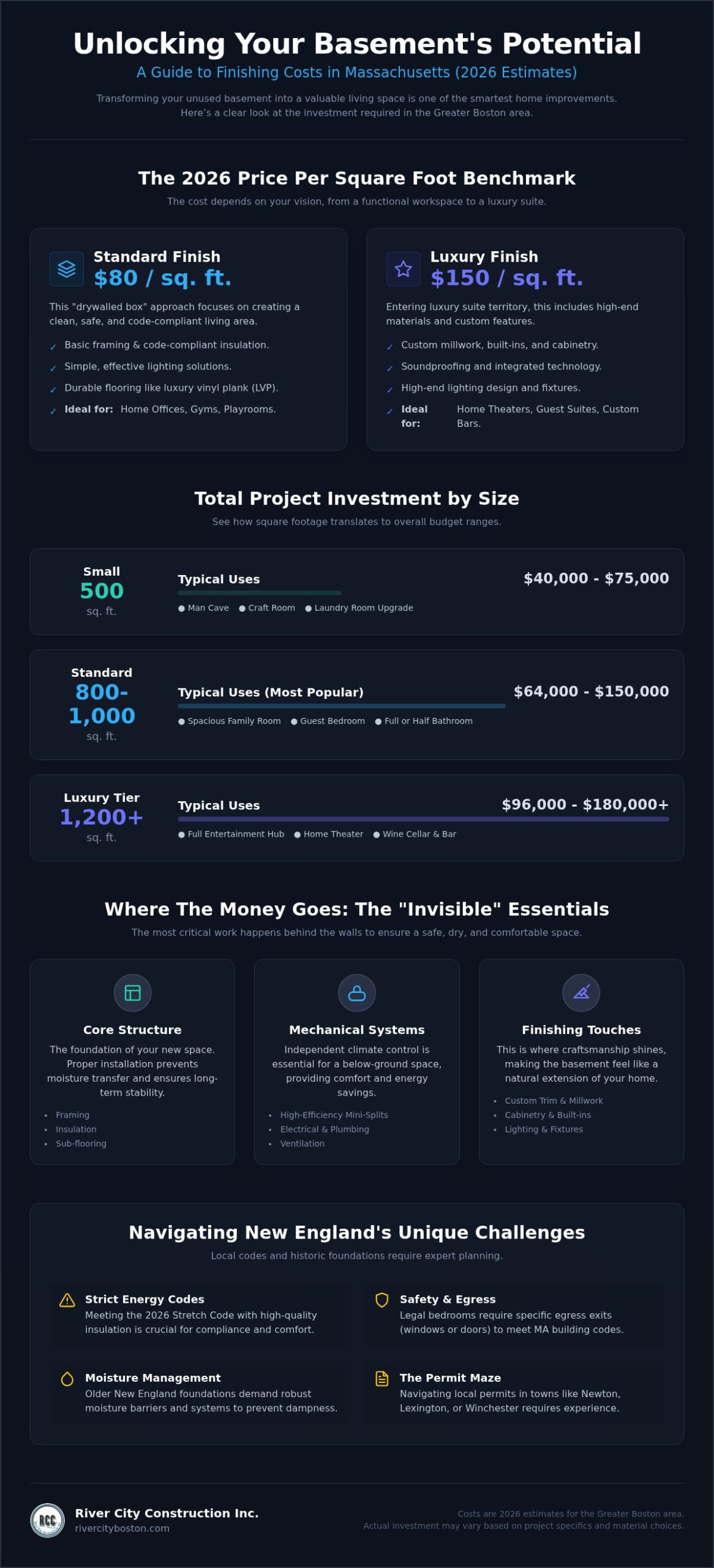
In 2026, the average cost to finish a basement in Massachusetts typically ranges from $80 to $150 per square foot depending on the complexity of the design and the quality of finishes selected.
The 2026 Price Per Square Foot Benchmark
The $80 to $150 range covers a wide spectrum of quality and intent. At the lower end, you’re looking at a “drywalled box” approach. This includes basic framing, insulation that meets current energy codes, simple lighting, and durable flooring like luxury vinyl plank. It’s a great choice for a home office or a gym. As you move toward the $150 mark, you’re entering luxury living suite territory. This often includes custom millwork, soundproofing, high-end lighting, and integrated technology. Your specific town also matters; working in a tight urban environment like Cambridge often costs more than a project in Wayland because of parking constraints and more complex permitting processes.
Total Project Estimates for Common Basement Sizes
To give you a better sense of the total investment, here are some common project sizes we see at River City Construction Inc:
- Small (500 sq. ft.): Ideal for a focused “man cave,” a dedicated craft room, or a modern laundry room upgrade.
- Standard (800-1,000 sq. ft.): This is our most popular size, often including a spacious family room, a guest bedroom, and a full or half bathroom.
- Luxury Tier (1,200+ sq. ft.): These projects transform the entire footprint into an entertainment hub, often featuring home theaters, climate-controlled wine cellars, and full custom bars.
Massachusetts Basement Budget Breakdown: Where the Money Goes
Understanding the cost to finish a basement in Massachusetts starts with realizing that the most important work happens behind the walls. Many homeowners focus on the paint colors and the bar top, but the foundation of your budget lies in the “invisible” components. Because we’re in New England, our foundations are often cold and prone to moisture. Using the right materials isn’t just about comfort; it’s about following Massachusetts building codes to ensure your new living space is safe and legal. These core elements include:
- Framing: The skeleton of your new rooms, which must be installed with proper gaps to prevent moisture transfer.
- Insulation: Crucial for meeting 2026 energy standards and keeping the space cozy during a Nor’easter.
- Sub-flooring: A vital barrier that protects your finished floors from the natural dampness of concrete.
Mechanical systems are another significant line item. You can’t simply vent your upstairs HVAC into the basement and call it a day. In 2026, many homeowners opt for high-efficiency mini-split systems. These provide independent climate control, which is essential for a space that sits below the frost line. While it adds to the initial cost to finish a basement in Massachusetts, the long-term energy savings and comfort make it a worthwhile investment. Finally, the finishing touches like custom trim and cabinetry are where the “Master Craftsman” quality shows, ensuring the space feels like a natural extension of your home rather than an afterthought.
Labor vs. Material Splits in 2026
In the Greater Boston area, labor typically accounts for 60% to 70% of your total budget. Towns like Wellesley and Newton have high standards for licensed trades, and skilled plumbers or electricians command a premium because of their specialized local expertise. On the material side, we’ve seen a massive shift toward moisture-resistant products. Luxury Vinyl Plank (LVP) has become the gold standard for Massachusetts basements. It offers the look of high-end hardwood but provides the durability needed for below-grade environments where traditional wood might warp.
The Value of Professional Design-Build
Choosing a design-build approach with River City Construction Inc means your project is planned to the last detail before a single hammer swings. Professional planning prevents expensive “change orders” that often plague cheaper, vague quotes from a local handyman. A permitted, engineered remodel ensures your home’s structural integrity remains intact and your investment is protected. If you’re dreaming of adding a basement bar or a small kitchenette, you might find inspiration in our River City kitchen remodeling guide, which covers the same high standards we apply to basement cabinetry and layouts.
Our fixed-price contracts provide the peace of mind you need when making a significant investment in your property. You’ll know exactly where your money is going, from the initial permits to the final walkthrough. If you’re ready to start planning your transformation, you can reach out for a detailed quote from our team.
Navigating the Hidden Hurdles of Old New England Basements
Old New England homes possess incredible character, but their foundations often tell a story of centuries-old moisture and shifting soil. When you look at the cost to finish a basement in Massachusetts, you have to account for these hidden variables. We once worked with a family in Winchester who dreamed of a simple guest suite. After removing the existing wood paneling, we discovered a foundation crack that had been slowly weeping for years. What started as a cosmetic remodel became a structural rescue. While it felt like a hurdle at the time, addressing it correctly ensured their new living space wouldn’t be ruined by mold or rot two years later. Having a partner who identifies these issues early is the difference between a successful project and a costly mistake.
The Cost of Waterproofing and French Drains
Moisture is the primary budget-killer in local basements. You should never finish a space that has active dampness or seasonal flooding. In many cases, a simple sump pump isn’t enough to protect your investment. Older foundations in towns like Somerville or Medford often require a full interior drainage system, commonly known as a French drain. This involves cutting into the perimeter of the concrete floor to channel water away before it ever touches your new drywall. While the 2025 Cost vs. Value Report shows that New Englanders see great returns on their homes, those gains only happen if the basement remains bone-dry. Pre-remodel prep work for a 100-year-old foundation can be intensive, but it’s the only way to build with confidence.
Meeting Massachusetts Egress Codes
Safety is a non-negotiable part of the cost to finish a basement in Massachusetts. If you plan to include a legal bedroom, state law requires a dedicated egress window or door. This isn’t just a suggestion; it’s a vital fire safety measure that allows for an emergency exit. Local inspectors in towns like Belmont and Concord are particularly strict about these requirements. Installing an egress window involves excavating a portion of your yard and cutting through your concrete foundation. It’s a heavy-duty task that requires precision to maintain the home’s structural integrity, but it’s what transforms a “finished cellar” into a true, high-value living area.
Low ceilings and bulky ductwork are the final hurdles. In many older homes, the main HVAC trunk lines sit right in the middle of the room. A master craftsman doesn’t just box these in with ugly soffits. We use creative solutions like rerouting pipes or using recessed lighting to maintain as much vertical space as possible. This attention to detail ensures your basement feels like a natural part of your home rather than a cramped underground room.
Maximizing ROI: Is a Finished Basement Worth the Investment?
When you evaluate the cost to finish a basement in Massachusetts, it’s essential to look beyond the initial invoice and consider the long-term equity. In the competitive Greater Boston real estate market, a finished basement isn’t just a luxury; it’s a strategic asset. While a high-end kitchen or bathroom remodel might offer a higher percentage of cost recovery, a basement transformation provides a significant increase in total square footage for your dollar. In Middlesex County, appraisers value below-grade space differently than main-level rooms, yet a well-executed basement can increase a home’s market value by 5% to 10%.
This investment effectively changes how your home is perceived during an appraisal. Instead of being compared only to homes with similar footprints, your property is now compared to those with finished bonus levels. This shift is particularly impactful in towns where land is scarce and expanding outward is impossible. You’ll find a deeper analysis of these market trends in our Boston ROI guide.
Basement Apartments and ADU Potential
We’ve seen a massive surge in homeowners in Somerville and Cambridge looking to turn their basements into Accessory Dwelling Units (ADUs). There’s a clear distinction in the cost to finish a basement in Massachusetts when you move from a simple family room to a legal rental unit. A legal ADU requires independent entrances, full kitchens, and separate utility meters. While the upfront cost is higher, the potential for monthly rental income can pay for the renovation itself over time. If you’re exploring this path, comparing your options with established ADU builders in Newton can help you understand the specific zoning and design requirements for a legal secondary residence.
The “Lifestyle ROI”: More Than Just Dollars
Beyond the financial spreadsheets, there’s a “lifestyle ROI” that’s hard to quantify but easy to feel. In the era of remote work, a quiet basement home office removed from the noise of the main house is invaluable. It creates a boundary between your professional and personal life that many homeowners find essential for their well-being. We also see many families creating a “Guest Oasis” to accommodate multi-generational living arrangements. Whether it’s for an aging parent or a returning college student, a well-finished basement makes a house feel like a home by providing everyone with the space and privacy they need.
The River City Advantage: Your Partner in Basement Transformation
Deciding to invest in your home is a significant emotional and financial step. You’ve researched the cost to finish a basement in Massachusetts and weighed the potential return on investment. Now, the most critical factor is choosing a partner who treats your home with the same respect as their own. At River City Construction Inc, we approach every project with the mindset of a Master Craftsman. This means we don’t just look for the quickest way to hang drywall. We look for the right way to ensure your new living space is durable, safe, and aesthetically cohesive with the rest of your property.
Our commitment to transparency is the foundation of our business. We understand the anxiety homeowners feel about contractors who overpromise and under-deliver. We provide clear, detailed estimates that eliminate the fear of hidden fees. When you work with us, you’re entering a partnership based on honest communication and high standards of integrity. We believe that a disciplined work ethic and a straightforward approach are the only ways to build lasting trust within our community.
Our Local Expertise in Greater Boston
Navigating the “red tape” of local building departments is often the most stressful part of a remodel. Every town has its own unique requirements. The permit process in Winchester or Lexington can look very different from the regulations in Medford, Somerville, or Cambridge. Because we are deeply rooted in these neighborhoods, we understand the specific local codes and egress requirements inside and out. We handle the paperwork and coordinate with inspectors so you don’t have to spend your afternoons at city hall.
Many of our basement projects involve adding essential amenities to make the space truly functional. If your vision includes a new guest suite or a convenient half-bath for your home gym, our specialized bathroom remodeling services ensure that your new plumbing meets all modern standards. We take pride in our local identity and our reputation for managing complex projects with order and clarity.
Request Your Free Basement Consultation
The journey toward a better home begins with a professional walkthrough. During your initial consultation, we’ll listen to your goals and assess the unique characteristics of your foundation and mechanical systems. We don’t believe in one-size-fits-all solutions. Instead, we help you align your creative vision with a realistic budget, ensuring that the final result is a space you’ll love for years to come. We provide the technical competence and the personal commitment needed to turn an underutilized cellar into a high-value asset.
Start your basement journey today
Ready to Unlock Your Home’s Full Potential?
Transforming your basement is about more than just adding rooms; it’s about reclaiming space you already own. We have explored how the cost to finish a basement in Massachusetts reflects the high standards of our local building codes and the unique challenges of New England foundations. By prioritizing proper moisture management and safety requirements like egress windows, you ensure your investment adds genuine value to your property. A well-planned project doesn’t just increase your square footage; it enhances your daily lifestyle.
River City Construction Inc is here to guide you through this process with the expertise of a seasoned neighbor. We specialize in historic renovations and modern basement conversions throughout Greater Boston, including towns like Winchester, Newton, and Lexington. Our design-build approach focuses on transparency and technical excellence, so you can move forward with complete confidence in your project’s success. Your home is likely your most significant asset, and it’s our duty to help you make every square foot of it count.
We look forward to partnering with you to create a beautiful, functional space that your family will enjoy for decades to come.
Frequently Asked Questions
How much does it cost to finish a 1,000 sq. ft. basement in Massachusetts?
Finishing a 1,000 square foot basement in Massachusetts involves an investment that varies based on your choice of materials. For a mid-range project with drywall and durable flooring, the cost to finish a basement in Massachusetts for this size often falls between $40,000 and $60,000. High-end features like custom bars can push budgets for larger spaces over $100,000. This investment covers the specialized labor and moisture-resistant materials required for our unique New England climate.
Do I need a permit to finish my basement in Boston or Somerville?
You absolutely need a building permit to finish a basement in Boston, Somerville, or any other Massachusetts municipality. Local building departments require these permits to ensure the project meets strict fire safety and structural standards. Separate permits are also necessary for any electrical or plumbing work. At River City Construction Inc, we handle this administrative “red tape” for our clients. This process usually takes two to four weeks depending on the specific town’s current workload.
Does a finished basement count toward my home’s official square footage?
A finished basement generally does not count toward your home’s official “Above Grade Finished Area” in a standard appraisal. However, it is included in the “Total Finished Area,” which significantly impacts your market value. In Middlesex County, appraisers recognize the utility of this space even if it sits below the frost line. A high-quality renovation can increase your property’s market value by 5% to 10%, making it a strategic move for long-term equity.
What is the cheapest way to finish a basement floor in a damp climate?
Luxury Vinyl Plank (LVP) is often the most cost-effective and practical solution for basement floors in our damp coastal climate. While painted concrete is technically cheaper, it doesn’t provide the warmth or aesthetic appeal most homeowners want. LVP is completely waterproof and handles the natural moisture of a concrete slab without warping or molding. It provides a durable, attractive finish that mimics hardwood while standing up to the specific humidity challenges found in Greater Boston homes.
How long does a typical basement finishing project take in the Boston area?
A standard basement finishing project in the Boston area typically takes between six and ten weeks to complete. This timeline includes everything from the initial framing and rough-ins to the final trim work and painting. If you are planning a full in-law apartment conversion with a kitchen and full bath, the schedule usually extends to 10 or 14 weeks. Factors like permit approval times and the availability of specialized local trades can also influence the total duration.
Can I finish my basement if I have an older home with a low ceiling?
You can certainly finish a basement with low ceilings, but we must carefully navigate the Massachusetts building code requirements for minimum head height. Most towns require a finished height of at least seven feet, though exceptions are often made for localized obstructions like beams or ductwork. We use creative design strategies, such as rerouting pipes or using recessed lighting, to maximize every inch of vertical space. This ensures the room feels open and comfortable despite the older foundation.
What is the ROI on a basement remodel in Massachusetts?
The average return on investment for a finished basement in Massachusetts is currently between 70% and 75%. This is a strong figure for our region, where “found space” is highly valued. Beyond the financial ROI, the cost to finish a basement in Massachusetts pays off through improved daily function. You’re gaining an office or guest suite for a much lower cost per square foot compared to building a traditional home addition.
Is it worth adding a bathroom to my basement remodel?
Adding a bathroom is almost always worth the investment because it transforms a simple room into a true living suite. While a bathroom rough-in can add between $4,000 and $9,000 to your budget, the convenience and added resale value are substantial. A basement without a bathroom often feels disconnected from the rest of the home. Including one ensures the space is fully functional for guests or long-term residents, significantly boosting your home’s overall appeal.
