
Picture a Boston homeowner deciding whether to turn a basement into a separate living space for family or future renters. The idea may seem like a clear way to add value, but the ADU property value increase Boston homeowners can expect depends on more than adding a new unit. The property’s layout, the ADU’s intended use, and local requirements all shape the decision.
It’s reasonable to ask whether a potential resale benefit will justify the construction expense. An ADU may provide useful living space and potential income, but no project comes with a guaranteed return. Rules can also differ between Boston and nearby communities, so understanding the requirements for the property’s municipality is an important early step.
This guide explains what can influence an ADU’s usefulness and buyer appeal, and how family or rental use may fit your plans. You’ll also find ways to compare an ADU with other home improvements and assess your property before committing. River City Construction Inc provides ADU design-build solutions for Greater Boston homeowners, connecting project goals with the existing home and site.
Key Takeaways
- An ADU property value increase Boston homeowners may see depends on how well the unit fits the property, its intended use, and its appeal to potential buyers.
- Compare family, guest, and potential rental uses by considering privacy, access, and how comfortably the unit connects with the main home.
- Weigh an ADU against kitchen, bathroom, and other improvements based on usable space, household benefits, disruption, and uncertainty about resale value.
- Before building, define your goal, assess the property, review local requirements, compare alternatives, and separate confirmed details from assumptions.
- A property-specific design-build plan can bring your long-term needs and the home’s practical limits into the same decision.
How an ADU Could Affect Your Boston Home’s Property Value
Would adding a separate living space to your Boston home mean more usable room, a higher resale value, or both? An accessory dwelling unit (ADU) is a separate living space associated with a primary residence. It may be created within or added to a home. Its effect on value depends on how well the finished space fits the property and how useful it is to current or future occupants.
ADU value potential means a well-planned, usable living space may strengthen a property’s appeal. It does not promise a specific resale gain or financial return. That distinction matters before you commit. A finished unit can meet a real household need even when its eventual effect on a sale price is difficult to predict.
What homeowners mean by an ADU property value increase
“Value” can mean different things. One homeowner may focus on the price a buyer might pay; another may care more about having a private space for an aging parent or adult child. Rental use may offer another potential benefit, but rent is not automatic. It depends on whether the unit can be used that way, the local market, and the details of the property.
An appraiser and a prospective buyer may view the same ADU differently. An appraiser estimates value using property details and relevant market information. A buyer may give more weight to the unit’s layout, privacy, condition, or usefulness for their own plans. Added space, household benefits, possible rental income, and estimated resale value are related, but they are not interchangeable.
Why Boston-area property context matters
Start with the home itself. A basement with a workable layout presents different possibilities from a tight lot with limited access. The condition of the existing house, how the new space connects with it, and whether the intended use is for family, guests, or a possible rental all affect the project’s practicality and appeal.
Homes in Boston and nearby communities can have different property conditions and local requirements. Rules may affect whether a proposed ADU is feasible, so review current City of Boston guidance or the relevant municipality’s official information before relying on assumptions. For a different kind of property-specific improvement, explore kitchen remodeling in Boston.
Any ADU property value increase Boston homeowners hope to realize should be weighed against these practical details, not treated as a guaranteed outcome. Begin by asking whether the proposed unit fits the home and solves a real need. Then consider how that fit may matter to future buyers or occupants.
Which ADU Design and Use Factors Can Shape Value in Boston?
An ADU is more likely to feel like a lasting asset when it works well for the people who use it. A practical layout, comfortable privacy, convenient access, and a sensible connection to the main home make the space more useful. Those features may also shape how a future buyer views the property, but they can’t guarantee a higher sale price.
How intended use influences an ADU’s appeal
Begin with the person who will use the space. A parent moving closer to family may need a private entrance and room for everyday routines. A guest space may be used only occasionally, while a separate household may need more independence and a layout suited to daily life. Rental use is another possibility, but demand and income depend on circumstances and shouldn’t be assumed.
Consider a homeowner whose adult child may live at home now, while a future owner might use the ADU for a relative or guests. A flexible arrangement could serve both needs more comfortably than a design built around one narrow purpose. Adaptability does not guarantee greater resale value, since buyer preferences vary by property and neighborhood.
How layout and connection to the home affect buyer perception
Think through the everyday path between the two living spaces. Can each occupant enter without disrupting the other? Is there enough privacy for separate routines? Does the ADU receive natural light, and does its layout make ordinary tasks straightforward? These details can matter more to daily usefulness than simply adding floor area.
Material choices and exterior design also affect how an addition sits alongside the existing home. A coherent appearance can help the ADU feel like a considered part of the property, while durable construction supports dependable use over time. Neither is an automatic value multiplier, but both can contribute to a finished space that feels cared for rather than tacked on.
Practical design turns added space into a living area people can use comfortably over time. For a Boston homeowner, that means considering the intended use alongside the existing home’s layout and the site’s constraints. Local requirements matter too. Review the City’s current Boston ADU regulations early in planning, since a design’s appeal is useful only if the project fits applicable requirements.
River City Construction Inc’s ADU design-build planning connects a homeowner’s goals with the existing property. If you’re weighing different uses or layouts, the contact page provides a way to discuss your Boston ADU project in the context of your home.
ADU vs. Other Home Improvements: How Should Boston Owners Compare Value?
A homeowner who needs a private space for a parent has a different problem from someone whose kitchen feels cramped every day. Both might consider a major renovation, but a useful comparison starts with the need, not a promise about resale. When weighing ADU property value increase Boston homeowners should consider how the project’s practical benefits and uncertainties compare with other ways to improve the home.
The table below is a starting point. Disruption and potential value vary with the home’s condition, project scope, and how well the improvement fits the property.
| Project | Usable space | Household benefit | Disruption | Value uncertainty |
|---|---|---|---|---|
| ADU | Adds separate living space | May support family, guests, or a separate household | Can involve changes beyond the main living area | Depends on property fit, intended use, and buyer priorities |
| Kitchen remodel | Improves an existing room | Can better support cooking, storage, and gathering | Work takes place in a frequently used part of the home | Depends on the home’s needs and the completed design |
| Bathroom remodel | Improves an existing room | Can make daily routines more comfortable | Work affects access to a regularly used room | Depends on the room’s condition and household priorities |
| Basement remodel | Can make existing lower-level space more usable | May add room for recreation, work, or storage | Varies with the scope and existing conditions | Depends on how useful and well-integrated the finished space is |
When an ADU may fit better than an interior remodel
An ADU may be more relevant when someone needs a distinct living area, not simply a better version of a room the household already uses. For example, a family planning for a relative to live nearby may value separation and privacy more than updated finishes. The added space still needs to work with the lot, the home, and occupants’ routines. Homeowners considering Newton can also read the ADU builders in Newton buying guide for related local context.
When a targeted remodel may be the more fitting choice
If the main issue is an awkward kitchen, a bathroom that no longer suits the household, or an underused basement, improving that space may address the problem without creating a separate dwelling. A Boston kitchen remodeling project, for instance, focuses on improving an existing room. For broader context on weighing renovations and home value, refer to the published home-value remodeling guide.
There’s no universal winner. Compare the need each project solves, the space it changes, and the uncertainty around future resale. River City Construction Inc can connect those priorities to a property-specific ADU or remodeling plan. The contact page is available for discussing your home improvement goals.
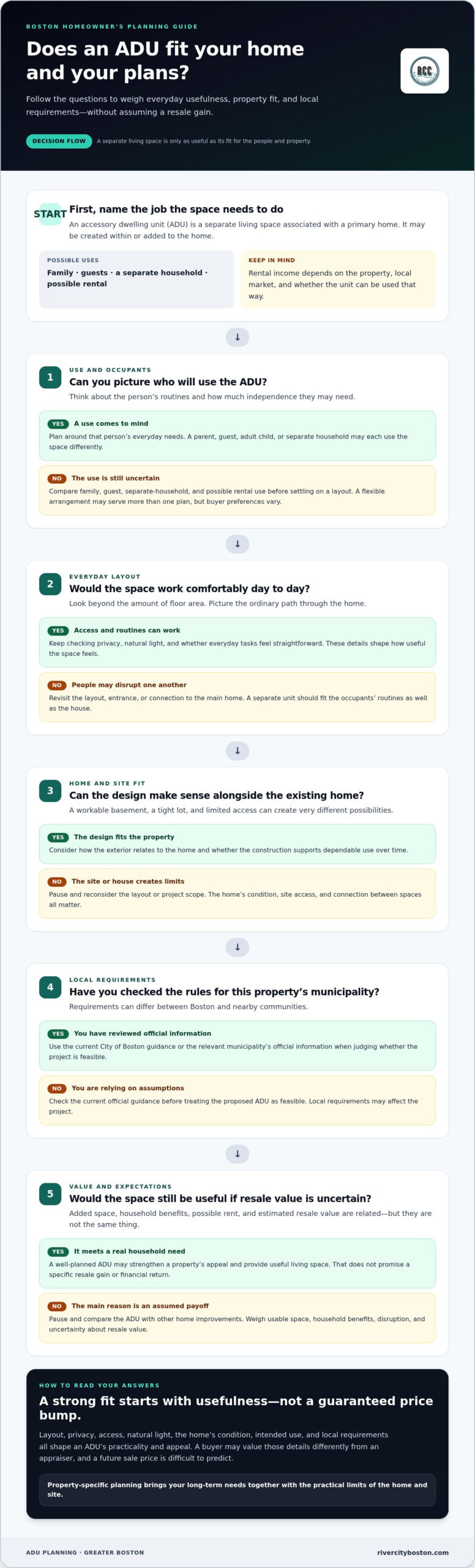
How to Evaluate an ADU’s Potential Value Before Building in Boston
A careful evaluation can help you decide whether an ADU fits your home and your plans before design decisions are set. The goal isn’t to predict an exact resale price. It’s to separate what you can assess now, such as the property’s layout and project scope, from what remains uncertain, such as future buyer interest or rental demand.
Start with the property and the household’s goals
Write down who might use the unit and what they’d need. Consider privacy, access, and how occupants would move between the ADU and the main home. Then look at the available space and the existing home’s condition. A basement, an addition, and a backyard unit raise different design questions, so avoid settling on a layout before understanding the property.
Next, compare the ADU with other priorities. If your main goal is to create an independent living area for a family member, an ADU may address that need directly. If the household is struggling with an outdated kitchen or bathroom, a targeted remodel may be a closer fit. Clarifying the goal makes it easier to weigh practical benefits alongside possible resale value.
Research local feasibility and value assumptions
Requirements depend on the property’s municipality. For a Boston address, start with the City’s current ADU guidance. For a home in another community, use that municipality’s official information. Don’t assume rules in a nearby city or town apply to your address.
Then separate established details from estimates. Record the proposed scope, known property conditions, and information you’ve confirmed. Keep future resale value and rental demand in a separate category: they’re possibilities, not facts about what your project will earn. If reliable comparable-property information is available, focus on homes genuinely similar in location and features rather than drawing conclusions about all of Greater Boston.
A qualified local real estate professional or appraiser may help you understand how an ADU could be viewed alongside comparable properties. A construction planning discussion can connect your intended use with the home’s physical conditions and project scope. Neither can guarantee a future sale price.
No single feature, including added living space, can guarantee an ADU value increase. The outcome depends on the property, the project, and how the finished space serves its occupants. That’s the practical lens for assessing ADU property value increase Boston homeowners may hope for: define the goal, review the home, check local requirements, compare alternatives, and develop a project scope before relying on a projected return.
Plan a Boston ADU Around Long-Term Use and Property Value
A sound ADU plan starts with more than a resale estimate. Think about who will use the space, how its layout can serve them, how it fits the existing home, and which local requirements apply. Market conditions may change, so treat future buyer interest or rental demand as uncertain rather than as a guaranteed return.
What a thoughtful ADU planning conversation should cover
Bring the everyday picture into the planning discussion: who might live in the unit, how much privacy they need, how they’ll enter, and how the new space should relate to the main home. Note the property’s existing conditions and your layout priorities, too. These details help shape a project scope around how the ADU needs to work, not just how much space it might add.
Design-build planning considers design and construction together. That can help connect your goals with the home’s physical conditions as the project takes shape. The right approach is specific to each property; no plan can promise a particular increase in resale value.
Choose next steps that fit your Boston-area property
Before discussing the project, gather what you know about the property and write down the questions you still have. Keep confirmed details, such as intended use and existing layout, separate from assumptions about future resale or rent. Review current requirements for the municipality where the home is located, since nearby communities may have different rules.
River City Construction Inc provides ADU design-build solutions in Boston and nearby communities, including Somerville, Cambridge, Medford, and Newton. A property-specific discussion can bring intended use, design priorities, local considerations, and project scope into one conversation. That gives you a clearer basis for deciding what to explore next, without treating an ADU property value increase Boston homeowners hope for as a certainty.
Organize your property details and goals as you consider a plan suited to your home. River City Construction Inc offers free quotes for residential renovation projects.
Make Your Next ADU Decision Property-Specific
An ADU can create useful living space, support changing household needs, and potentially influence resale appeal. But the ADU property value increase Boston homeowners may see depends on the property, the design, its intended use, and local requirements. There’s no guaranteed return.
Before moving forward, consider three questions: Will the unit serve a real need for your household? Can its layout and access work well with the existing home? Have you separated confirmed project details from assumptions about future rent or resale value? Comparing an ADU with a kitchen, bathroom, or other targeted remodel can also clarify which improvement best fits your priorities.
River City Construction Inc offers ADU design-build solutions across Greater Boston, serving Boston and nearby communities including Somerville, Cambridge, Medford, and Newton. A project discussion can bring your goals, property conditions, and design options into focus without promising a particular value outcome.
With clear priorities and a plan shaped around your home, you can make your next step with greater confidence. The right project is one that fits both the property and the life you want to build there.
Frequently Asked Questions
Can an ADU increase property value in Boston?
Yes, an ADU may add to a Boston home’s appeal and value, but the result depends on the property and the finished unit. A useful layout, privacy, condition, and fit with the home can matter to buyers. The ADU property value increase Boston homeowners may see isn’t guaranteed, and a unit’s practical benefit to a household may differ from how an appraiser or buyer assesses its resale value.
How much value does an ADU add to a Boston home?
There isn’t one reliable amount that applies to every Boston home. The effect depends on factors such as the property’s location and condition, the ADU’s design and permitted use, and how comparable properties are viewed. An appraiser or qualified local real estate professional may help assess a specific home using relevant local information. Treat any estimate as a project-specific assessment, not a guaranteed return or promise about a future sale price.
Does an ADU increase resale value more than a home renovation?
Not in every case. An ADU may address a need for separate living space, while a kitchen or bathroom remodel can improve a room the household already uses. Which project makes more sense depends on the home’s condition, the household’s priorities, and the property’s layout. Compare the practical benefit and scope of each option rather than assuming one type of improvement will always deliver a stronger resale result.
Can I rent out an ADU in Boston?
Potentially, but rental use depends on the property and applicable Boston requirements. The City’s ADU rules include an owner-occupancy requirement, and eligibility can depend on the property type and proposed unit. Don’t assume every ADU can be rented or that rental income is assured. Review current City of Boston guidance for your specific property before planning around rent as part of the project’s value.
What factors affect an ADU’s value to future buyers?
Buyers may consider whether the ADU is comfortable, functional, private, and well integrated with the main home. Access, natural light, durable construction, and a layout suited to everyday use can shape its appeal. Intended use matters, too: one buyer may value space for family, while another may prioritize guest or rental potential. Buyer preferences differ, so no single feature guarantees a particular resale benefit.
Do I need to check Boston regulations before building an ADU?
Yes. Review current requirements before settling on a design, because local rules can affect whether a project is feasible. Boston has its own ADU requirements, and nearby municipalities may have different processes. Homeowners in Boston, Winchester, Medford, Somerville, Cambridge, Belmont, Lexington, Concord, Wellesley, Newton, Wayland, and Natick should consult the official guidance for the municipality where the property is located.
