What if the best spot for your TV isn’t the wall you first had in mind? Before choosing a bracket, consider the room, the wall itself, and where power and connected devices will sit. If you’re planning a TV wall mounting service Medford project, those early decisions can make the difference between a setup that simply holds the screen and one that feels right in everyday use.
It’s reasonable to wonder whether your wall can support the TV, how visible the cables will be, and whether the viewing height will feel comfortable from the sofa. Medford homes can have different wall materials, so understanding what’s behind the finish is an important part of planning.
This guide will help you map out a practical installation plan, from choosing a location and mount style to thinking through cables and connected devices. You’ll also learn what details to prepare before arranging the work. If you’re planning a larger room update, River City Construction’s residential remodeling work can help connect the TV’s intended placement with the wider design of the space.
Key Takeaways
- Start with the room layout and viewing position so the TV feels comfortable to watch and fits the space.
- Compare fixed, tilting, and full-motion mounts by how much movement you need and where you’ll watch from.
- Consider the wall surface before settling on a mounting plan. Drywall, plaster, brick, and concrete can call for different approaches.
- For a TV wall mounting service Medford homeowners are planning, a brief with the TV details, wall photos, and cable preferences can make project conversations clearer.
- If a room renovation is also on your mind, include TV placement in the wider plan with River City Construction, a residential remodeling contractor serving Medford.
Planning a TV Wall Mounting Service in Medford, MA: Start With the Room
A comfortable viewing position and a tidy room are the goals. The right spot isn’t always the largest empty stretch of wall. Picture a family settling onto the sofa, only to find afternoon glare from a window washing out the screen. Start with how the room is used, then work out where the TV, seating, and connections can fit together. A clear plan also makes it easier to explain what you want from a TV wall mounting service Medford homeowners are arranging.
In a Medford home, the room’s layout, lighting, wall surface, and potential cable route all shape the installation plan. A setup that works in one living room may feel awkward in another, even with the same TV. Consider the features of your own room rather than relying on a generic placement rule.
What should you decide before arranging TV wall mounting?
Choose the main seat first, then picture the screen facing it. Look for windows and lamps that could create glare, furniture that might obstruct the view, and walking paths people use to cross the room. Consider whether one sofa is the main viewing area or whether people also watch from a dining space or another seat. These details help narrow down a sensible location before you focus on hardware.
What information helps describe a Medford TV mounting project?
Note the TV’s approximate size and the room where it will go. Describe the wall surface as best you can, such as drywall, plaster, brick, or concrete, and point out visible outlets and cable connections. You don’t need to identify every detail yourself. A few clear photos of the proposed wall and nearby furniture can make the project easier to discuss.
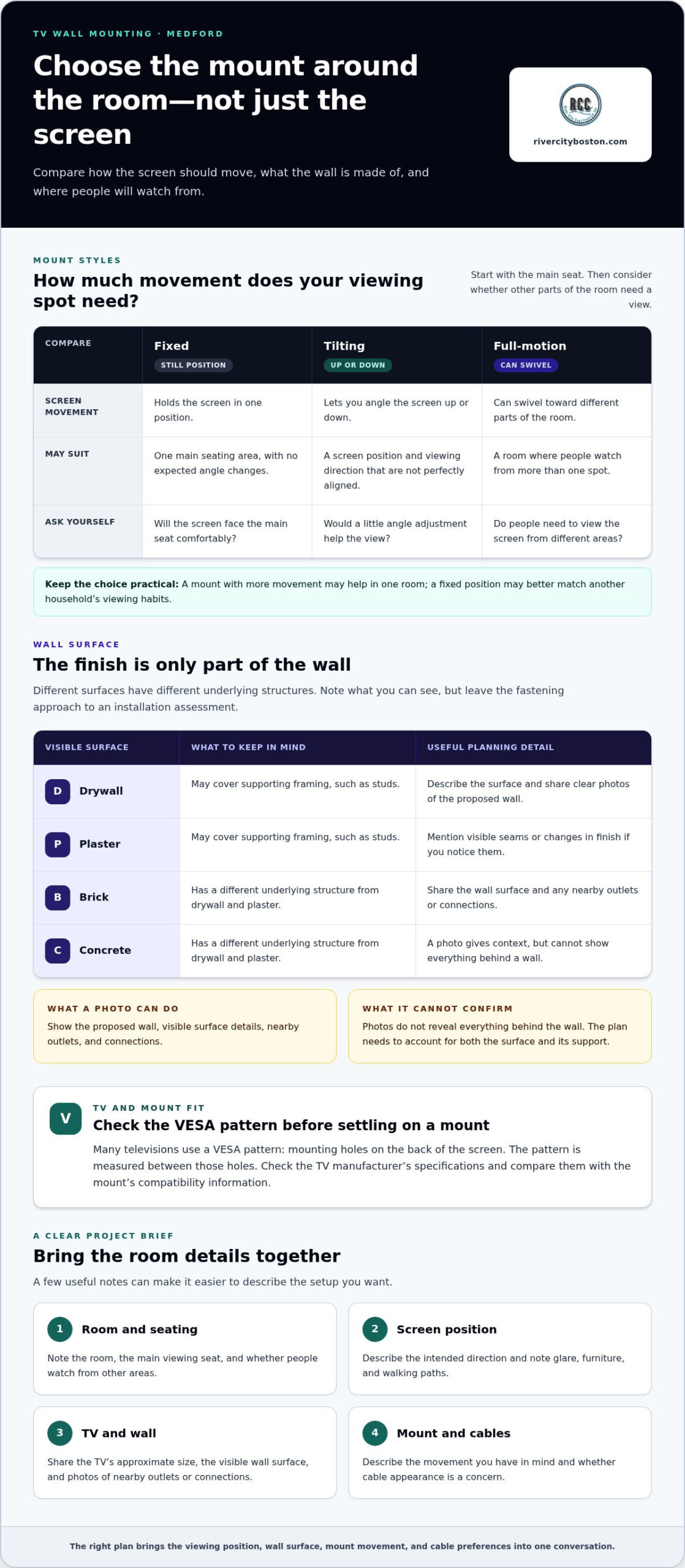
It also helps to describe how you want the screen to move. A fixed mount holds it in one position; a tilting mount angles it up or down; a full-motion mount can swivel as well. Compare these options with your seating and viewing habits. A screen facing one central sofa may not need the same movement as one watched from different parts of an open room.
- Room: Identify where you watch most often and what other areas need a view.
- Position: Mark the intended screen direction and note glare, furniture, and foot traffic.
- Wall: Describe the visible surface and photograph outlets or connections nearby.
- Preferences: Share the mount movement you have in mind and whether cable appearance is a concern.
Keep the plan practical. A neat result depends on more than placing the screen at the room’s center. It should suit the people using the space and leave everyday movement comfortable. If you’re also planning broader home updates, River City Construction serves Medford with residential remodeling, including bathroom remodeling. Considering separate improvements as part of a wider home plan can help you describe your priorities clearly.
TV Wall Mount Types and Wall Surfaces: Understand the Choices
Once you have a proposed screen location, the next decisions are connected: how the TV should move, what the wall is made of, and whether the mount fits the television. There isn’t one mount style or wall approach that suits every home. A setup for a screen viewed straight on from one sofa may not fit a room where people watch from different seats.
Which TV mount style fits your viewing position?
A fixed mount keeps the screen in one position, which can suit a room with a consistent viewing spot. A tilting design lets you angle the screen up or down, while a full-motion mount can also swivel toward different parts of the room. Think about where people sit and whether you value a steady position or the flexibility to adjust the view.
- Fixed: Consider it when the screen will face one main seating area and you don’t expect to adjust its angle.
- Tilting: It offers some angle adjustment, which may help when the screen position and viewing direction aren’t perfectly aligned.
- Full-motion: Its movement can suit a room where people watch from more than one spot.
These are planning distinctions, not a substitute for checking that the chosen mount suits your TV and wall. Before settling on a style, consider how the screen will be used day to day. A mount with more movement may be helpful in one room, while in another the simplest choice may better match the homeowner’s preferences.
How do drywall, plaster, brick, and concrete affect planning?
The visible wall surface is only part of the picture. Drywall and plaster may cover supporting framing, such as studs, while brick and concrete have a different underlying structure. Because these surfaces differ, the mounting plan needs to account for both the wall material and what supports it. Note what you can see, but leave the fastening approach to the installation assessment.
Share clear details during the discussion: the wall surface, any visible seams or changes in finish, and nearby outlets or connections. Photos can give useful context, though they don’t reveal everything behind a wall. For a TV wall mounting service Medford homeowners are planning, describing the wall accurately helps focus the conversation without assuming one fixing method works everywhere.
There’s also a fit between the TV and the mount. Many televisions use a VESA pattern, a set of mounting holes on the back of the screen. The pattern is measured between those holes. Check the TV manufacturer’s specifications and compare them with the mount’s compatibility information before choosing hardware. Don’t rely on screen size alone, since the exact pattern can vary by model.
To prepare, gather the TV model or manufacturer’s information, a description or photo of the wall, and your preferred mount movement. If the TV location is part of a broader room renovation, River City Construction can discuss the wider residential project with you. Start a conversation about your home project and how the room should work as a whole.
How to Compare TV Wall Mounting Options in Medford
A useful comparison starts with how you want the finished room to feel, not with the mount that looks most versatile. Think about how the screen will be viewed, whether visible wires would bother you, and what devices need to connect. For a TV wall mounting service Medford homeowners are considering, separating these choices makes it easier to describe the result without treating every part of the setup as one package.
What should a homeowner compare when deciding on a mount?
Match the mount’s movement to the room. A steady screen position may suit one main viewing spot, while adjustable movement can help in a room used from different seats. Then compare the TV and mount manufacturers’ compatibility details, including the VESA hole pattern described in the previous section. Also consider how the mount’s profile will look on the wall and whether its movement fits how you use the space.
Fixed mount
Movement: Holds the screen in one position.
Viewing need: A consistent seat and viewing direction.
Cable preference: Decide whether visible cables suit the room or you prefer a less noticeable route.
Tilting mount
Movement: Allows the screen to angle up or down.
Viewing need: A viewing position that may benefit from a changed screen angle.
Cable preference: Consider how cables will appear as the screen angle changes.
Full-motion mount
Movement: Allows the screen to swivel as well as adjust its angle.
Viewing need: More than one viewing position in the room.
Cable preference: Include cable movement and appearance in the plan.
How should you think about visible wires and connected devices?
Separate the physical mount choice from the finish and device preferences. One homeowner might be happy with cables neatly managed along the wall, while another may prefer a concealed look. In-wall routing depends on the home and applicable requirements, so describe the desired appearance without assuming that every wall or cable can be handled the same way.
List the equipment you expect to connect, such as a streaming device, game console, or soundbar. Note where each item might sit and whether you want it considered as part of the room layout. Mounting the screen, arranging connected devices, and deciding how cables should appear are related planning questions, but they are distinct choices. A clear brief helps keep them from being confused.
Before deciding, weigh the TV’s compatibility, the wall, the room layout, and the finish you want together. A full-motion mount may sound appealing, for example, but the room’s seating and cable plan still matter. If your TV location is one part of a larger renovation, River City Construction can discuss the broader home project. Share your home project plans as you think through how the space should work.
Prepare for TV Wall Mounting in Medford With a Clear Project Brief
A concise project brief turns a rough idea into a clear picture of what you want. You don’t need technical drawings or perfect measurements. A few practical details, plus photos of the wall and nearby connections, can make it easier to discuss the location, viewing position, and finish you have in mind. For a TV wall mounting service Medford homeowners are arranging, start with the room and build the brief one step at a time.
- Choose the room. Note where the TV will go and how the space is used. A living room used for family viewing may call for a different plan from a bedroom or shared open area.
- Document the TV. Record its approximate size and, if available, the model information. This gives the project discussion a useful reference without requiring you to know every technical detail.
- Describe the wall. Note the visible surface and take a clear photo of the proposed location. Include nearby outlets, cable connections, and devices so their positions are easy to understand.
- List your preferences. Describe the main viewing position, desired mount movement, and whether you prefer visible, neatly managed cables or a cleaner-looking arrangement.
What details belong in your TV mounting project brief?
Include the room, approximate TV size, preferred viewing position, and mount movement you’re considering. Mention features that affect placement, such as windows, a fireplace, or furniture that could limit the screen’s position. Photos should show the full wall and enough of the surrounding room to explain how people sit and move through the space. Your preferred seat matters: discuss the screen in relation to where you’ll actually watch, not just the center of an empty wall.
- Room and viewing: Identify where the TV will be and the seat or seats people use most.
- Wall and connections: Describe the visible wall surface and show nearby outlets and existing cable connections.
- Furniture and features: Note items such as a sofa, console, windows, or fireplace that influence the intended position.
- Mount and finish: State whether you’re considering a fixed, tilting, or full-motion mount, and how you want cables to look.
How can you plan cable and device preferences in advance?
Make a short list of equipment the household expects to connect, such as a streaming device, game console, or soundbar. Note where you’d like each item to sit and which connections are already nearby. Then describe your cable preference plainly: visible but tidy, or a less noticeable finish. If you’re unsure what the room allows, flag that as a planning question rather than assuming a particular route will work. The goal is to explain the desired result, not prescribe a method.
If the TV location is part of a broader room renovation, bring the placement and finish preferences into that larger project conversation.
Discuss a Medford Home Project With River City Construction
A TV’s location can affect how a room feels and functions, especially when other changes are already planned. If you’re renovating a living room, basement, or another part of your home, screen placement can be one detail in the wider layout conversation. Thinking about it alongside furniture, lighting, and wall use helps keep the room plan connected rather than treating each choice in isolation.
River City Construction Inc is a Greater Boston residential remodeling contractor serving Medford. The company handles home improvement projects, so homeowners planning a larger renovation can discuss how they want the space to function and what changes matter most. TV placement can be one part of the room-planning conversation, alongside the broader remodeling project and how the room should work as a whole.
When does TV placement belong in a larger remodeling conversation?
Bring up the screen location while the room layout is still being considered. For example, a homeowner updating a basement may want to think about where people will sit, how the room will be lit, and which walls should remain open for other uses. Raising these preferences early gives them a place in the overall plan. It also connects the intended viewing area with the room’s everyday purpose.
This kind of coordination can be useful beyond a single room. If your project involves changes to adjoining spaces, consider how people move between them and where the room’s focal points should be. The goal isn’t to make the TV the center of every decision. It’s to make sure the room’s layout, lighting, furniture plans, and wall use support the way you want to live in the space.
How can Medford homeowners start a River City project conversation?
Start with the residential remodeling work you’re considering and the goals behind it. Describe what isn’t working in the room now, what you’d like to change, and how you hope to use the space when the project is complete. If you’re also planning a bathroom renovation, you can learn more about bathroom remodeling services as part of your home improvement planning.
River City provides free quotes for its residential projects. Sharing the project scope and your priorities gives you a straightforward starting point for discussing a home renovation in Medford.
Whether you’re planning a broader room update or another residential remodeling project, describe the changes you have in mind and the result you hope to achieve. A clear conversation about the scope, layout, and priorities helps keep the project focused on your home and how you want to use it.
Put Your Room Plan Into Motion
For homeowners planning a TV wall mounting service Medford project, the next step is to turn preferences into a clear plan for the room. Think about what matters most: a comfortable place to watch, a neat finish, or a layout that works for several people. Those priorities can guide your decisions as the project takes shape.
If TV placement is part of a larger home update, consider how it fits with the rest of the renovation. A conversation about your broader project can help you set priorities and describe the changes you want to make. River City Construction offers residential remodeling and free quotes for its projects. Include the TV’s intended position in the wider room plan.
Share your goals and the changes you’re considering to start a conversation about your home project.
A thoughtful plan is a solid start toward a room that feels comfortable, useful, and truly your own.
Frequently Asked Questions
Can a TV be mounted on drywall?
Yes, a TV can be mounted on a drywall-covered wall, but the plan needs to account for the structure behind the drywall. Drywall is a finish, not necessarily the part that carries the load. A wall can look straightforward while hiding framing or other features that affect the approach. Describe the wall as best you can, and make sure the mounting plan considers the wall’s construction rather than relying on its surface alone.
What type of TV wall mount should I choose?
Choose based on how people use the room. A fixed mount can suit a TV viewed from one regular seat, while a tilting or full-motion option gives you more angle adjustment. For instance, if someone often watches from an armchair beside the sofa, swivel movement may be useful. Also consider how close the screen will sit to the wall and whether you’ll adjust it often.
How high should a TV be mounted in a living room?
Use your usual seated position as the starting point. A screen that makes you tilt your head during a full film can become uncomfortable, even if it looks well placed on an empty wall. Sit where you normally watch and picture the screen in that line of sight. Then account for furniture and how the room is used, rather than choosing a height based only on the wall’s center.
Can a TV be mounted above a fireplace?
It may be possible, but the fireplace location deserves careful thought. Consider whether the screen would feel too high from the sofa, whether the fireplace’s use could expose it to heat, and how the wall is built in that spot. A mantel or other feature can also affect placement. Weigh viewing comfort and the fireplace setting together before deciding this is the best wall for the TV.
Do TV wall mounts fit every television?
No. A mount needs to match the television’s mounting-hole pattern and compatibility requirements. Check the specifications for the exact TV model and compare them with the mount information. Screen size alone doesn’t establish a fit. For example, two TVs with the same diagonal measurement can have different mounting-hole layouts. If you’re unsure which model details matter, record the model number so the compatibility information is easier to find.
Can TV cables be hidden inside a wall?
Some cables may be routed inside a wall, but the right approach depends on the cables and the home. A standard TV power cord should not be run inside the wall; an appropriate in-wall power solution is used for that purpose. HDMI and similar cables that carry picture or sound are handled differently. If the plan involves a new outlet or electrical work, include that in the project discussion and account for applicable requirements.
What information should I have ready before arranging TV mounting in Medford, MA?
Have the TV’s make and model, approximate size, the room, and a description or photo of the proposed wall ready. Note where you usually sit, nearby furniture or windows, and which devices you expect to connect. For a TV wall mounting service Medford homeowners are planning, these details help explain the desired outcome. Clearly state Medford, Massachusetts, so the project location isn’t confused with another Medford.
River City Construction serves homeowners in Medford and throughout the Greater Boston area, including Boston, Winchester, Somerville, Cambridge, Belmont, Lexington, Concord, Wellesley, Newton, Wayland, and Natick. If your TV placement is part of a home renovation, contact River City Construction to discuss your project and request a free quote.