What if the rent that makes an ADU feel like a smart investment is only half the story? An ADU for rental income Massachusetts homeowners can count on starts with a property-specific plan, not a headline monthly figure. A backyard unit may seem straightforward until local rules, site conditions, or design choices affect what you can build and how the space will work for tenants.
Wanting rental income is a sensible reason to explore an ADU. But the state framework isn’t a permit for your specific address, and local requirements can still shape the project. Your estimate also needs to account for expenses, not just the rent you hope to collect.
This guide explains how to build a realistic rental scenario, distinguish statewide rules from local approvals, and compare long-term and short-term rental plans. You’ll also learn how layout and property conditions affect the project. River City Construction’s Design-Build process combines design, planning, budgeting, and construction under one roof, helping connect the project to its intended use from the start.
Key Takeaways
- Before planning an ADU for rental income Massachusetts homeowners should separate potential rent from questions about property feasibility and local approval.
- Build a grounded income estimate with local rental comparisons, then account for vacancy and recurring expenses.
- Compare long-term and short-term rental plans, including management needs, privacy, and expected occupancy.
- Use a feasibility checklist to distinguish whether a property can support an ADU from whether local renters are likely to want one.
- River City Construction’s Design-Build process combines design, planning, budgeting, and construction under one roof to align the ADU with its intended use and property conditions.
Can an ADU Generate Rental Income in Massachusetts? Start with the Rules
Potential rent can make an accessory dwelling unit feel like a promising investment. But before estimating monthly income, answer two questions: can an ADU be built on your property, and can it be used for the rental arrangement you have in mind? An ADU is a secondary home on the same property, with its own living facilities and entrance. It’s different from renting a bedroom in your main home. For a general overview, see Accessory Dwelling Unit (ADU).
For an ADU for rental income Massachusetts homeowners need to distinguish broad state eligibility from the steps that apply to a specific address. A statewide framework may allow certain ADUs to proceed by right, but that doesn’t settle every design, permit, site, or rental question. Statewide ADU eligibility is not confirmation that a particular design can be built on your property and rented for your intended use.
What does Massachusetts’ by-right ADU framework mean?
Mass.gov’s current ADU page describes qualifying units of no more than 900 square feet, or 50% of the primary home’s gross floor area, meaning the total floor area of that home, whichever is smaller, as allowed by right under the state framework. In plain language, “by right” means a qualifying project generally doesn’t need a special permit. It doesn’t mean all approvals disappear: building permits and compliance with applicable requirements still matter.
There’s also a timing consideration. Proposed revisions to the state ADU regulations were subject to a public-comment period that closed on October 9, 2026. That date alone doesn’t tell you whether a proposal has since been adopted or changed. Before relying on a rule, review the latest Mass.gov guidance and confirm the current status of any regulation or draft material through official sources.
What should a Massachusetts homeowner clarify before counting on rent?
Start by deciding how you want the space to be used. A long-term rental and a short-term stay can involve different expectations for occupancy, management, privacy, and household use. Massachusetts allows local municipalities to restrict or prohibit short-term rentals of 31 consecutive days or fewer, so the rules for your specific city or town matter.
Then separate four questions that are easy to blur together:
- Eligibility: Does the state framework cover the property and proposed ADU?
- Local approval: What current zoning, permitting, or rental requirements apply in that municipality?
- Design and site: Can the planned unit fit the property and meet applicable requirements?
- Rental operation: Is your intended rental term permitted, and does it suit your household plans?
For example, Boston has its own ADU rules, while homeowners in Medford, Somerville, or Winchester need to review the official requirements that apply to their address. Rules and property conditions also deserve address-specific consideration in Cambridge, Belmont, Lexington, Concord, Wellesley, Newton, Wayland, and Natick. Don’t treat a neighboring town’s process as a substitute. For broader context on ADU project types and builder selection, the Massachusetts ADU buying guide can help frame your next planning questions.
How to Estimate ADU Rental Income Without Overpromising
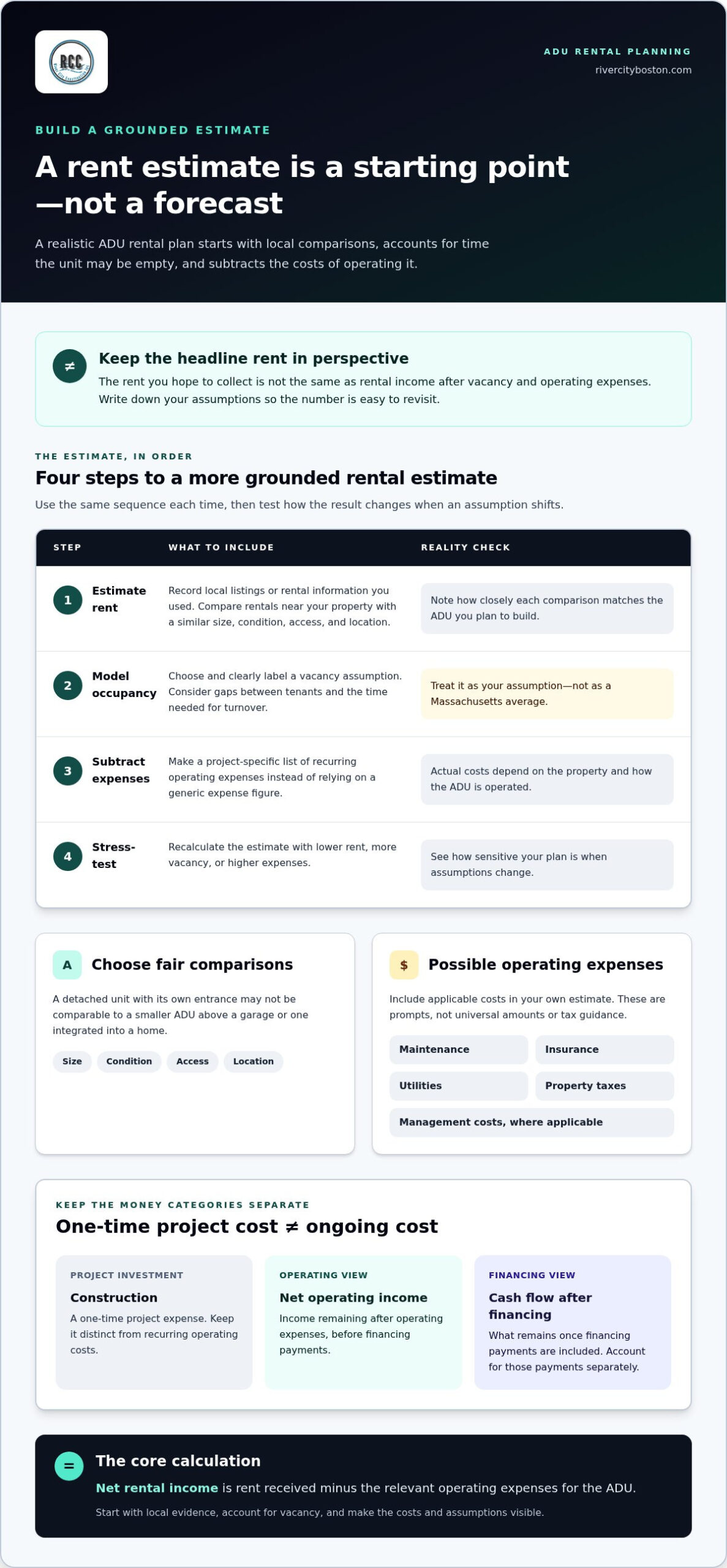
A rent estimate is a starting point, not a forecast. For an ADU for rental income Massachusetts homeowners should use local comparisons and write down each assumption, so an attractive headline number doesn’t hide vacancy, upkeep, or financing costs.
Which assumptions belong in a rental-income estimate?
Build the estimate in a consistent order. Start with rent, account for periods when the unit may be empty, subtract recurring operating expenses, then test what happens if your assumptions change. Compare rentals near your property with a similar size, condition, access, and location. A detached unit with its own entrance may not be comparable to a smaller unit above a garage or one integrated into a home.
- Estimate rent: Record the local listings or rental information you used, and note how closely each comparison matches the planned ADU.
- Model occupancy: Choose a clearly labeled vacancy assumption. Consider how a gap between tenants or time needed for turnover could affect rent received. Don’t present your assumption as a Massachusetts average.
- Subtract operating expenses: Make a project-specific list instead of relying on a generic expense figure.
- Stress-test the result: Recalculate with lower rent, more vacancy, or higher expenses to see how sensitive the plan is.
Net rental income is rent received minus the relevant operating expenses for the ADU. Possible expense prompts include maintenance, insurance, utilities, property taxes, and management costs, where applicable. These aren’t universal amounts or tax guidance; actual expenses depend on the property and how it’s operated.
Keep the construction investment separate from recurring costs. Construction is a one-time project expense, while operating costs continue as the unit is rented. For a more complete cash-flow picture, account for financing payments separately. Net operating income is generally the income remaining after operating expenses, before financing payments; cash flow after financing shows what remains once those payments are included.
How should homeowners interpret projected returns?
Prepare three versions of the estimate: conservative, middle, and optimistic. Label the assumptions behind each, including rent, vacancy, and expenses. The conservative case can show whether the plan remains manageable if the unit earns less than hoped. The optimistic case is useful for comparison, but it isn’t a promise.
A lender’s decision about financing and an ADU’s rental profitability are separate questions. Qualification doesn’t establish that rental income will cover costs, and a promising projection doesn’t ensure financing approval. Keep any potential change in property value separate from rental income rather than treating it as a guaranteed return. For questions about how rental income or expenses apply to your taxes, speak with a qualified tax professional.
A clear estimate can also help shape the project scope. River City Construction’s ADU planning considers intended use, design, and property conditions together. If you’re developing a property-specific scenario, discuss your ADU plans with River City Construction as part of your next planning step.
Long-Term or Short-Term Rental? Match the ADU Plan to Its Use
Choosing how an ADU will be used affects more than the rent estimate. A long-term tenant, a series of short stays, or a family member may each need a different balance of privacy, access, furnishings, and day-to-day upkeep. Before settling on a design, compare the options against how you want the property to function. No rental model is right for every homeowner.
When might a long-term rental fit better?
A longer tenancy may suit homeowners who value fewer turnovers and a steadier occupancy plan. That’s a planning preference, not a promise of continuous rent. Think about how often you’re comfortable preparing the space for a new occupant, how much privacy you want between the ADU and your home, and whether you’ll manage the unit yourself.
Design should follow the expected occupant’s everyday routines. Consider storage, comfortable circulation, practical kitchen and bathroom space, and a clear entrance. These choices matter whether the ADU is detached, attached, above a garage, or created through a garage conversion. A functional layout can support daily living, but it can’t guarantee demand or rental income.
What changes when considering short-term rentals?
Short-term stays may involve more frequent guest turnover and hands-on coordination. Don’t assume that permission to build an ADU also allows short-term rental operation. Local rules for rental use can differ from construction requirements, so review current town or city guidance, including any applicable registration, tax, or operating requirements, through official sources before building your income plan around this use.
Include the work and costs that come with your intended operation in your estimate. Furnishing, cleaning between stays, management, and gaps between bookings are assumptions to model, not guaranteed expenses or occupancy levels. Rental examples from other parts of Massachusetts shouldn’t be treated as benchmarks for Greater Boston. Use information relevant to the property’s own market.
A simple comparison can make the trade-offs visible without declaring one approach universally better:
- Long-term use: Record your expected rent, assumed vacancy, turnover frequency, management approach, privacy needs, and fit with household plans.
- Short-term use: Note your expected booking pattern, possible gaps, furnishing and cleaning needs, management plan, and local operating requirements to verify.
- Family use: Consider whether an in-law suite or integrated unit would better support a relative, even if rental income isn’t the primary purpose.
Review the options together. For example, a homeowner might initially picture short stays but prefer less frequent turnover after considering the management tasks. Another household may value an in-law suite because it keeps family close while preserving a measure of independence. Detached, attached, above-garage, and garage-conversion ADUs can all be considered in light of the intended use and property conditions. A well-matched plan keeps design decisions connected to how the space will actually be occupied.
A Massachusetts ADU Rental Feasibility Checklist Before Construction
A workable rental plan starts with intended use and current local requirements, not just a floor-plan sketch. For an ADU for rental income Massachusetts homeowners need to consider three things separately: whether the proposed project fits the applicable rules, whether the property can support the design, and whether local renters are likely to want that kind of unit. A positive answer to one doesn’t guarantee the others.
What property and municipal questions belong on the checklist?
Begin with official state and municipal information for the specific address. Keep construction and rental use as separate lines of inquiry, then record what needs to be resolved during project planning and local review.
- Intended use: Decide whether the ADU is for a long-term rental, a short-term rental, family, or flexible use over time.
- Local requirements: Review current state and municipal ADU guidance, construction and permitting requirements, and any rules that apply to the intended rental use.
- Site layout: Note existing structures, available site area, access to the unit, and how occupants would move between the ADU and the main home.
- Privacy: Consider windows, entrances, outdoor areas, and how the proposed arrangement would feel to both occupants and the household.
- Utilities: Identify where utility connections may need coordination as part of the design and project scope.
- Rental demand: Separately research comparable local units and consider whether their size, condition, and location resemble the proposed ADU.
Site suitability and rental demand answer different questions. A property may have room for a thoughtful design, yet the unit’s location or layout may not match what prospective renters seek. Likewise, local interest in ADUs doesn’t establish that a specific lot can support the planned project. Use the checklist to identify unknowns before design decisions make them harder to address.
How can a homeowner test whether the plan is financially resilient?
Take the income estimate from the previous step and test it with lower rent or occupancy assumptions. Keep those assumptions visible. Include recurring costs and financing figures based on information specific to your project, rather than treating a broad estimate as a personal forecast. Then compare rental use with family use or a future flexible living arrangement. That comparison can clarify whether the ADU still makes sense if rental plans change.
Property value may be part of the discussion, but an increase isn’t guaranteed. The home remodeling and property value guide offers broader context, not a promise of a particular result for an ADU.
Once the intended use, local review, site questions, and financial assumptions are in view, coordinated planning can bring them into the design and project scope before construction begins.
Plan a Massachusetts ADU with River City’s Design-Build Process
A rental plan is only useful if the design, property conditions, and project scope work together. River City Construction Inc. offers ADU Design-Build Services. Its coordinated Design-Build process combines design, planning, budgeting, and construction under one roof, so the unit’s intended use can inform the project from the start.
How does coordinated Design-Build support an ADU project?
The process begins with a consultation to discuss the property, intended use, and early project goals. Design and planning then turn those priorities into a project scope. For example, a unit intended for long-term rental may need a different layout discussion from an in-law suite planned for a family member. These conversations help guide decisions, but they can’t promise a particular rental outcome.
As plans develop, budgeting and permitting considerations are addressed alongside the design. Construction follows project planning, with a final walkthrough at the end. Coordinating these stages helps homeowners understand how decisions connect and what needs attention next. The specific plans, scope, and requirements depend on the property and project.
River City brings 20+ years of experience to its work and is BBB Accredited, Licensed & Insured. Homeowners can also review its 4.9 stars from 110 Google reviews. The company’s values are honesty, quality, relationships, and innovation, with attention to the homeowner’s goals as well as the practical details of the build.
What is a practical next step for Greater Boston homeowners?
Homeowners in Boston, Winchester, Medford, Somerville, Cambridge, Belmont, Lexington, Concord, Wellesley, Newton, Wayland, Natick, and surrounding Massachusetts communities can bring a few useful details to an initial conversation:
- Intended use: Share whether your ADU for rental income Massachusetts is being considered for rental income, family use, or future flexibility.
- Property context: Describe existing structures, access, and any site conditions that may shape the plan.
- Income assumptions: Bring your early rent and expense estimates, clearly marked as assumptions rather than guaranteed results.
- Questions: Note local requirements or design decisions you want to address as planning begins.
A free, no-obligation consultation offers a practical setting to discuss those details and receive personalized remodeling guidance. With exclusive project savings, you can save up to $2,500. Craftsmanship work includes a “5 Years of Limited warranty.”
Bring your questions and property context. A clear first discussion can help you understand the next planning steps without promising approval, income, or a completion date.
Turn Your ADU Idea Into a Clear Next Step
An ADU can be more than a line in a rental-income estimate. It may also offer flexibility as household needs change, from welcoming family to creating a separate living space for future use. Consider that possibility before committing to a plan built around one rental scenario.
If an ADU for rental income Massachusetts project is on your mind, bring your intended use, property details, and early assumptions into one conversation. River City Construction’s Design-Build approach can connect those goals with a project plan shaped around your home. The first step doesn’t need to settle every question. It can help you identify what to explore next.
A thoughtful plan starts with your property and priorities. Take the next step with confidence, knowing the details can be worked through one decision at a time.
Frequently Asked Questions
Can I build an ADU for rental income anywhere in Massachusetts?
No. Massachusetts allows one qualifying ADU by right on lots zoned for single-family use in most communities, but that doesn’t establish that every property can support a buildable, rentable unit. The state framework sets size limits, including 900 square feet or 50% of the main home’s gross floor area, whichever is smaller. Boston has separate ADU rules. Review current state and municipal guidance for the property’s location.
How much rental income can an ADU generate in Massachusetts?
There isn’t one dependable rent figure for every Massachusetts ADU. A unit near Cambridge or Newton may differ from one elsewhere in Greater Boston, even if the floor area is similar. Compare local rentals with similar condition, access, and layout, then adjust for expected vacancy and recurring costs. Keep projected gross rent separate from what may remain after expenses, and label estimates as assumptions, not promised income.
Do I need a permit to build an ADU in Massachusetts?
Yes. A building permit is required for ADU construction, even when a qualifying project can proceed by right without a special permit. Other applicable requirements may also affect the project, including building and health codes. If the property uses a septic system, review the relevant state and local requirements early, since the added unit may affect system planning. Confirm current permit steps with the municipality before finalizing plans.
Is short-term rental use automatically allowed for a Massachusetts ADU?
No. State ADU eligibility doesn’t automatically grant permission to operate a short-term rental. Massachusetts municipalities can restrict or prohibit rentals of 31 consecutive days or fewer, so rules may differ from one town to another. Before basing a project on short stays, review current local rental requirements and any applicable operating steps through official sources. This is especially important if your income estimate depends on frequent guest bookings.
What happens if the ADU’s rental income is lower than expected?
If rent or occupancy falls short, the amount left after operating costs and financing payments may also be lower than planned. Test that possibility before construction by using a lower-rent scenario and allowing for vacancy, maintenance, and other recurring expenses. Consider whether the layout could still work for family use or another living arrangement. A flexible use plan can preserve value to your household if rental demand changes.
Can I use projected ADU rent to qualify for financing?
Possibly, but don’t assume a lender will count projected rent or use it in a particular way. Financing qualification depends on the lender’s criteria and your financial details, while rental profitability depends on actual rent, vacancy, expenses, and payments. Treat a rent projection as one planning input, not proof that financing will be approved. Ask the lender how it evaluates projected income for your specific application.
Does building an ADU guarantee that my property value will increase?
No. An ADU doesn’t guarantee a higher sale price or a particular return. Its effect can depend on the property, the finished unit, and how local buyers value the added living space. Construction may also affect the property’s assessed value, meaning the value assigned to the property for property-tax purposes, and annual tax bill. Consider rental income, household use, project costs, and possible assessment changes separately rather than relying on resale value alone.