The lowest remodeling estimate may not be the clearest path to a well-managed project. If you’re wondering how to vet a remodeling contractor, look beyond the bottom line. Credentials, relevant experience, a clearly defined scope, communication, and plans for managing the work all matter.
It’s understandable to feel uncertain when estimates seem to cover the same project but leave different questions unanswered. A practical evaluation process helps you compare what’s included, understand how planning and budgeting fit together, and decide whether the working relationship feels right before you commit.
This guide covers the key steps, from reviewing credentials and assessing project fit to discussing communication and planning. River City Construction Inc. is BBB Accredited, Licensed & Insured, and uses a Design-Build process that coordinates design, planning, budgeting, and construction under one roof. Greater Boston homeowners can start with a free, no-obligation consultation to discuss their project and get personalized remodeling guidance.
Key Takeaways
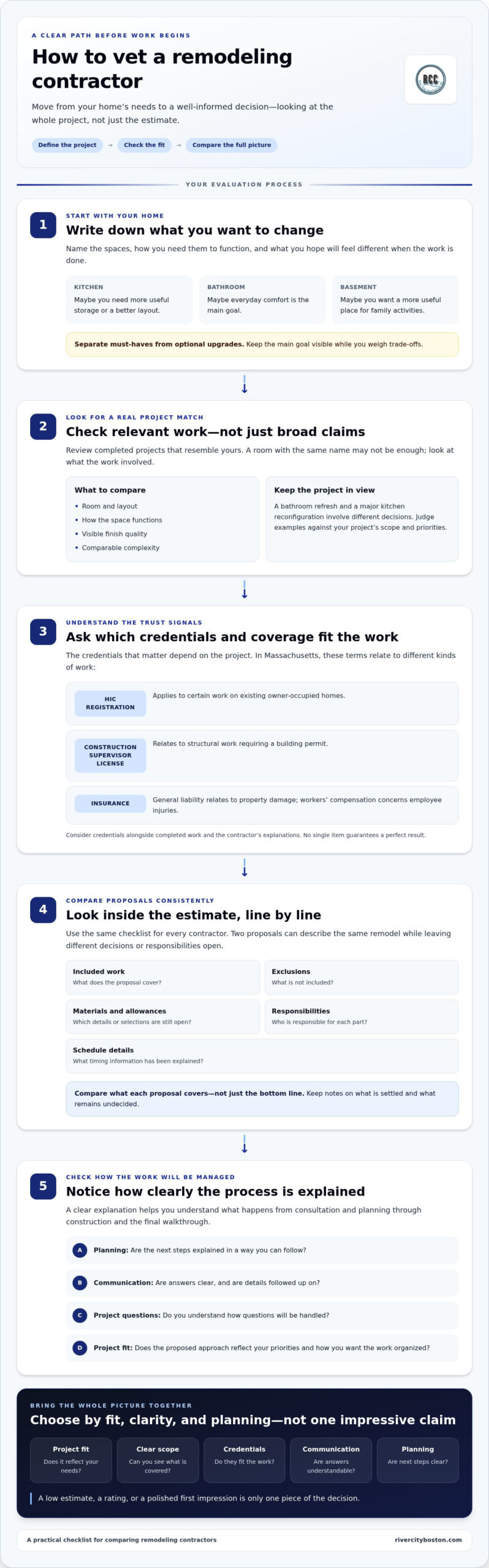
- To learn how to vet a remodeling contractor, use a repeatable process: define your needs, review relevant experience, compare project details, and assess how the work will be managed.
- Look for completed projects that resemble yours, and consider layout and finish quality rather than relying on broad claims of experience.
- Compare estimates line by line, including materials, exclusions, allowances, responsibilities, and schedule details, so you can see what each proposal covers.
- Pay attention to how clearly the contractor explains the steps from consultation and planning through construction and the final walkthrough.
- Make your decision using the full picture: project fit, clear scope, credentials, communication, and planning, not a single estimate or rating.
How to vet a remodeling contractor before work begins
Comparing contractors can feel like a project of its own. You’re weighing proposals while trying to protect your home, budget, and daily routine. A polished website or appealing estimate may make a good first impression, but neither shows on its own whether the contractor’s experience, proposed work, and planning approach fit your home.
Contractor vetting means evaluating experience, scope, communication, and credentials together, rather than relying on one impressive claim or a low estimate. A practical sequence is to define what you want, review relevant examples, compare what each proposal includes, assess how the project will be managed, and decide which approach fits. A general overview of a contractor’s role and responsibilities can help clarify the range of work involved.
Start with the project you actually want to complete
Before discussing proposals, write down the spaces you want to change, how you need them to function, and what you hope will be different when the work is done. For example, a kitchen project might focus on more useful storage and a better layout, while a bathroom remodel may address everyday comfort. A basement project may have a different purpose, such as creating a more useful place for family activities.
Separate essential work from optional upgrades. If improving storage is a must-have but adding a decorative feature is optional, make that clear in your notes. This gives you a way to compare proposals and weigh trade-offs without losing sight of your main goal. Homeowners planning kitchen remodeling in Boston can use the same approach: define the desired changes first, then consider how each proposal addresses them.
Build a consistent comparison checklist
Use the same criteria for every conversation instead of letting a confident presentation or attractive estimate shape your first impression. A consistent checklist helps you compare what you learn and keep your focus on what matters to your home.
- Relevant experience: Look for completed work similar to your project, such as the room, layout, or type of finish.
- Project scope: Note what work is included, what is excluded, and which decisions are still open.
- Planning: Consider whether the next steps are explained in a way you can follow.
- Communication: Notice whether answers are clear, details are followed up on, and you understand how project questions will be handled.
- Project fit: Consider whether the proposed approach reflects your priorities and how you want the work organized.
For instance, two proposals may both describe a kitchen remodel, yet one may leave important selections or responsibilities open. Your checklist can reveal those differences before you compare totals. Keep your notes together, mark which details are settled and which remain undecided, and use the same questions in each conversation. This makes it easier to judge the overall project approach, not just a first impression.
How to check a remodeling contractor’s experience and credentials
A contractor may describe themselves as a remodeling specialist, but that label alone doesn’t show whether they’ve handled work like yours. Look for experience that matches the room, the changes you’re planning, and the coordination the project may involve. Evaluate experience against the project type, scope, and evidence of completed work. This helps distinguish general claims from examples that are relevant to your home.
As you review a contractor’s background, focus on evidence you can connect to your project. A portfolio can show the kind of work they take on, while credentials and a consistent reputation offer additional context. No single item guarantees a perfect result, but together they give you a more grounded picture than a broad claim alone.
Match the contractor’s experience to your remodeling project
Review completed projects that resemble yours. Consider the layout, how the space functions, the visible finish quality, and whether the work appears comparable in complexity. A bathroom refresh and a major kitchen reconfiguration involve different decisions, so a few attractive photos may not answer every question.
For a kitchen project, look for examples that help you picture the layout and everyday use you have in mind. Homeowners exploring Boston kitchen remodeling services can use their own priorities to assess which examples feel relevant. Apply the same approach to bathroom or basement plans: look for similarities in function and scope, not just a room with the same name.
Understand the trust signals behind a remodeling firm
Credentials and insurance are important parts of evaluating a remodeling firm because they help you understand its professional standing and approach to risk. In Massachusetts, a Home Improvement Contractor registration applies to certain work on existing owner-occupied homes, while a Construction Supervisor License relates to structural work requiring a building permit. Which credentials matter depends on the project. Insurance also deserves attention: general liability relates to property damage, while workers’ compensation concerns employee injuries.
Consider these details alongside the contractor’s work examples and explanations. A steady reputation can provide useful perspective, but reviews are one signal, not a guarantee that every project will unfold the same way. Use your review of experience and credentials to develop specific questions about the proposed work and its management.
If you’re weighing your project against a firm’s experience and approach, a conversation about your remodeling project can help you understand the process.
How to compare remodeling estimates beyond the bottom line
Two remodeling estimates can use similar language and still describe different projects. One may include particular materials or preparation work, while another leaves those choices open or excludes certain tasks. Comparing only the headline figures can make proposals look more alike than they are. A fair comparison starts with what each contractor says will be done, what remains undecided, and how the work will be coordinated.
Compare what each proposal says will be done
Read each proposal with your project priorities beside it. Look for named work areas, key tasks, and clear descriptions of the expected finished work. Mark each item as included, excluded, or awaiting a decision. That distinction helps you see whether a detail is part of the current plan or could affect the scope later.
Use a table like this to organize the comparison. Add notes from each proposal rather than relying on memory.
| Compare | What to record |
|---|---|
| Scope | Rooms, work areas, tasks, and expected deliverables described. |
| Materials | Selections named and choices still open, including finish or product details. |
| Exclusions | Work or services the proposal specifically leaves out. |
| Allowances | Budgeted amounts for items not selected yet, and what choices they cover. |
| Responsibilities | Who handles decisions, coordination, and project tasks described in the proposal. |
| Schedule detail | What planning or sequencing information is provided, without treating it as a guaranteed completion date. |
An allowance is a placeholder for an item that hasn’t been selected or fully defined. If one kitchen proposal names a specific cabinet selection and another leaves cabinetry as an allowance, those figures don’t represent the same scope. The lower headline amount isn’t directly comparable until you understand what’s included and what decisions remain.
Evaluate budgeting and change communication
Good budgeting connects the planned work with the selections being considered. Notice whether the proposal distinguishes confirmed details from open choices, and whether the contractor explains how changing one decision could affect other parts of the plan. This gives you a clearer basis for weighing priorities, such as putting function first or choosing finishes that matter most to your household.
Unexpected conditions may also require a conversation about the plan. Before choosing, look for a straightforward explanation of how a change could affect the scope and what decisions may be needed from you. Clear discussion helps prevent a small unknown from becoming a larger misunderstanding. Consider those priorities alongside the project scope. Comparing the clarity of the process as carefully as the proposed work is an important part of how to vet a remodeling contractor.
How to assess communication, planning, and project management
A remodeling project brings a steady flow of questions, choices, and updates. The way a contractor communicates before you sign can give you a sense of how project information will be shared later. Notice whether explanations are easy to follow, whether your priorities are reflected in the discussion, and whether you understand who will keep you informed.
A well-coordinated remodeling process has clear responsibilities and communication points, so homeowners know who to speak with and how decisions move forward. Don’t stop at a reassuring first conversation. Consider whether the proposed plan helps you understand what happens next, from early design decisions through the final walkthrough.
Look for a clear plan from consultation to final walkthrough
A project plan should make the steps understandable without promising a fixed completion date. River City Construction Inc. follows a process that moves from consultation into design and planning, permits, construction, and a final walkthrough. As you discuss these stages, notice whether the contractor explains what each involves and when you may need to make decisions.
Early planning connects your vision with the budget and construction work. For example, if a bathroom’s layout or finish selections are still under discussion, clarifying those choices during planning can help align expectations before work begins. Homeowners considering bathroom remodeling can use this stage to talk through their goals and understand how decisions will be carried forward.
Understand who coordinates the work and communication
A dedicated point of contact gives you a clear person to approach with questions and updates. Discuss how information will be shared, how decisions will be recorded, and how an unexpected issue will be explained. A clear answer helps set expectations and reduces the chance that you’ll be unsure who has the latest information or what response is needed from you.
River City Construction Inc. uses a Design-Build process, a coordinated process that combines design, planning, budgeting, and construction under one roof. Communication continues from consultation through the final walkthrough, with a dedicated point of contact throughout the project. As you assess this approach, focus on how the stages connect to your plans and how you’ll stay informed as decisions are made.
Try walking through a simple scenario: a selection needs to change, or a question comes up during planning. Would you know who to speak with and how the next steps would be explained? A useful conversation should leave you with a clearer picture of responsibilities and how updates are handled.
Good project management isn’t only about organizing the work. It also means keeping you informed as the plan takes shape. When you understand how questions, decisions, and updates will be handled, you can approach the next stage with greater confidence.
Choose a remodeling contractor whose process fits your home
At this stage, the goal isn’t to find one perfect number or a flawless-sounding promise. It’s to decide which contractor’s experience, project plan, and communication approach best match your home and priorities. A strong rating can add context, and an estimate can clarify proposed work, but neither tells the whole story on its own.
Use this final decision matrix to bring your notes together. A contractor who fits your project should make the next steps understandable, rather than leaving you to piece together how the work will happen.
Use a final checklist before making your decision
- Relevant experience: Are there examples of work that resembles your project’s type, needs, or complexity?
- Clear scope: Does the proposed work reflect your priorities, and are open choices or exclusions easy to identify?
- Credible credentials: Have you considered the contractor’s credentials alongside the project details?
- Communication: Do you understand who will coordinate updates, decisions, and questions?
- Project fit: Does the planning approach make the relationship between design, budget, and construction clear?
Look at the whole picture rather than letting one impressive reference, rating, or estimate decide for you. If a proposal feels promising but leaves a key responsibility or decision unclear, make sure you understand that detail before moving ahead. The right fit is the one whose approach makes sense for your home and the way you want the project managed.
Take a low-pressure next step in Greater Boston
For homeowners who want to talk through their plans, River City Construction Inc. offers a free, no-obligation consultation and personalized remodeling guidance. The company brings 20+ years of experience and is BBB Accredited, Licensed & Insured. Its Design-Build process connects design, planning, budgeting, and construction under one roof, keeping the project’s decisions and work coordinated.
River City serves Boston, Medford, Somerville, Winchester, Woburn, Reading, Wilmington, and surrounding Massachusetts communities. Greater Boston homes in Boston, Winchester, Medford, Somerville, Cambridge, Belmont, Lexington, Concord, Wellesley, Newton, Wayland, and Natick each bring their own context to a remodeling plan. Homeowners can also explore exclusive project savings of up to $2,500 as they consider the value of a remodeling project.
You don’t have to settle every detail before starting a conversation. A consultation can help you explain what you hope to change, understand how the process may fit your home, and decide whether the next step feels right.
With a clear plan and a coordinated team, the goal is simple: Love Your Home Again.
Take the Next Step With a Clear Starting Point
A remodeling project doesn’t need every detail settled before you explore what’s possible. Start with the changes that would make daily life at home work better, then use those priorities to guide a conversation about your goals. A thoughtful approach to how to vet a remodeling contractor can help you move forward with a clearer sense of what matters most to your household.
River City Construction Inc. offers a free, no-obligation consultation for homeowners considering a remodeling project. It’s an opportunity to discuss your ideas and consider a practical next step without having every choice made in advance.
Your home should support the way you want to live. With a clear starting point and the right conversation, you can begin shaping a space that feels more like yours.
Frequently Asked Questions
What should I check first when vetting a remodeling contractor?
Start by writing down the changes you want and what a successful result would look like in your home. That gives you a reference point for every conversation. As you consider how to vet a remodeling contractor, compare relevant completed projects, credentials, proposal detail, and communication. For a Greater Boston home, consistent criteria can keep an attractive website or persuasive conversation from outweighing the details that matter to you.
How can I compare remodeling contractor estimates fairly?
Compare the written details, not just the totals. One proposal may identify specific finish selections while another leaves them open, making it difficult to judge whether they describe the same work. Note what’s included, excluded, and still awaiting a decision. Then consider how each contractor describes handling changes. A side-by-side comparison helps you understand the value and practical fit of each proposal without assuming the lowest figure covers the same project.
Should a remodeling contractor be licensed and insured?
Licensing and insurance are important credentials to consider, but requirements can depend on the work and location. Avoid assuming a single rule applies to every home project. For work in Massachusetts, make sure your review accounts for the type of remodel and the relevant credentials. Insurance information is also part of understanding how a contractor approaches risk. Treat these checks as one part of a wider decision, alongside project experience and clear communication.
What are red flags when vetting a remodeling contractor?
Unclear responsibilities, vague answers about how the budget relates to the work, or pressure to decide before you understand the proposal are reasons to pause. For instance, if you can’t tell who will explain a change or what remains undecided, get that project information clarified before moving forward. These signs don’t predict the outcome, but slowing down can help you decide with a better understanding of expectations and next steps.
Is a Design-Build contractor a good fit for a home remodel?
It may suit you if you value having design decisions and construction planning considered together. Think about how involved you want to be in choices such as layout, materials, and priorities, and whether the process makes clear how those choices connect. A good fit depends on your project and preferred communication style. The useful question is whether the approach makes responsibilities and decisions easier to follow.
How do I know whether a remodeling contractor is a good fit for my home?
A good fit should make sense for both the project and your household. Consider whether the contractor’s relevant work aligns with your goals, whether the proposal reflects the changes you want, and whether you understand how decisions and updates will be handled. Imagine asking a question midway through planning: would you know where to direct it and how you’d get a clear answer? That practical confidence matters more than any one credential or estimate.
What should happen during a remodeling contractor consultation?
A useful consultation gives you room to describe the project in your own words and explain what you hope will change in daily life. Before the conversation, jot down your main priorities, any choices you’re unsure about, and questions about the planning steps. River City Construction Inc. offers a free, no-obligation consultation with personalized remodeling guidance. Use the discussion to understand possible next steps, then take time to decide what feels right.