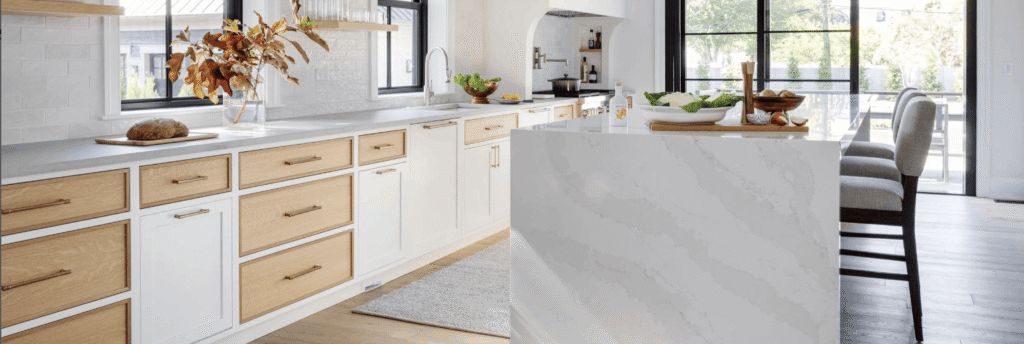
The toughest-looking countertop isn’t always the easiest to live with in a busy family kitchen. Quartz is often among the best countertops for kitchen durability because it resists many everyday stains and scratches and doesn’t need sealing. However, hot pans can scorch it, and its edges can chip.
It makes sense to want a surface that handles spilled juice, meal prep, and the occasional dropped utensil without demanding a lot of care. Granite is another durable option, especially around heat and scratches, though it needs periodic resealing. The right choice depends on which trade-offs matter most in your kitchen.
This comparison covers quartz and six alternatives: granite, soapstone, porcelain, marble, butcher block, and laminate. You’ll see how each performs for durability and upkeep, and where a material may be less suited to family routines. Use these practical differences to narrow your options based on how your household uses its kitchen.
Key Takeaways
- Compare countertops by the everyday demands that matter most in your kitchen, such as heat, stains, scratches, and upkeep.
- Quartz is a practical low-maintenance option, but protect it from hot pans and impacts to its edges.
- Granite handles heat, cuts, and scratches well, though periodic resealing helps it resist stains.
- Consider how each material responds to damage: some marks can be sanded or repaired, while others call for more careful daily use.
- Match the surface to your family’s cooking habits and care preferences, not appearance alone.
What countertop lasts the longest?
The best countertops for kitchen durability include granite, quartzite, and soapstone, which can last more than 50 years when properly installed. Granite stands out for resisting heat, cuts, and scratches, but its sealing needs are part of the long-term upkeep.
Granite Countertops
Granite is a natural stone countertop that stands up well to daily wear in a busy kitchen. In countertop testing, it resisted heat, cuts, and scratches, making it a strong choice for cooking areas where hot cookware and meal prep are routine.
Its main trade-off is sealing. Granite needs periodic resealing to help prevent stains, and properly sealed granite repels stains and bacteria. Since granite can last for decades with the right care, include that occasional maintenance in your decision rather than judging durability by scratch resistance alone.
Granite Versus Quartz
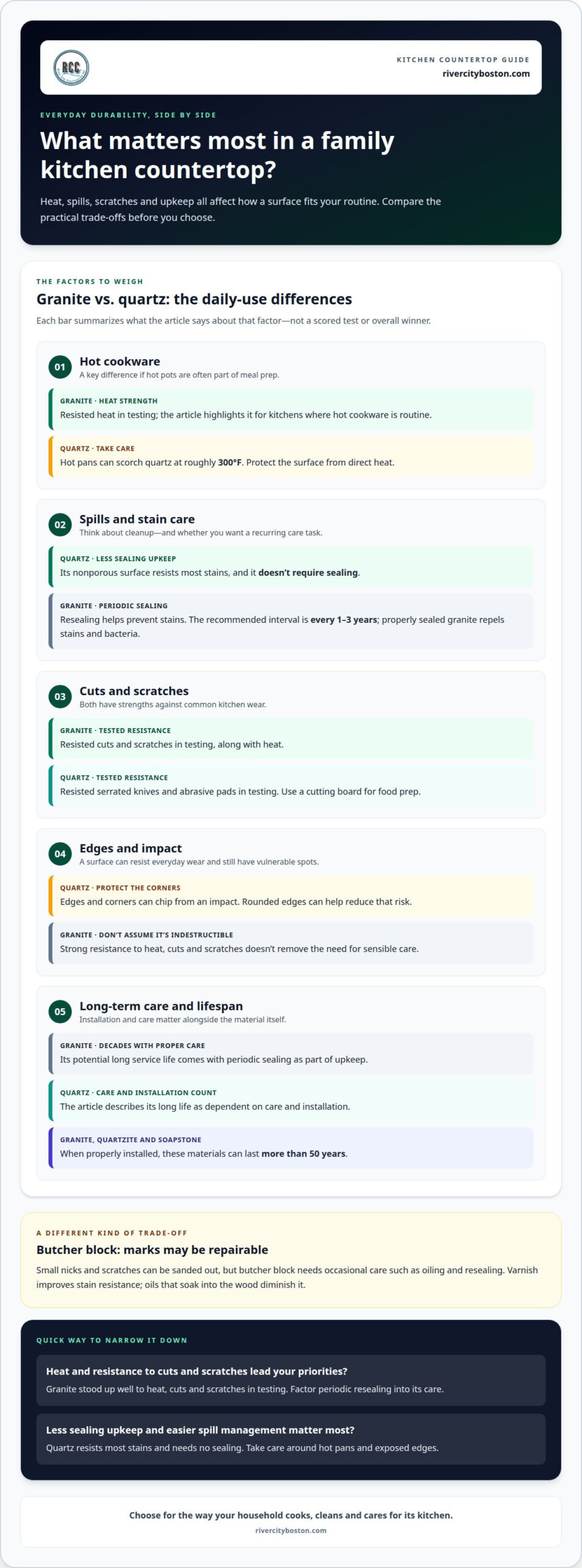
Granite and quartz both stand up well to common kitchen wear, but their strengths differ. Granite resisted heat, cuts, and scratches in testing. Quartz resisted hot pots, serrated knives, abrasive pads, and most stains, and it doesn’t require sealing.
That makes quartz simpler to maintain, while granite offers strong heat resistance with periodic sealing as a care task. Quartz can scorch under hot pans at roughly 300°F, and its edges or corners can chip. Rounded edges can help reduce that risk. For a kitchen where hot cookware is frequent, granite’s heat performance may matter more; for less sealing upkeep, quartz may suit better.
Long service life also depends on choosing a surface that fits your habits. Granite can last for decades with proper care, while properly installed granite, quartzite, and soapstone can last more than 50 years. Those figures describe potential longevity, not a reason to ignore maintenance or installation.
For granite, sealing is the practical step that supports stain resistance over time. The recommended interval is every 1-3 years. A properly sealed surface repels stains and bacteria, but sealing doesn’t make granite immune to damage. Use a cutting board for food prep and avoid treating any countertop as indestructible.
| Material | Heat, cuts, and scratches | Stain care | Longevity |
|---|---|---|---|
| Granite | Resisted heat, cuts, and scratches | Periodic sealing helps prevent stains | Can last decades with proper care |
| Quartz | Resisted hot pots, serrated knives, and abrasive pads | Non-porous; no sealing required | Long life depends on care and installation |
| Quartzite | Hard stone option | Depends on the surface’s care needs | More than 50 years when properly installed |
| Soapstone | More than 50 years when properly installed | Care needs vary by surface | More than 50 years when properly installed |
Choose granite if heat and resistance to cuts and scratches lead your priorities, and you’re comfortable with periodic sealing. A shortlist of the best countertops for kitchen durability should also reflect how your household cooks and maintains its surfaces. For Boston homeowners planning a kitchen update, countertop selection can be considered as part of a Boston kitchen remodeling project, alongside the room’s layout and everyday use.
Quartz durability and maintenance
Quartz suits kitchens where routine cleaning matters as much as resistance to everyday wear. It doesn’t require sealing, and its nonporous surface keeps liquids from soaking in, making spills easier to manage. Still, durability depends on how you use it: hot pans can scorch quartz, and an impact can chip its edges or corners.
Quartz resists most stains, making it a practical option for spills such as juice or sauce. In testing, most recycled-glass countertops were less stain-resistant, while properly sealed granite helps repel stains. If quick cleanup and less sealing upkeep are priorities, quartz may suit your routine. Take care around hot cookware and exposed edges.
Consider sinks, seams, and edges as you plan a countertop. Quartz edges and corners can chip, and rounded edges can help reduce that risk. Avoid striking an edge with a heavy pot, and use a cutting board instead of chopping directly on the surface. These habits protect busy prep areas where knives, dishes, and cookware are in regular use.
Butcher block offers a different balance. Small nicks and scratches can be sanded out, but the surface needs occasional care, such as oiling and resealing. That means more routine maintenance than quartz. A household that likes a wood work surface may find the ability to sand away small marks worthwhile, provided the upkeep fits its schedule.
The finish also affects butcher block’s stain resistance. Varnish improves it, while oils that soak into the wood diminish it. This matters near a sink or wherever a child might set down a dripping cup. Consider likely spills and cleanup habits, then choose a finish and care routine that suit how you’ll use the counter.
Durability and repairability are different considerations. Quartz can resist common wear yet chip at vulnerable edges; butcher block can develop marks that sanding may remove. Read the written warranty terms to understand what damage they address. Don’t assume a warranty covers every scratch or chip.
To make a practical choice, weigh stain resistance, heat exposure, edge impacts, and the time you’ll spend on maintenance. Quartz reduces sealing chores, while butcher block offers repairable marks with ongoing care. If these choices are part of a larger kitchen update, discuss your kitchen remodeling project and how your household uses the space.
What is the most durable countertop material?
Durability depends on the wear a countertop faces, from hot cookware to scratches and spills. Soapstone, limestone, and marble each have different strengths and care requirements.
Soapstone, Limestone, and Marble
Soapstone resists heat damage, and fine sanding and mineral oil can repair small scratches. That gives it a practical repair option. Consider limestone in relation to its surface and intended kitchen use. Before choosing it, think about likely spills, hot cookware, and food preparation in your household.
Marble calls for more care around heat and everyday contact. It was damaged by heat in testing, and its Mohs hardness is 3-4. The Mohs scale ranks how well a material resists scratching, so this rating means marble scratches easily. Etching leaves dull marks, while scratches create visible lines. Marble can suit a household that accepts these changes, but it’s less forgiving of rough daily use.
For example, a family that often puts hot pans on the counter may value soapstone’s heat resistance. A household drawn to marble should be comfortable with scratches and etching becoming part of the surface. With limestone, consider how you’ll use the countertop near the sink and during meal preparation. Everyday habits matter as much as appearance.
Quartz, Granite, Quartzite, Porcelain, and Laminate
Quartz resists most stains and common kitchen wear, but hot pans can scorch it and edges can chip. Granite resists heat, cuts, and scratches, with periodic sealing. Quartzite has a Mohs hardness of approximately 7, meaning it ranks well for resistance to scratching. Porcelain countertop slabs are fired at 1,200°C and come in 12 mm thicknesses. Direct cutting can permanently damage laminate.
Each material has a different weak point, so “most durable” depends on the kitchen’s main risks. Quartz offers a nonporous surface without sealing, but heat and edge impacts remain concerns. Granite handles heat well, while sealing helps with stain resistance. Quartzite’s scratch resistance is one measure of durability, not a promise against every kind of damage. Porcelain’s firing process and slab thickness describe how it is made, but don’t remove the need for careful use.
Damage often starts with a mismatch between habits and material. Different countertop materials can be vulnerable to different kinds of damage, so use protective habits suited to the surface. Wipe spills promptly and protect marble from hot cookware. Keep hot pots off quartz and avoid striking exposed corners. These steps address specific risks without expecting any countertop to be indestructible.
Choose based on the damage you most want to avoid: heat, scratches, stains, or marks that are difficult to repair. A household comfortable with patina, the worn look a surface develops over time, may accept marble’s visible wear, while one seeking a repairable surface may prefer soapstone.
Alternative materials: recycled glass, lava, and copper
Recycled glass, lava, and copper are alternatives to familiar stone surfaces. Compare each by the kitchen wear it must handle, especially cuts, scratches, heat, and stains.
Recycled Glass Countertops
Recycled-glass countertops combine glass pieces into a distinctive surface. In Consumer Reports’ tests, most tested recycled-glass countertops resisted cuts, scratches, and heat well. Their main weakness was stains: they were less resistant than some competing surfaces. In a family kitchen, weigh that trade-off against how often spills happen and how quickly someone can clean them.
That test result makes recycled glass a useful reminder that “durable” covers several kinds of wear. A surface can handle a knife or hot cookware yet remain more vulnerable to stains. For example, a household that prepares tomato sauce often may care more about stain resistance than scratch resistance. Another family may place greater value on resisting marks from daily meal preparation.
Lava and copper also merit comparison, but judge them by practical criteria, not appearance alone. Think through a typical weekday: a pan comes off the stove, someone chops vegetables, and a drink spills near the sink. These examples help clarify which performance traits matter most before you choose a surface.
Copper Countertops
Copper is a metal countertop material, unlike the glass pieces in recycled-glass surfaces or the stone in granite and marble. Its suitability for a busy kitchen depends on how its appearance and care fit your household. Consider where food preparation happens, how you’ll clean the surface, and whether visible changes would suit the kitchen’s look.
When comparing copper, include the finish and care routine. Choose based on the actual surface, not just the material name. Use a sample or finish reference during planning, then consider how it will look beside the cabinets and sink. This grounds the decision in the finished kitchen.
With lava, focus on the same practical questions: how the surface handles heat, cuts, scratches, and stains, and what care it needs. Don’t assume a material’s name alone predicts performance. Compare the specific countertop surface and its upkeep with your household’s habits, such as frequent baking or quick weekday meals.
For all three materials, make a short priority list before deciding. Rank stain resistance, heat resistance, and scratch performance according to your routine. Recycled glass has documented strengths against cuts, scratches, and heat, alongside a stain-resistance trade-off. For lava and copper, let the specific surface and care requirements guide your choice rather than relying on a broad material label.
Choosing a countertop for kitchen use
Choose a countertop by matching its strengths to the tasks your kitchen sees most. A household that cooks with hot pans has different priorities from one focused on stain resistance or easy repairs.
Start with the spills and impacts your surface will face. Quartz resisted most stains in testing, but hot pans can scorch it and its edges can chip. Granite resisted heat, cuts, and scratches, while periodic sealing helps prevent stains. Everyday habits are more useful than a general durability label when comparing these materials.
Next, consider how you want damage handled. Fine sanding and mineral oil can repair small scratches in soapstone. Butcher-block nicks and scratches can be sanded out, although the surface needs occasional maintenance, such as oiling and resealing. If you’d rather avoid that care, a repairable wood surface may not suit your routine.
- For frequent hot cookware: compare granite’s heat resistance with quartz’s risk of scorching under hot pans.
- For stain concerns: consider nonporous quartz or properly sealed granite, which helps repel stains.
- For direct food preparation: use a cutting board on laminate, since cutting directly on it can cause permanent damage.
- For a surface you can refresh: consider butcher block, where small nicks and scratches can be sanded out.
Then consider cleanup and upkeep together. Concrete countertops can be sealed to resist stains, while granite needs periodic resealing. Butcher block calls for occasional oiling and resealing; varnish improves its stain resistance, while penetrating oils diminish it. Picture a busy evening with a spill near the sink, then choose a care routine you can realistically maintain.
Review edges and work zones separately. Quartz edges and corners can chip, so rounded edges can help reduce that risk. Put the most demanding prep area away from exposed corners, and keep a cutting board near your usual chopping spot. This simple layout choice helps protect vulnerable areas.
Finally, weigh durability against the marks you’re willing to live with. Marble scratches easily and can show heat damage, while soapstone scratches may be repairable. A family comfortable with visible wear may choose differently from one seeking a more uniform surface. The best fit balances use, upkeep, and repair expectations.
River City Construction Inc: Kitchen Remodeling
River City Construction Inc helps homeowners incorporate countertop decisions into a broader kitchen remodeling plan. Consider kitchen remodeling when you’re ready to connect your material choice with the room’s layout, work areas, and daily routines. For example, quartz may suit a household seeking less sealing, while granite may better fit priorities around heat resistance.
A kitchen remodel is also an opportunity to plan how the countertop works alongside the sink and food-preparation areas. Sharing how your family cooks, cleans, and uses the space helps shape practical project decisions. The goal is a cohesive kitchen that works comfortably for everyday life.
Contact River City Construction Inc to discuss your kitchen remodeling project.
Make a Confident Choice for Your Kitchen
The best countertops for kitchen durability are the ones that suit your household’s routines and care preferences. Before settling on a surface, picture how you want the kitchen to work on a busy weekday, from meal preparation to cleanup. That practical vision can turn a material choice into a plan for a more comfortable home.
River City Construction Inc can incorporate countertop decisions into a wider remodeling project. Its services include kitchen, bathroom, and basement remodeling for homeowners planning improvements in more than one part of the home. A clear sense of your priorities is a useful starting point for discussing the kitchen you want.
With a thoughtful plan, your next kitchen can support how your family lives and cooks every day.
Frequently Asked Questions
What countertop is best for a busy family with kids?
Quartz is a practical choice for families who want a nonporous surface and less routine upkeep. Consider juice spills, busy meal preparation, and frequent wiping: quartz resists most stains, but hot pans and impacts to exposed corners remain concerns. Granite is another strong candidate when heat resistance matters more. For homes in Boston and nearby communities such as Winchester, Medford, Somerville, Cambridge, Belmont, Lexington, Concord, Wellesley, Newton, Wayland, and Natick, match the material to your family’s habits.
Which countertop requires the least maintenance?
Quartz generally requires less ongoing care because it doesn’t need sealing. Its nonporous surface also makes everyday spills easier to manage, although hot cookware still needs a trivet. By comparison, granite needs periodic sealing, and butcher block calls for occasional oiling or resealing. Consider the care you can realistically keep up with, not just cleanup after a single meal.
Which kitchen countertop materials are most durable overall?
Granite, quartzite, and soapstone are strong long-term candidates. Properly installed countertops made from these materials can last more than 50 years. Granite resists heat, cuts, and scratches; soapstone handles heat and allows small scratches to be repaired. Quartz offers stain resistance and doesn’t need sealing. The best overall fit depends on which risks matter in your kitchen and how much maintenance you’re prepared to do.
Which countertops resist scratches, chips, heat, and impact best?
No single material leads in every category. Granite resisted heat, cuts, and scratches in testing, while quartz resisted hot pots, serrated knives, abrasive pads, and most stains. Most tested recycled-glass countertops performed well against cuts, scratches, and heat, but were less stain-resistant. Quartz edges and corners can chip, so consider impacts as well as surface resistance.
Do granite and quartz countertops need sealing, and how often?
Granite needs periodic sealing to help prevent stains; the interval is every 1-3 years. Quartz doesn’t require sealing because it’s nonporous. A helpful way to plan granite care is to set a recurring reminder, then follow the sealing routine for the countertop. Don’t confuse sealing with protection from every kind of damage: a sealed surface can still be scratched or chipped.
What is the average installed cost per square foot for durable kitchen countertops in the U.S.?
Installed cost depends on the material and project details, so one average won’t describe every kitchen. Granite and quartz have different material cost ranges, and the final installation also depends on the countertop’s dimensions, cutouts, edges, and layout. A kitchen with a sink opening or joined sections involves different work from a simple run. Compare materials using the same project scope.
How long do different kitchen countertop materials typically last?
Properly installed granite, quartzite, and soapstone can last more than 50 years; granite can last for decades with appropriate care. Other materials don’t share one universal lifespan, because use, installation, and maintenance affect how they hold up. For example, a surface exposed to frequent impacts may show wear sooner than one used mainly for light food preparation. Consider expected care alongside longevity.
What maintenance and cleaning do durable countertop materials require?
Match routine care to the material. Quartz doesn’t need sealing, while granite needs periodic resealing to help prevent stains. Butcher block needs occasional oiling or resealing, and small nicks can be sanded out. Use a cutting board on laminate, since direct cutting can cause permanent damage. In any kitchen, wiping spills and keeping hot cookware off vulnerable surfaces helps reduce avoidable wear.