
Last month, a homeowner in Concord named Sarah sat at her kitchen table, surrounded by stone samples and a pile of conflicting quotes. She had heard that quartz was the modern, pricey choice, but she just received a bid for an exotic granite slab that was nearly double her original budget. It’s a frustrating spot to be in when you’re just trying to build a kitchen that lasts. You want a beautiful space, but you also don’t want to overpay for a material that might not fit your daily life.
If you feel overwhelmed by the shifting quartz vs granite price landscape, you aren’t alone. Most people we talk to in the Boston area are worried about hidden fabrication fees or picking a stone that looks dated in five years. We’re here to provide the clarity you need. This guide breaks down the real-world costs of these materials in 2026, from the initial slab purchase to the final installation. We’ll explore how specific choices impact your budget and your home’s ROI, giving you the confidence to choose the right surface for your lifestyle and your wallet.
Key Takeaways
- Learn why the initial price per square foot is only one part of the total investment for your Boston kitchen remodel.
- Understand the quartz vs granite price differences across entry-level, mid-range, and luxury tiers to find the best fit for your budget.
- Discover how specific design choices, such as choosing rare granite slabs or book-matching quartz patterns, impact your final costs.
- Explore how the “Fabrication Gap” and professional installation requirements influence the overall price of heavy stone materials.
- Get expert insights on which material offers the best long-term return on investment for homes in high-end neighborhoods like Wellesley and Lexington.
Understanding the Countertop Price Gap in 2026
If you’ve been researching online, you might think quartz is the premium choice while granite is the budget-friendly alternative. In 2026, those old rules don’t always apply. The quartz vs granite price comparison is now more about the specific slab you choose than the category of stone itself. While one material is made in a factory and the other is pulled from the earth, their market values have moved closer together than ever before.
A homeowner we worked with in Medford recently faced this exact dilemma. He fell in love with a rare, exotic granite slab that featured unique mineral deposits; it was stunning, but the cost was nearly double his initial estimate. By choosing a high-quality, standard quartz instead, he achieved the modern, clean look he wanted without the “exotic” markup. This shift is common in the current market, where high-end granite often costs more than mid-range quartz.
The Basics: Engineered Quartz vs. Natural Granite
Quartz is an engineered stone. It combines crushed minerals with resin binders to create a slab that is incredibly tough and non-porous. Because it requires a manufacturing process, the starting price accounts for factory overhead and chemical components. You’re paying for a product designed for consistency and durability.
Granite is a 100% natural material. It is quarried directly from the earth in giant blocks and sliced into slabs. Its price is dictated by its rarity and the difficulty of extraction. A common granite might be cheaper to source than quartz, but a slab with rare colors or patterns involves significant shipping and mining costs that drive the price upward.
Why Pricing Isn’t Always Black and White
Price per square foot is only a starting point. We often tell our clients that the total quote depends heavily on “yield.” If your kitchen layout requires two full slabs but only uses a fraction of the second one, your costs go up because you’re still paying for that entire second piece of stone. It’s about how efficiently the material fits your specific counters.
In the Greater Boston area, logistics also play a major role in your final investment. Delivering a heavy, fragile slab to a historic home in Lexington or a narrow street in the North End requires specialized equipment and experienced labor. Stone pricing is usually organized into tiers:
- Entry-Level: Common granite colors or basic, solid-colored quartz.
- Mid-Range: Granite with more “movement” or quartz that mimics natural stone patterns.
- Luxury: Exotic natural slabs or designer quartz with intricate, hand-painted veining.
Understanding these levels helps you navigate the quartz vs granite price debate with a clear budget in mind. It’s not just about the stone; it’s about the total project value.
Quartz Countertops: The Modern Premium for Busy Kitchens
Quartz is often called “engineered stone” because it is a man-made product. This manufacturing process allows for incredible control over the final look. When you look at the quartz vs granite price, you’ll notice that quartz often starts at a higher floor. You’re paying for the technology that makes the material non-porous and incredibly hard. Predictability is a luxury in home remodeling. You won’t need to spend hours at a stone yard hoping the slab you saw online is the one that arrives at your door.
A busy family in Somerville recently chose a marble-look quartz for their kitchen renovation. They were tired of worrying about red wine rings or coffee spills on their old surfaces. Because quartz is sealed during the manufacturing process, it doesn’t absorb liquids. This stain resistance makes it a “set it and forget it” investment for high-traffic homes. For them, the value wasn’t just in the aesthetic; it was in the time saved on maintenance.
The Cost of Consistency and Customization
One benefit of quartz is pattern predictability. If you have a large kitchen in Newton with a massive center island, you might need “jumbo” slabs. These larger pieces allow for a seamless look without the need for multiple joints. While these slabs carry a premium, they often reduce labor costs during the cutting and polishing process because the patterns are easier to align. We also see a rise in “book-matching,” where two slabs are manufactured to be mirror images of each other. This creates a stunning visual effect on backsplashes or islands that is much harder to find in natural granite. Most high-end Boston homes use 3cm slabs for a substantial, luxury feel, which is the standard for a premium look.
Long-Term Value: Maintenance and Durability
When evaluating the quartz vs granite price, it’s helpful to look at the ten-year cost of ownership. Granite requires periodic sealing to stay stain-resistant. Quartz never needs this treatment. This saves you both the cost of the sealant and the time spent applying it every year. This durability is why we see so many homeowners choosing quartz for Accessory Dwelling Units (ADUs) in Somerville. It stands up to the wear and tear of different users without losing its luster or requiring special care. If you’re weighing these factors for your own home, reaching out for a professional consultation can help you determine which material provides the best long-term value for your specific cooking style.
Granite Countertops: The Timeless Value of Natural Stone
Unlike the factory-made consistency of quartz, granite is a 100% natural product. This means every slab is unique. When you’re looking at the quartz vs granite price, you’re often paying for the rarity of the pattern rather than just the material itself. While quartz offers a controlled aesthetic, granite provides a piece of geological history for your home. No two kitchens will ever look exactly the same when natural stone is involved.
We recently helped a homeowner in Concord who wanted a kitchen that felt like it had been part of her historic home for decades. She didn’t want the uniform look of engineered stone. After visiting several local stone yards, she found a one-of-a-kind slab with dramatic swirling veins that became the centerpiece of her entire design. This type of “movement” in the stone is something quartz can try to mimic, but it can’t quite replicate the genuine depth of natural minerals. For her, the extra time spent viewing slabs was a vital part of the investment.
Granite pricing is typically organized into tiers. Level 1 stones, such as the dark and classic “Uba Tuba,” are plentiful and often more affordable than even basic quartz. On the other end of the spectrum, exotic stones like “Blue Bahia” are rare and can far outprice premium quartz. The cost is driven by how difficult the stone is to find and extract from the earth.
Rarity as a Price Driver
Geography plays a huge role in what you pay. If a stone is quarried in a remote part of Brazil or Italy, the shipping and logistics to get it to Boston add to the total. Some exotic granites are also more delicate due to their high mineral content. These slabs require more careful handling and specialized fabrication techniques. This increased labor often explains why a quote for a rare granite slab is higher than a standard quartz vs granite price estimate might suggest.
The “Natural” Maintenance Factor
Many homeowners worry about the maintenance of natural stone. While granite is porous, modern sealants are very effective and easy to apply. Budgeting for a simple wipe-on sealing every year or two is a small task for the longevity you get in return. In older Boston homes, we often see original granite surfaces that have lasted for generations with only occasional professional restoration. This timeless quality is why granite remains a top choice for a luxury bathroom remodel where homeowners want a spa-like, organic feel that stands the test of time.
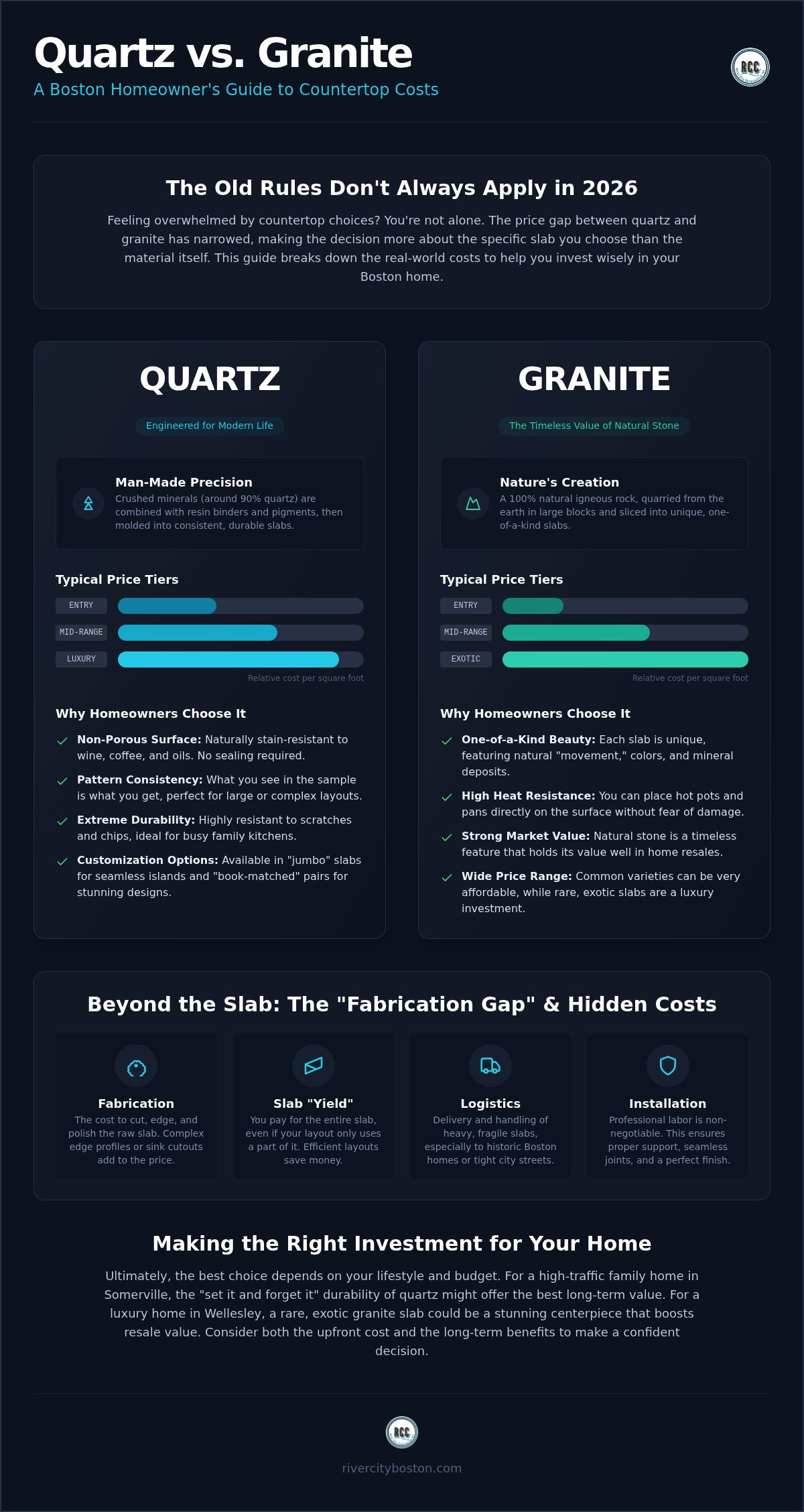
Side-by-Side: Quartz vs. Granite Price Comparison
National websites often quote broad price ranges that don’t reflect the logistical reality of a 2026 Boston remodel. When you look at the quartz vs granite price side-by-side, the cost of the raw stone is only the starting point. The complexity of your kitchen layout and the specific details you choose can shift the final quote more than the material category itself. For example, a simple rectangular island is much easier to fabricate than one with multiple curves or a “waterfall” edge where the stone continues down to the floor.
To help you plan, it’s useful to look at these materials in three distinct tiers:
- Entry-Level: This usually includes solid-colored quartz or “salt-and-pepper” granite. These are durable, reliable options that offer a clean look without a high premium.
- Mid-Range: Here you’ll find quartz with realistic veining and granites with more “movement” and color variation. This is the most popular tier for homeowners in neighborhoods like Concord.
- Luxury: This tier features designer quartz collections or exotic, one-of-a-kind granite slabs. These choices often require more specialized labor to ensure the patterns align perfectly at the seams.
The “Fabrication Gap” is also a major factor. Granite is a natural, brittle material that can be more challenging to cut for intricate sink shapes or complex edge profiles. Quartz is bound with resin, which makes it slightly more flexible during the cutting process. These technical differences directly influence the labor hours required to finish your project.
Breaking Down the Quote: Beyond the Material
If you live in a historic home in Lexington or a multi-story townhome in Cambridge, logistics play a huge role in your final cost. We always include a professional template fee in our process. This involves using lasers to create a digital map of your cabinets. Since older Boston homes often have walls that aren’t perfectly square, this step is essential to ensure your heavy stone fits exactly. You should also consider the labor of delivering a 400-pound slab to a third-floor unit, which requires a larger crew and specialized equipment.
Hidden Costs Homeowners Often Miss
A beautiful stone top often requires more than just the slab itself. If you’re planning a large island with a deep overhang for seating, you’ll likely need hidden support brackets to prevent the stone from cracking. Granite, being heavier and more prone to snapping under its own weight, usually requires more robust support than quartz. Additionally, don’t forget to budget for a plumber to reconnect your sink and dishwasher once the new tops are set. These finishing touches ensure your kitchen remodel is functional the moment we leave.
Making the Right Investment for Your Boston Kitchen Remodel
Choosing between these materials involves more than just comparing the initial quartz vs granite price. In high-end markets like Lexington and Wellesley, buyers have specific expectations for finishes. A thoughtful choice here can make your home stand out when it’s time to sell. However, the most important “return” is the daily enjoyment of a kitchen that functions exactly how you need it to. We always remind our clients that while the stone is the crown jewel, it’s only one part of a successful renovation.
ROI: Which Stone Wins in the Boston Market?
In 2026, many Boston buyers lean toward quartz for its modern, low-maintenance reputation. It’s consistent and predictable. But don’t count out granite. In historic areas like Concord, a unique natural stone often feels more authentic to the home’s character. We suggest looking at our Increase Home Value with Remodeling guide to see how these selections fit into a broader investment strategy. Generally, a timeless, neutral stone, whether engineered or natural, protects your equity better than a highly trendy pattern that might look dated in five years.
As a master craftsman, my advice is to match the material to your cooking style. If you’re a home chef who frequently moves hot pots directly onto the counter, granite’s heat resistance is a major benefit. If you’re a busy parent who doesn’t want to worry about lemon juice or wine stains, quartz is the clear winner. Sometimes, the best way to balance your budget is to choose a beautiful entry-level stone and put those savings into high-quality cabinetry. Great cabinets last for decades, but a countertop is much easier to update later if your tastes change.
Your Next Steps with River City Construction
At River City Construction, we simplify the quartz vs granite price debate by integrating material selection directly into our design-build process. We handle the sourcing, procurement, and professional installation so you don’t have to manage multiple vendors. Our expertise in kitchen remodeling Boston MA ensures that your heavy stone slabs are installed with the precision they require, especially in older homes with unique structural needs.
We believe in transparency. That’s why we provide fixed-price contracts to protect you from the unexpected costs that often plague home renovations. When you work with us, you get the peace of mind that your project is managed by local experts who value quality and diligence. If you’re ready to transform your space, reaching out for a quote is the first step toward a kitchen that truly fits your lifestyle and your budget.
Planning Your 2026 Kitchen Transformation
Choosing the right stone for your home is a significant financial and emotional investment. We’ve discovered that the quartz vs granite price in 2026 isn’t a simple comparison of one being cheaper than the other. Instead, it’s about finding the perfect balance between natural character and engineered durability for your specific lifestyle. Whether you fall in love with the unique movement of a granite slab or the stain-resistant consistency of quartz, the success of your project relies on professional design and precision installation.
At River City Construction, we take the guesswork out of this complex process. Our design-build expertise means we handle everything from sourcing materials to navigating the logistical challenges of historic Boston neighborhoods. We’re here to ensure your investment adds lasting value to your property while providing the peace of mind that comes from working with a trusted local partner. We’re ready to help you create a space that reflects your standards and stands the test of time.
We look forward to helping you build a kitchen that your family will enjoy for years to come.
Common Questions About Countertop Pricing
Is quartz more expensive than granite in 2026?
Quartz typically has a higher starting cost, but the quartz vs granite price gap closes quickly when you look at high-end materials. While entry-level granite can be more affordable, exotic slabs with unique patterns often cost significantly more than premium quartz. In the Boston market, we find that homeowners usually choose based on their lifestyle needs rather than a slight difference in the initial material quote.
Does granite require a lot of maintenance compared to quartz?
Granite requires slightly more attention, but it isn’t overwhelming. You’ll need to apply a simple sealer once every year or two to prevent stains. Quartz is non-porous, so it never needs sealing. For many of our clients in Medford or Somerville, the choice comes down to whether they want the natural beauty of stone or the “set it and forget it” convenience of an engineered surface.
Which countertop material is better for resale value in the Boston area?
Both materials are excellent for resale value in neighborhoods like Wellesley or Newton. Buyers in these areas expect high-quality stone surfaces. Quartz is currently trending for its modern look and durability, making it very attractive to young professionals. However, a stunning, one-of-a-kind granite slab can be a major selling point in a historic Lexington home where character and authenticity are highly valued by potential buyers.
Can I install quartz or granite myself to save on price?
We strongly advise against DIY installation for these materials. These slabs are incredibly heavy and can easily crack if they aren’t handled with specialized equipment. A single mistake during the cut or placement can ruin an expensive piece of stone. Our team at River City Construction manages the entire procurement and professional installation process to ensure your investment is protected and fits perfectly in your unique kitchen layout.
What are the hidden costs of replacing a kitchen countertop?
Homeowners often overlook the costs of templating, old countertop disposal, and plumbing reconnects. In older Boston homes, walls are rarely square, which makes professional laser templating essential for a good fit. You might also need to pay for extra support brackets if you’re planning a large island overhang. These details are part of our fixed-price contracts, so you won’t face surprises during your kitchen remodel.
Does the thickness of the slab significantly change the price?
Yes, the thickness of the stone impacts both the material cost and the labor required. Most luxury renovations in the Greater Boston area use 3cm slabs for a substantial, high-end appearance. While 2cm slabs are cheaper, they often require plywood sub-tops for support, which adds back some of the labor costs. We typically recommend 3cm stone for its superior strength and the classic, thick edge profile it provides.
How long does it take to install new countertops during a remodel?
The actual installation usually takes just one day. However, the process from templating to the final set typically takes about one to two weeks. This is because the fabricator needs time to precisely cut your stone based on the laser measurements of your actual cabinets. We coordinate this timeline carefully during our design-build process to minimize the time your kitchen is out of commission during the renovation.
Are there eco-friendly options for quartz or granite?
There are several sustainable choices available for your remodel. Many quartz manufacturers now use recycled glass and mirrors in their slabs to reduce waste. For granite, you can look for stones quarried closer to the East Coast to reduce the carbon footprint of shipping. While 100% “green” stone is rare, choosing durable materials that last for decades is a sustainable way to avoid the waste of frequent replacements.
