
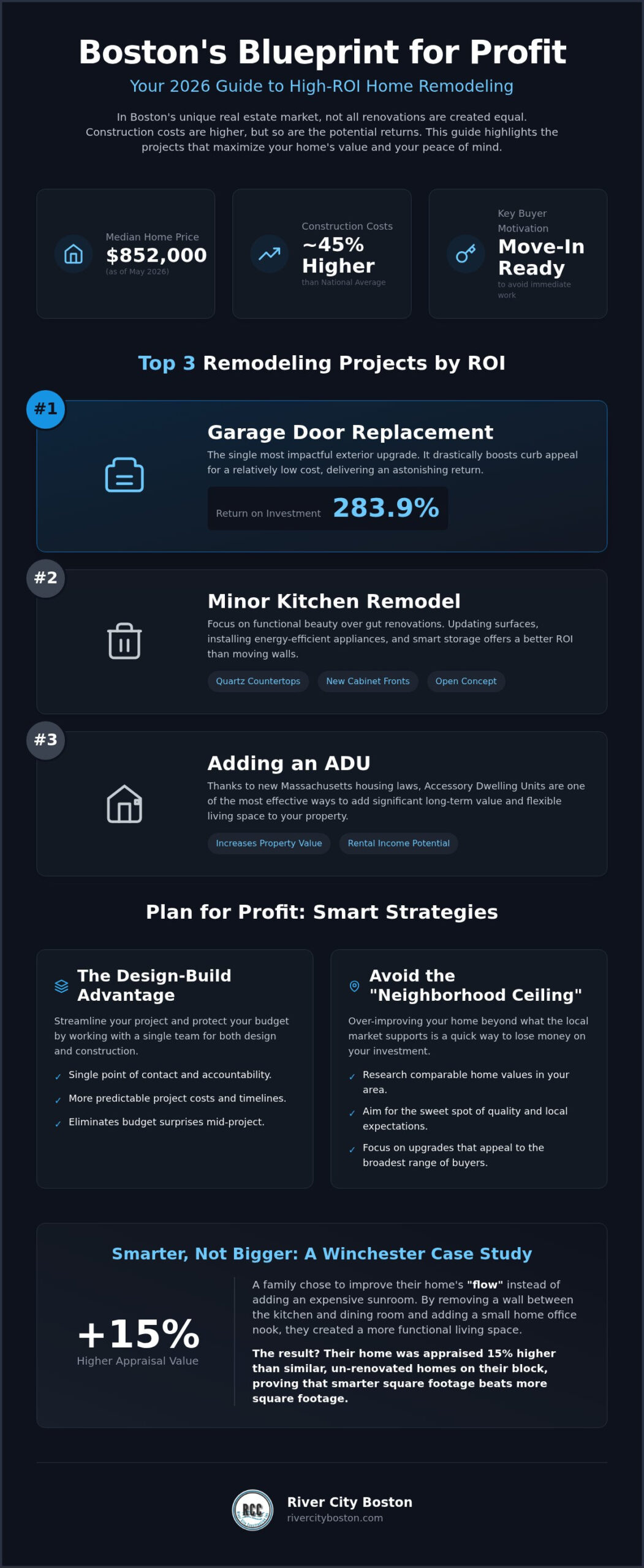
Did you know that simply replacing a garage door in the Boston area currently offers a significant 283.9% return on investment? It sounds high, but in our unique 2026 market, these exterior improvements are outperforming almost everything else. We all know that owning a home in Greater Boston comes with its own set of headaches, from navigating strict local permitting to managing construction costs that are often 45% higher than the national average. You want your home to look beautiful, but you also want to feel certain that you aren’t throwing your hard-earned savings away on a trend that will be gone by next season.
In this guide, we’ll show you the remodeling projects with highest ROI Boston has to offer right now. Whether you are curious about the recent surge in Accessory Dwelling Units (ADUs) or wondering if a minor kitchen refresh is better than a full gut renovation, we’ve got the data to help you decide. We will walk through a prioritized list of projects that balance modern energy standards with the timeless craftsmanship our local neighborhoods demand. By the end, you’ll have a clear, professional roadmap for your 2026 remodeling budget that maximizes both your home’s value and your peace of mind.
Key Takeaways
- Learn why minor kitchen and bathroom updates often provide a better return than a complete overhaul in the current 2026 market.
- Discover how new Massachusetts housing laws have made Accessory Dwelling Units (ADUs) one of the most effective ways to increase your property’s long-term value.
- Identify the specific remodeling projects with highest ROI Boston families are using to boost equity without exceeding their neighborhood’s price ceiling.
- Understand how the design-build approach protects your budget by providing a single point of contact and more predictable project costs.
- Find out which exterior improvements, such as deck installations and entry door upgrades, offer the most immediate impact on your home’s resale price.
Understanding the Boston Real Estate Market and Remodeling ROI in 2026
Boston’s real estate market doesn’t follow the same rules as the rest of the country. With a median home price of $852,000 as of May 2026, the stakes are significantly higher here. While it’s true that construction costs in our area are roughly 1.3 to 1.45 times the national average, the potential for equity growth is also much higher. Finding the remodeling projects with highest ROI Boston homeowners can rely on requires looking at our local inventory. Because we have so few homes for sale, buyers are willing to pay a premium for properties that are truly finished and functional.
Boston ROI vs. National Averages
Our local labor rates are higher than in most states, which can feel intimidating when you first look at a quote. However, the limited supply of homes in Massachusetts keeps our ROI strong. In many cases, a “Midrange” project actually yields a better percentage of return than an “Upscale” one. For example, a minor kitchen remodel that keeps the existing footprint but updates the surfaces often recoups more than a massive structural overhaul. Buyers in towns like Winchester or Medford aren’t just looking for luxury; they’re looking for smart, durable investments that won’t require immediate work after they move in.
High-Value vs. Low-Value Upgrades
It’s tempting to spend your budget on things you can’t see, like upgrading old plumbing or electrical panels. While these are vital for safety and passing inspections, they rarely increase your home’s appraisal on their own. We call these maintenance rather than improvements. To see a real jump in value, you need to focus on high-impact areas like bathroom remodeling or creating dedicated living space. The psychological impact of a move-in ready home is massive for today’s buyers who are already stretching their budgets to cover a 6.47% mortgage rate.
I recently worked with a family in Winchester who wanted to sell their colonial. Instead of adding a flashy, expensive sunroom, they focused on the “flow” of their existing first floor. They opened up the wall between the kitchen and dining room and added a small, functional home office nook to accommodate their remote work schedule. This focus on how the house actually lives resulted in a 15% higher appraisal than similar homes on their block. They didn’t need more square footage; they just needed better square footage. This is a perfect example of avoiding the “Neighborhood Ceiling.” If you’re in Malden or Medford, over-improving beyond what the local market can support is a quick way to lose money. Always aim for the sweet spot of quality and local market expectations.
The Interior Heavy Hitters: Kitchen and Bathroom Remodeling
When we discuss remodeling projects with highest ROI Boston homeowners should consider, the conversation usually starts in the kitchen. It’s the heart of the home. In 2026, buyers are specifically looking for “functional beauty” rather than just flashy finishes. This means prioritizing energy-efficient appliances and smart storage solutions that make a busy morning easier. According to Zillow’s research on highest ROI home improvements, minor kitchen updates frequently provide a better return on investment than major, high-end overhauls that require moving structural walls or gas lines.
Kitchen ROI: Minor Fixes vs. Major Overhauls
In towns like Newton, quartz countertops are currently winning the ROI battle because they offer the look of marble with none of the maintenance. A fresh kitchen cabinet installation in Boston can breathe new life into a room while keeping the budget manageable. If your home has a closed-off floor plan, removing a non-load-bearing wall to create an open-concept layout is one of the most effective ways to boost your property’s appeal. I recently worked with a homeowner in a 1920s colonial who wanted to update their kitchen without losing its historic soul. We kept the original footprint but replaced the warped cabinets with custom, period-appropriate millwork and added hidden pull-out pantries. It looked timeless, but it functioned like a dream.
Bathroom ROI: Modernizing the Most Used Space
Investing in bathroom remodeling in Boston is widely considered the #2 way to increase home value. In Somerville and Cambridge, we’re seeing a massive trend toward turning standard bathrooms into spa-like retreats. This often involves replacing a traditional tub-and-shower combo with a large, glass-enclosed walk-in shower. Buyers in 2026 value these high-end showers over tubs, especially in primary suites.
For smaller guest baths, focus on the details. A custom vanity that maximizes a tight footprint or updated lighting can make a world of difference. These projects are about making the most of every square inch. If you’re curious about which specific updates will work best for your home’s layout, you can start a conversation with us today to explore your options.
Maximizing Square Footage: ADUs and Basement Conversions
In neighborhoods like Cambridge and Brookline, living space is the most valuable commodity you can own. When you can’t expand your home’s footprint because of tight lot lines, you have to get creative with the square footage you already have. This is why adding an Accessory Dwelling Unit (ADU) or finishing a basement has become one of the remodeling projects with highest ROI Boston residents are investing in this year. These projects don’t just add a room; they change how your property functions and how it’s valued by future buyers.
Accessory Dwelling Units (ADUs) as ROI Goldmines
The rise of the ADU is perhaps the biggest shift in the Massachusetts market. Thanks to the Affordable Homes Act, municipalities across the state approved 854 ADUs in the first six months of 2026 alone. This legislation created a consistent statewide standard that has unlocked massive property value for local homeowners. Whether you’re looking for rental income to offset a mortgage or a “granny flat” for multi-generational living, a well-designed ADU is a high-yield investment. If you’re in the suburbs, our ADU Builders in Newton Guide can help you decide between a detached unit or an attached addition that fits your specific lot.
Basement Finishing: The Lowest Cost Per Square Foot
If an ADU isn’t feasible for your property, look down. Converting a dark, damp basement into a bright, productive area is often the most cost-effective way to add living space. While a basement remodeling cost might seem like a large upfront investment, it’s really a long-term equity play. We recently helped a family in Brookline transform a spider-filled storage room into a high-end guest suite and home office. They essentially added a third floor to their home without the massive expense of a full addition.
The key to basement ROI is moisture control. You can’t skip the “un-fun” parts like professional waterproofing and proper insulation if you want your investment to last. By creating distinct functional zones, you can turn a forgotten cellar into a “bright and productive” space that buyers will love. When you focus on these remodeling projects with highest ROI Boston neighborhoods prioritize, you ensure every dollar spent builds real equity.
Curb Appeal and Outdoor Living: Decks and Exterior ROI
First impressions are everything. In the Boston real estate market, a buyer often decides if they love a house before they even step through the front door. This is why exterior work ranks so high among remodeling projects with highest ROI Boston homeowners can invest in. While we’ve discussed the value of interior square footage, the way a home presents itself to the street sets the emotional tone for the entire showing. If the outside looks neglected, buyers assume the “bones” of the house are in trouble, too.
Deck Installation: The Social ROI
To achieve these kinds of results, looking at the work of established professionals like 1st Class Painting & Restoration can provide a benchmark for the quality and attention to detail necessary for a successful exterior restoration.
In high-density areas like Medford and Somerville, outdoor space is a luxury. A well-built deck acts as an “outdoor room,” effectively extending your living space without the cost of a full addition. When choosing materials, composite is the clear winner for longevity. Boston winters are brutal on natural wood, and buyers in 2026 are willing to pay a premium for a deck they don’t have to sand and stain every two years. Navigating the permitting process in these high-density or historic areas can be tricky, but the payoff in property value is substantial. For a deeper look at planning these spaces, check out our Custom Deck Builders Boston Guide.
Small Fixes with Big Returns
You don’t always need a massive budget to see a huge return. Some of the most profitable upgrades are surprisingly simple. According to 2026 data, a garage door replacement in Boston currently offers a staggering 283.9% return on investment. Similarly, a new steel entry door can recoup about 216.4% of its cost. These aren’t just aesthetic choices; they signal to a buyer that the home is secure and energy-efficient. Other high-impact exterior projects include:
- Manufactured Stone Veneer: Applying this to your home’s exterior has a cost recoup of 207.9% in the current market.
- Energy-Efficient Windows: These are a major selling point for buyers worried about high Massachusetts utility bills.
- Low-Maintenance Landscaping: Busy Boston professionals want a yard that looks great without requiring hours of weekend weeding.
I remember a project in Somerville where the backyard was essentially a patch of dirt. We installed a tiered composite deck and added simple, clean landscaping. The home sold over the asking price within a week. The buyers explicitly mentioned the “maintenance-free” outdoor living space as the deciding factor. It’s about showing the buyer a lifestyle, not just a property.
Planning for Profit: The Design-Build Advantage in Massachusetts
Selecting the right project is only half the battle. To truly secure the remodeling projects with highest ROI Boston market conditions allow, you must focus on the execution. Many homeowners lose their potential profit during the construction phase due to poor planning or miscommunication between architects and builders. This is why the design-build model has become so popular in 2026. By having a single point of contact for both the design and the construction, you can often save 10 to 15% on your total project costs. It keeps everyone on the same page from the first sketch to the final coat of paint—a standard of efficiency also championed by specialized contractors like PRO Construction.
I saw this firsthand with a homeowner in Concord who was planning a major kitchen refresh. In the design phase, we caught a layout error where the new island would have blocked the refrigerator door from opening fully. Because we caught this on paper rather than after the cabinets were installed, we saved them roughly $20,000 in rework and delays. This level of detail is also essential when navigating local home renovation permits. Massachusetts rules can be strict, especially in historic districts, and a design-build team handles that paperwork so you don’t have to worry about the headache of city hall.
When you begin looking for a partner for your home remodel, look for local experience. Boston’s housing stock is unique; a contractor who doesn’t understand the quirks of a 100-year-old triple-decker can quickly blow your budget. Watch for red flags like unusually low bids or a lack of clear project milestones. The “cheapest” option often becomes the most expensive when you factor in delays and sub-par quality that hurts your resale value. You want a partner who values durability and professional standards as much as you do. If you’re looking for a kitchen remodeler in Boston, ensure they have a portfolio that shows they understand our regional architecture.
The ROI-Driven Timeline
In New England, timing is everything. You don’t want to start an exterior project like a deck installation in November. We recommend planning your interior projects for the winter months and saving exterior work for the spring and summer. In 2026, we are still seeing some supply chain shifts for specific high-end materials, so it’s smart to order your fixtures early in the design phase. Finally, never skip the final walkthrough. This is your chance to ensure every detail meets the high standards that will eventually impress a buyer. Taking these steps ensures that the remodeling projects with highest ROI Boston families admire actually deliver the equity you expect.
Building Equity in the Greater Boston Area
Investing in your home is a significant financial and emotional commitment. We’ve seen how focusing on the remodeling projects with highest ROI Boston currently offers, such as minor kitchen refreshes or the addition of an ADU, can significantly boost your property’s equity. By prioritizing projects that improve functional flow and curb appeal, you ensure your house stands out in our competitive 2026 market. It’s about making smart choices that respect your budget and your neighborhood’s price ceiling.
Our team brings expert local knowledge of Boston building codes and a specialization in high-ROI kitchen and bathroom renovations to every project. With a dedicated design-build team, we handle the seamless project management required to avoid costly layout errors before they happen. We value the diligence and transparency needed to turn your vision into a reality that lasts for years. You deserve a partner who is personally invested in your success.
Your home is likely your largest asset. We look forward to helping you protect and grow that investment through quality craftsmanship and reliable service. Let’s build something lasting together.
Frequently Asked Questions
What is the single highest ROI remodeling project in Boston for 2026?
The most profitable updates right now are those that maximize curb appeal for a lower initial cost. While we’ve discussed specific exterior replacements earlier, the general category of “front-facing” improvements remains the winner. These remodeling projects with highest ROI Boston buyers prioritize are effective because they remove immediate “work” from a purchaser’s plate. A house that looks perfect from the sidewalk allows a buyer to focus on the interior’s potential rather than worrying about basic maintenance.
How much does a typical kitchen remodel in Boston cost compared to the value it adds?
While we don’t quote specific prices for our services, industry data shows that minor kitchen updates generally recoup a much higher percentage of their cost than major overhauls. A minor remodel focuses on functional beauty, like updating surfaces and energy-efficient appliances, rather than moving walls. In the Greater Boston area, these projects consistently outperform national averages because our limited housing inventory makes any modern, move-in ready kitchen a significant selling point for prospective buyers.
Are ADUs legal in all Boston-area suburbs like Somerville and Medford?
Yes, recent state laws have made ADUs legal across Massachusetts, but local municipalities still have their own specific zoning rules. Somerville and Medford have seen a rise in these units since the Affordable Homes Act passed in 2025. However, you must still follow local building codes regarding setbacks and height. We always recommend checking with your specific town’s building department or consulting a professional who understands the unique permitting landscape in your neighborhood.
Does finishing a basement always increase a home’s appraisal value?
Finishing a basement only increases appraisal value if it meets specific legal requirements for living space. This includes having proper ceiling height and “egress,” which is a safe way to exit in an emergency, like a large window or door. If the space is damp or lacks these safety features, an appraiser may only count it as finished storage. Professional moisture control is a non-negotiable step to ensure your basement conversion adds real, lasting equity.
Is it better to do many small repairs or one large renovation for ROI?
For pure percentage of return, several small, targeted repairs often beat one large renovation. Projects like replacing an entry door or updating light fixtures require less capital and offer immediate visual impact. However, a large renovation might be necessary if your home’s layout is significantly outdated compared to your neighbors. We suggest focusing on “move-in ready” updates that allow a buyer to imagine themselves living in the home without a long list of immediate chores.
How do historic district regulations in Boston affect remodeling ROI?
Historic regulations can make remodeling more expensive because they often require specific, period-accurate materials. While this might lower your immediate ROI percentage, it often protects your home’s long-term value. Homes in Boston’s historic districts tend to appreciate steadily because the neighborhood’s character is preserved. Working with a team that understands these local rules is essential to avoid fines or having to redo work that doesn’t meet district standards.
Should I choose composite or wood for a new deck installation in Massachusetts?
Composite is generally the better choice for ROI in the Massachusetts climate. While natural wood is beautiful, it requires frequent staining and sanding to survive our harsh winters and humid summers. Buyers in 2026 are looking for “maintenance-free” living and are often willing to pay a premium for the durability of composite materials. It ensures your deck looks as good on the day you sell the home as it did on the day it was installed.
How does the ‘Design-Build’ process help protect my renovation investment?
The design-build process protects your investment by keeping the designer and the builder on the same team from day one. This prevents the common problem where an architect designs something that is too expensive to actually build. By having one point of contact, you reduce the risk of costly miscommunications and “scope creep,” which is when a project slowly grows in size and cost. It’s a methodical way to ensure your 2026 budget stays on track.
